

Tuesday, October 20, 2026
Science
No Result
View All Result
  • Login
  • HOME
  • SCIENCE NEWS
  • CONTACT US
  • HOME
  • SCIENCE NEWS
  • CONTACT US
No Result
View All Result
Scienmag
No Result
View All Result
Home Science News Technology and Engineering

Review: finite element modeling, artificial intelligence, digital twins and applications for additive manufacturing of refractory alloys

October 20, 2026
in Technology and Engineering
Denise Maddox
By Denise Maddox Scienmag Editorial Profile - Mechanical Engineering
Reading Time: 2 mins read
0
AI and Simulation Join Forces to Crack the Code of 3D-Printing the World’s Toughest Metals

AI and Simulation Join Forces to Crack the Code of 3D-Printing the World's Toughest Metals

65
SHARES
587
VIEWS
Share on FacebookShare on Twitter
ADVERTISEMENT

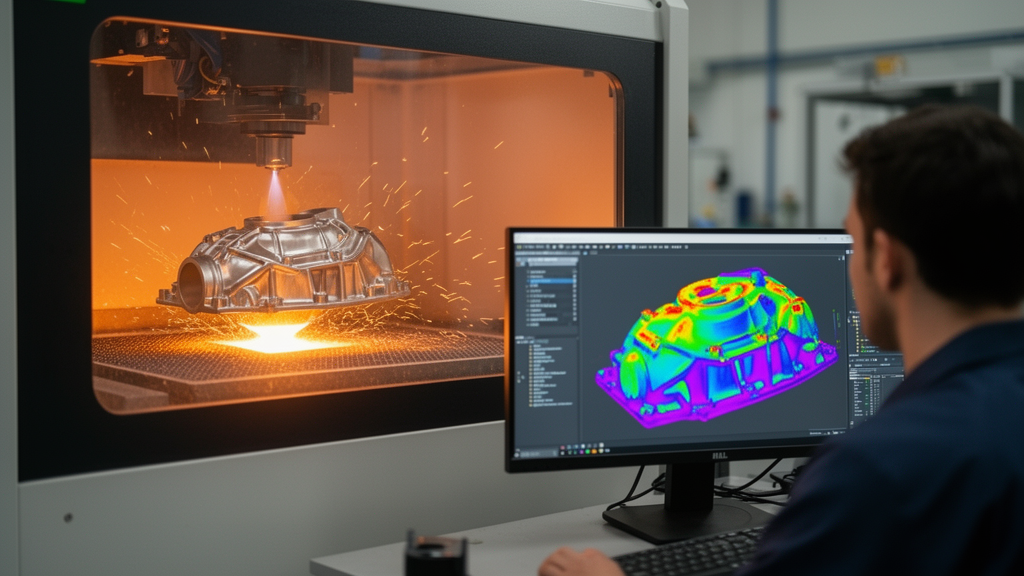
A review in the Journal of Materials Science examines how finite element modeling and artificial intelligence can support additive manufacturing of refractory alloys, according to the article abstract. The review covers refractory alloy systems based on tungsten, molybdenum, tantalum and niobium, as well as emerging refractory high-entropy alloys. It focuses on their potential for extreme-environment applications, where the abstract highlights high-temperature strength, thermal stability, creep resistance and radiation tolerance as notable properties, while also emphasizing that fabrication remains difficult because of high melting temperatures, oxidation sensitivity, ductile-to-brittle transition behavior and susceptibility to cracking and residual stress formation.

Additive manufacturing is presented in the abstract as a promising approach for producing complex refractory alloy components with improved material utilization and design flexibility. The review considers four major technologies: laser powder bed fusion, laser directed energy deposition, electron beam powder bed fusion and wire arc additive manufacturing. It also discusses the thermal gradients, rapid solidification rates and complex thermo-metallurgical phenomena associated with additive manufacturing. According to the abstract, these process conditions often contribute to microstructural heterogeneity, porosity, distortion and performance variability, although the review does not establish that a particular technology eliminates those issues.

The review’s modeling section addresses recent advances in thermal, mechanical, microstructural and multiscale finite element approaches, with emphasis on process–structure–property relationships. Its artificial-intelligence section provides a systematic review of machine learning, deep learning, physics-informed neural networks and digital twins in process optimization, defect prediction and quality assurance. The abstract highlights the integration of artificial intelligence and finite element modeling as a potential pathway toward predictive and autonomous manufacturing, but this is a forward-looking direction identified by the review rather than a demonstrated manufacturing outcome. Because the supplied evidence is limited to the abstract, the article does not permit assessment of the studies, simulations, datasets, performance measures or conclusions discussed in the full review.

The final section of the review identifies current challenges, knowledge gaps and future research opportunities connected to intelligent manufacturing frameworks for next-generation refractory alloy components. These unresolved issues are part of the review’s stated scope rather than results from a new experiment or production trial. The available abstract does not report a systematic search strategy, number of included studies, quantitative synthesis, validation results, process-specific comparisons or a completed digital-twin implementation. Accordingly, the review synthesizes an active research area spanning computational modeling, data-driven methods and additive manufacturing, while the supplied evidence does not support claims that artificial intelligence or digital twins have already made refractory-alloy manufacturing fully predictable, autonomous or reliable.

Subject of Research: A review of computational modeling and artificial intelligence for additive manufacturing of refractory alloys

Article Title: Review: finite element modeling, artificial intelligence, digital twins and applications for additive manufacturing of refractory alloys

Article References: Das, B., Patel, P., Madan, R., Aseef Khan, M. D., Yadav, A., & Bandyopadhyay, T. K. (2026). Review: finite element modeling, artificial intelligence, digital twins and applications for additive manufacturing of refractory alloys. Journal of Materials Science, 61(42), 32538-32605. https://doi.org/10.1007/s10853-026-13762-0

Image Credits: AI Generated

DOI: 10.1007/s10853-026-13762-0

Keywords: refractory alloys, additive manufacturing, finite element modeling, artificial intelligence, digital twins, machine learning, defect prediction, process optimization, refractory high-entropy alloys, Review, finite, element

Cite Scienmag News

Denise Maddox. (October 20, 2026). Review: finite element modeling, artificial intelligence, digital twins and applications for additive manufacturing of refractory alloys. Scienmag. https://scienmag.com/review-finite-element-modeling-artificial-intelligence-digital-twins-and-applications-for-additive-manufacturing-of-refractory-alloys/


Denise Maddox. "Review: finite element modeling, artificial intelligence, digital twins and applications for additive manufacturing of refractory alloys." Scienmag, 20 October 2026, https://scienmag.com/review-finite-element-modeling-artificial-intelligence-digital-twins-and-applications-for-additive-manufacturing-of-refractory-alloys/. Accessed 20 October 2026.

Denise Maddox. "Review: finite element modeling, artificial intelligence, digital twins and applications for additive manufacturing of refractory alloys." Scienmag. October 20, 2026. https://scienmag.com/review-finite-element-modeling-artificial-intelligence-digital-twins-and-applications-for-additive-manufacturing-of-refractory-alloys/

Tags: additive manufacturingadditive manufacturing techniques for refractory alloysArtificial Intelligenceartificial intelligence applications in materials sciencechallenges in manufacturing refractory alloys with advanced simulationdefect predictiondigital twinsdigital twins for high-temperature materialselectron beam additive manufacturing for high-temperature alloyselementfinitefinite element modelingFinite element modeling in refractory alloy additive manufacturinghigh-entropy refractory alloyslaser powder bed fusion for refractory metalsMachine learningmaterial property prediction for extreme environmentmicrostructural heterogeneity in 3D printed refractory materialsmodeling residual stresses and distortions in refractory alloy fabricationprocess optimizationrefractory alloysrefractory high-entropy alloysreviewthermal and mechanical modeling of additive processes
Share26Tweet16
Previous Post

Hidden knowledge gaps in mechanical ventilation care: a multicenter study of ICU nurses’ competence and patient safety risks in Iraq

Next Post

Southern New England cohort links self-detection and missed appointments with delayed breast cancer diagnosis

Related Posts

AI Learns to Map a Baby’s Brain: 3D Patch-Wise U-Net Delivers Millimeter-Precise Tissue Segmentation
Technology and Engineering

Patch-wise 3D U-Net segments six-month-old infant brain MRI in benchmark study

October 20, 2026
When Pain Meets Depression: The Combined Threat to Your Heart
Technology and Engineering

Pain and depressive symptoms linked with cardiovascular risk in Chinese adults

October 20, 2026
How Poisoning Attacks Threaten Federated Learning in Medical IoT—and the Defenses Fighting Back
Technology and Engineering

Systematic review maps poisoning threats and layered defenses in federated learning for medical IoT

October 20, 2026
Single-Switch Quadratic Converter Delivers Ultra-High Voltage Gain With Low Semiconductor Stress
Technology and Engineering

Laboratory prototype tests single-switch quadratic DC–DC converter with high voltage gain

October 20, 2026
Tiny AI Model Spots Classroom Behaviors Without Ever Sending Student Images to the Cloud
Technology and Engineering

Simulated federated TinyML detector runs classroom behavior analysis on a microcontroller

October 20, 2026
Magnetic Nanocomposite Scrubs Ions From Oilfield Wastewater and Boosts Oil Recovery
Technology and Engineering

Lab study links magnetic nanocomposite to divalent-ion removal and improved oil recovery in formulated flooding tests

October 20, 2026
Next Post
Why One in Five Breast Cancers Is Diagnosed Too Late: New Study Reveals the Cracks

Southern New England cohort links self-detection and missed appointments with delayed breast cancer diagnosis

  • Mothers who receive childcare support from maternal grandparents show more optimized

    Mothers who receive childcare support from maternal grandparents show more parental warmth, finds NTU Singapore study

    27656 shares
    Share 11059 Tweet 6912
  • University of Seville Breaks 120-Year-Old Mystery, Revises a Key Einstein Concept

    1061 shares
    Share 424 Tweet 265
  • Bee body mass, pathogens and local climate influence heat tolerance

    682 shares
    Share 273 Tweet 171
  • Researchers record first-ever images and data of a shark experiencing a boat strike

    546 shares
    Share 218 Tweet 137
  • Groundbreaking Clinical Trial Reveals Lubiprostone Enhances Kidney Function

    531 shares
    Share 212 Tweet 133
Science

Embark on a thrilling journey of discovery with Scienmag.com—your ultimate source for cutting-edge breakthroughs. Immerse yourself in a world where curiosity knows no limits and tomorrow’s possibilities become today’s reality!

RECENT NEWS

  • Southern New England cohort links self-detection and missed appointments with delayed breast cancer diagnosis
  • Review: finite element modeling, artificial intelligence, digital twins and applications for additive manufacturing of refractory alloys
  • Hidden knowledge gaps in mechanical ventilation care: a multicenter study of ICU nurses’ competence and patient safety risks in Iraq
  • Retrospective study links pediatric invasive Salmonella cases to summer clustering and uneven cephalosporin resistance

Categories

  • Agriculture
  • Anthropology
  • Archaeology
  • Athmospheric
  • Biology
  • Biotechnology
  • Blog
  • Bussines
  • Cancer
  • Chemistry
  • Climate
  • Earth Science
  • Editorial Policy
  • Marine
  • Mathematics
  • Medicine
  • Pediatry
  • Policy
  • Psychology & Psychiatry
  • Science Education
  • Science News
  • Social Science
  • Space
  • Technology and Engineering

Subscribe to Blog via Email

Enter your email address to subscribe to this blog and receive notifications of new posts by email.

Join 5,150 other subscribers

© 2025 Scienmag - Science Magazine

Welcome Back!

Login to your account below

Forgotten Password?

Retrieve your password

Please enter your username or email address to reset your password.

Log In
No Result
View All Result
  • HOME
  • SCIENCE NEWS
  • CONTACT US

© 2025 Scienmag - Science Magazine

Discover more from Science

Subscribe now to keep reading and get access to the full archive.

Continue reading