


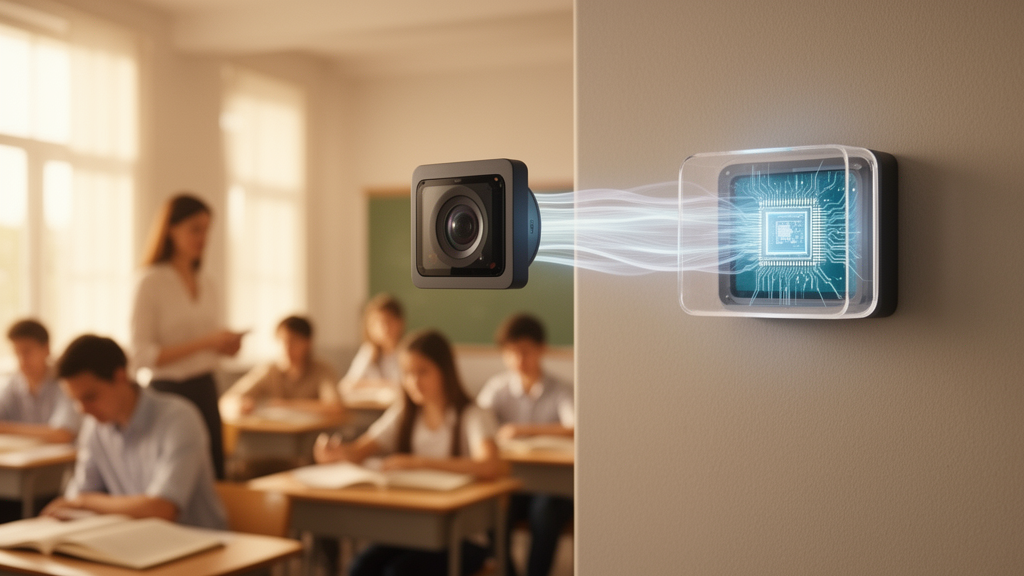
A simulated federated-learning study found that a compressed student-behavior detector retained 95.64% mAP@0.5 on the SCB-Dataset5 test set while running at 15.43 frames per second on a 120 MHz Arm Cortex-M4F microcontroller. The study evaluated a privacy-preserving framework that kept classroom images and annotations on simulated clients during training, exchanged model updates with a server and subsequently ran local inference on embedded hardware.
The research, published in Discover Artificial Intelligence, used SCB-Dataset5, which contains 7,428 classroom images and 106,830 annotated instances across 20 categories. These included student behaviors such as hand-raising, reading, writing, talking, yawning, phone use and leaning on a desk, together with teacher actions and classroom objects. The images were divided into 5,199 training images, 1,114 validation images and 1,115 test images, and all inputs were resized to 320 by 320 pixels.
The detector combined depthwise separable convolutional blocks, lightweight multi-scale feature fusion and a shallow detection head. Its output tensor contained three candidate boxes at each of 1,600 spatial locations, with each candidate representing four bounding-box coordinates, one objectness score and 20 class scores. The primary federated experiment simulated five clients, each corresponding to a classroom, school or edge node. In the non-independent and identically distributed evaluation, class allocations across those clients were generated with Dirichlet concentration parameters of 1.0, 0.5 and 0.1 to represent mild, moderate and severe heterogeneity.
Each simulated client trained locally and sent updated model parameters to a central server rather than transmitting raw images, labels or bounding-box annotations. Proximal regularization penalized excessive divergence of local updates from the global model. On the main SCB-Dataset5 test set, centralized training produced 98.12% F1-score, 98.42% mAP@0.5 and 86.35% mAP@0.5:0.95. The proximal federated model achieved the same 98.12% F1-score, along with 98.39% mAP@0.5 and 86.21% mAP@0.5:0.95.
Under the non-IID partition, standard FedAvg produced 96.24% F1-score and 96.58% mAP@0.5, compared with 98.12% F1-score and 98.39% mAP@0.5 for the proximal strategy. Performance declined gradually as heterogeneity increased: the proximal approach retained 97.84% F1-score under mild skew, 97.21% under moderate skew and 96.34% under severe skew. In an extended client-scalability simulation, mAP@0.5 decreased from 97.42% with five clients to 96.24% with 30 clients, while estimated communication cost rose from 2.37 MB to 14.22 MB per communication round.
The aggregated global model was then compressed through batch-normalization folding, 40% structured channel pruning, 20 epochs of post-pruning fine-tuning and full-integer INT8 quantization. Weights used per-channel symmetric INT8 quantization, activations used per-tensor asymmetric INT8 quantization, and biases were accumulated in INT32. The final compressed federated model achieved 95.52% F1-score, 95.64% mAP@0.5 and 78.86% mAP@0.5:0.95. Relative to the uncompressed federated model, its storage fell by 69.2% and its measured latency declined by 65.3%.
Embedded tests ran on an NXP FRDM-K64F development board with a 32-bit Arm Cortex-M4F processor, 1 MB of Flash memory and 256 KB of SRAM. The compressed model occupied 228.9 KB, while the complete TensorFlow Lite Micro runtime used 118.3 KB of SRAM for the tensor arena, activation and input/output buffers, and post-processing space. Each 320-by-320 image took 64.8 milliseconds through the full on-device path, including INT8 execution, output decoding, confidence filtering at 0.25 and non-maximum suppression at an IoU threshold of 0.50. Camera acquisition and image transmission were not included in that timing.
Diagnostic privacy tests indicated lower, but not eliminated, exposure relative to centralized full-precision training. Membership-inference attack accuracy fell from 67.84% in centralized FP32 training to 55.92% in the federated TinyML configuration; reconstruction PSNR declined from 21.62 dB to 14.86 dB, and model-inversion success fell from 38.71% to 12.58%. In a stress test with 30% malicious clients, mAP@0.5 was 94.12%. The method did not include secure aggregation, differential privacy, trust weighting or robust aggregation, and no direct board-level power measurements were reported.
Cross-dataset evaluation followed dataset-specific fine-tuning rather than zero-shot testing. The compressed federated INT8 model achieved 93.58% mAP@0.5 on UK_Dataset and 92.28% on SiTBehavior, below its SCB-Dataset5 result. The study was a computational federated simulation rather than a live multi-school deployment, and most evidence came from SCB-Dataset5, with limited validation on two additional datasets. Real-classroom testing, direct energy measurements, heterogeneous-hardware evaluation and stronger privacy and malicious-client defenses remain necessary before wider use.
Subject of Research: Evaluation of a simulated federated TinyML framework for detecting student behaviors in smart classrooms
Article Title: A real-time federated TinyML framework for student behavior detection in smart classrooms
Article References: Yahyati, C., Lamaakal, I., El Makkaoui, K., & Ouahbi, I. (2026). A real-time federated TinyML framework for student behavior detection in smart classrooms. Discover Artificial Intelligence, 6(1), Article 1282. https://doi.org/10.1007/s44163-026-02362-1
Image Credits: AI Generated
DOI: 10.1007/s44163-026-02362-1
Keywords: student behavior detection, federated learning, TinyML, microcontroller deployment, INT8 quantization, model pruning, classroom analytics, privacy-preserving AI, object detection, edge inference, real-time, federated
Cite Scienmag News
Blake Davidson. (October 20, 2026). Simulated federated TinyML detector runs classroom behavior analysis on a microcontroller. Scienmag. https://scienmag.com/simulated-federated-tinyml-detector-runs-classroom-behavior-analysis-on-a-microcontroller/
Blake Davidson. "Simulated federated TinyML detector runs classroom behavior analysis on a microcontroller." Scienmag, 20 October 2026, https://scienmag.com/simulated-federated-tinyml-detector-runs-classroom-behavior-analysis-on-a-microcontroller/. Accessed 20 October 2026.
Blake Davidson. "Simulated federated TinyML detector runs classroom behavior analysis on a microcontroller." Scienmag. October 20, 2026. https://scienmag.com/simulated-federated-tinyml-detector-runs-classroom-behavior-analysis-on-a-microcontroller/


