


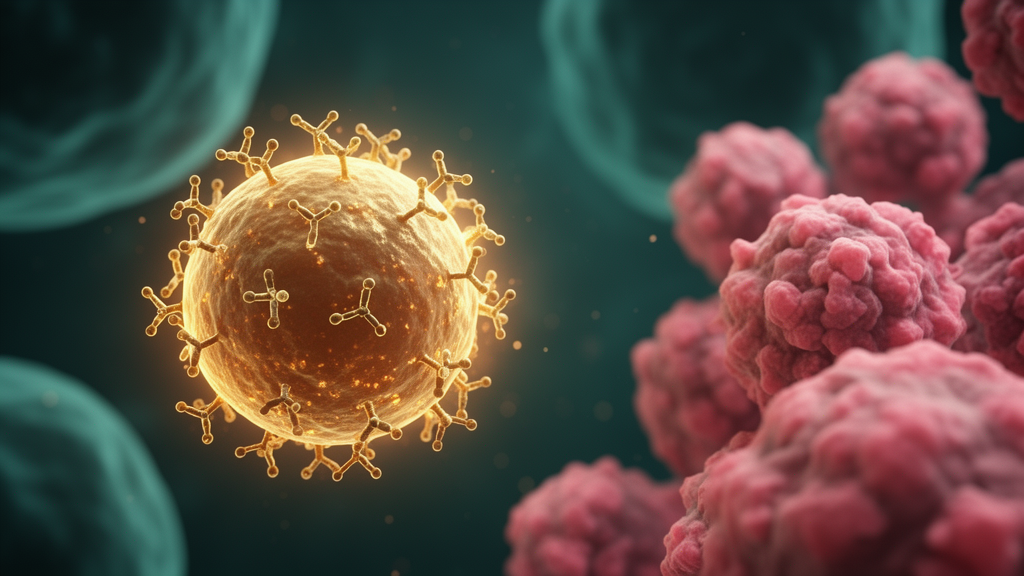
A multi-component nanosystem incorporating silver, doxorubicin and a manganese dioxide shell produced the strongest tumor-growth suppression among the formulations tested in laboratory models of triple-negative breast cancer (TNBC), according to an abstract published in BMC Cancer. The result was observed in 4T1 cells and tumor-bearing mice; the study did not evaluate the approach in people.
Researchers prepared spherical nanoparticles measuring approximately 95 nanometres, with a zeta potential of about −22 millivolts. The system, designated SNS, combined a nanosilver core, doxorubicin and a tumor-microenvironment-responsive manganese dioxide shell, with an anti–programmed death-ligand 1 (PD-L1) antibody attached to the surface. Dynamic light scattering and transmission electron microscopy were used to characterize the particles, while EDC coupling was used for antibody conjugation. The investigators also prepared an untargeted version, WTSNS, and three single-component controls: Ag@SNS, Dox@SNS and Mn@SNS.
In 4T1 TNBC cells, fluorescence microscopy indicated that PD-L1 targeting increased particle internalization and accumulation in tumors compared with the untargeted formulation. CCK-8 assays measured concentration-dependent cytotoxicity. The reported half-maximal inhibitory concentrations, or IC50 values, were 15.60 micrograms per millilitre for WTSNS and 12.42 micrograms per millilitre for SNS in 4T1 cells. In L929 fibroblasts, the corresponding values were 22.52 and 22.04 micrograms per millilitre. A comet assay showed the most DNA damage with SNS, while quantitative PCR found increased expression of BAX, Caspase-3 and Caspase-9 and decreased expression of BCL-2. The abstract describes these changes as associated with apoptosis.
In 4T1 tumor-bearing mice, near-infrared imaging was used to assess tumor accumulation, and tumor growth, histology and body weight were recorded to examine the formulations’ effects. SNS produced the greatest suppression of tumor growth, with stable body weight and no evident injury to major organs. These findings support activity in the tested cell and mouse models, but the available abstract does not provide detailed numerical efficacy results, statistical uncertainty, long-term safety data or evidence of clinical benefit in humans. The published version is an early-access article that the publisher says may undergo further edits.
Subject of Research: Laboratory evaluation of a PD-L1-targeted multi-component nanosystem in 4T1 triple-negative breast cancer cell and mouse models
Article Title: PD-L1-targeted multi-component nanosystem for synergistic triple-negative breast cancer therapy
Article References: Liu, J., Qiao, L., Cheng, W., He, Z., & Wang, L. (2026). PD-L1-targeted multi-component nanosystem for synergistic triple-negative breast cancer therapy. BMC Cancer. https://doi.org/10.1186/s12885-026-16784-8
Image Credits: AI Generated
DOI: 10.1186/s12885-026-16784-8
Keywords: PD-L1 targeting, triple-negative breast cancer, nanomedicine, nanosilver, doxorubicin, manganese dioxide, 4T1 cells, tumor-bearing mice, in vitro cytotoxicity, apoptosis, PD-L1-targeted, multi-component
Cite Scienmag News
Nathaniel Bowman. (October 20, 2026). PD-L1-targeted nanosystem shows antitumor activity in triple-negative breast cancer cell and mouse models. Scienmag. https://scienmag.com/pd-l1-targeted-nanosystem-shows-antitumor-activity-in-triple-negative-breast-cancer-cell-and-mouse-models/
Nathaniel Bowman. "PD-L1-targeted nanosystem shows antitumor activity in triple-negative breast cancer cell and mouse models." Scienmag, 20 October 2026, https://scienmag.com/pd-l1-targeted-nanosystem-shows-antitumor-activity-in-triple-negative-breast-cancer-cell-and-mouse-models/. Accessed 20 October 2026.
Nathaniel Bowman. "PD-L1-targeted nanosystem shows antitumor activity in triple-negative breast cancer cell and mouse models." Scienmag. October 20, 2026. https://scienmag.com/pd-l1-targeted-nanosystem-shows-antitumor-activity-in-triple-negative-breast-cancer-cell-and-mouse-models/


