


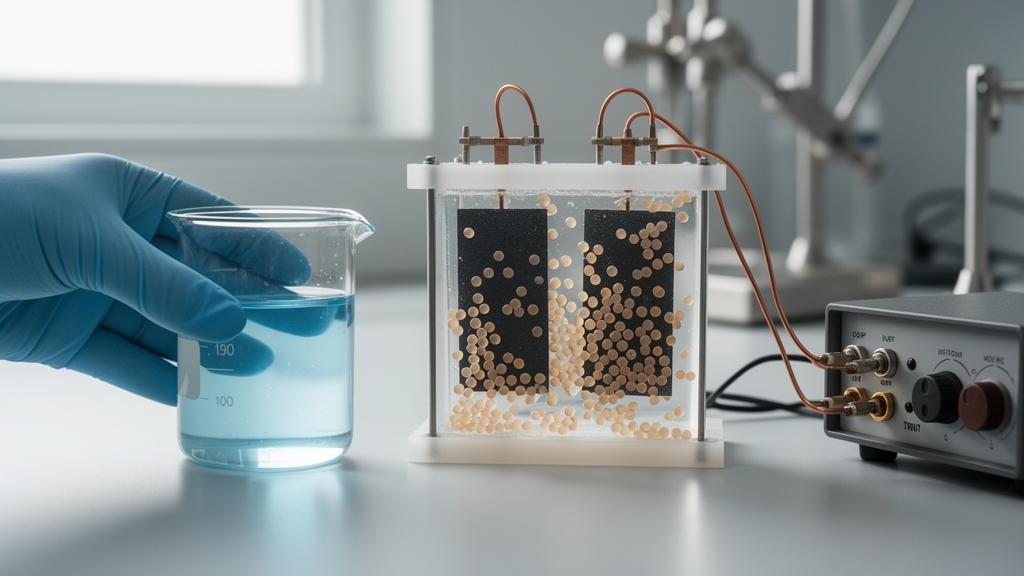
A laboratory study reports that a three-dimensional electrocatalytic system using an Fe2O3/Co3O4-loaded sodium alginate particle electrode removed 93.4% of tetracycline under optimized conditions. The work, summarized in the abstract of a Journal of Materials Science article, focuses on developing an electrode material for treating antibiotic-contaminated water and combines material characterization with mechanistic analysis of tetracycline degradation.
The researchers synthesized the sodium alginate-based particle electrode, designated Fe2O3/Co3O4-PB/SA, and applied it in a three-dimensional electrocatalytic system. According to the abstract, comprehensive characterization confirmed successful fabrication of the material and supported its enhanced electrochemical properties. The reported 93.4% result was obtained under optimized operating conditions, although the available abstract does not identify those conditions or provide the treatment duration, initial tetracycline concentration, reactor configuration, replicate count, or uncertainty estimates.
Mechanistic experiments indicated that hydroxyl radicals played the predominant role in degradation, accounting for 57% of the process. This was a measured contribution within the tested system rather than evidence that hydroxyl radicals act identically under all operating conditions. The researchers also combined liquid chromatography–mass spectrometry with density functional theory calculations to examine degradation pathways. In the abstract, they report that this analysis identified electrophilic hotspots on the tetracycline molecule and helped explain the reaction mechanism at the electronic level.
The available evidence is limited to the article abstract and access preview, so it does not allow assessment of the full experimental protocol or supporting figures. The abstract also does not report comparisons with untreated or alternative particle electrodes, performance in real wastewater matrices, by-product formation, mineralization, electrode durability, repeated-cycle stability, energy consumption, or scale-up performance. Accordingly, the 93.4% removal result demonstrates tetracycline removal in the optimized laboratory system but does not establish equivalent performance across wastewater conditions or establish the complete treatment products and environmental implications of the process.
Subject of Research: Laboratory electrocatalytic tetracycline degradation using an Fe2O3/Co3O4-loaded sodium alginate particle electrode
Article Title: High-efficiency three-dimensional electrocatalytic degradation of tetracycline over a novel Fe2O3/Co3O4-loaded sodium alginate particle electrode
Article References: Sun, Y., Lei, J., Ren, C., Liu, Z., Du, H., Teng, H., & Piao, M. (2026). High-efficiency three-dimensional electrocatalytic degradation of tetracycline over a novel Fe2O3/Co3O4-loaded sodium alginate particle electrode. Journal of Materials Science, 61(43), 33515-33531. https://doi.org/10.1007/s10853-026-13507-z
Image Credits: AI Generated
DOI: 10.1007/s10853-026-13507-z
Keywords: tetracycline degradation, electrocatalysis, particle electrode, sodium alginate, iron oxide, cobalt oxide, hydroxyl radicals, three-dimensional reactor, High-efficiency, three-dimensional, electrocatalytic, degradation
Cite Scienmag News
Denise Maddox. (October 20, 2026). Laboratory Fe2O3/Co3O4 particle electrode achieves 93.4% tetracycline removal under optimized conditions. Scienmag. https://scienmag.com/laboratory-fe2o3-co3o4-particle-electrode-achieves-93-4-tetracycline-removal-under-optimized-conditions/
Denise Maddox. "Laboratory Fe2O3/Co3O4 particle electrode achieves 93.4% tetracycline removal under optimized conditions." Scienmag, 20 October 2026, https://scienmag.com/laboratory-fe2o3-co3o4-particle-electrode-achieves-93-4-tetracycline-removal-under-optimized-conditions/. Accessed 20 October 2026.
Denise Maddox. "Laboratory Fe2O3/Co3O4 particle electrode achieves 93.4% tetracycline removal under optimized conditions." Scienmag. October 20, 2026. https://scienmag.com/laboratory-fe2o3-co3o4-particle-electrode-achieves-93-4-tetracycline-removal-under-optimized-conditions/


