

Tuesday, October 20, 2026
Science
No Result
View All Result
  • Login
  • HOME
  • SCIENCE NEWS
  • CONTACT US
  • HOME
  • SCIENCE NEWS
  • CONTACT US
No Result
View All Result
Scienmag
No Result
View All Result
Home Science News Agriculture

Six-month factorial trial links neem treatment and rack storage to better white yam quality

October 20, 2026
in Agriculture
Alan Morgan
By Alan Morgan Scienmag Editorial Profile - Precision Agriculture
Reading Time: 2 mins read
0
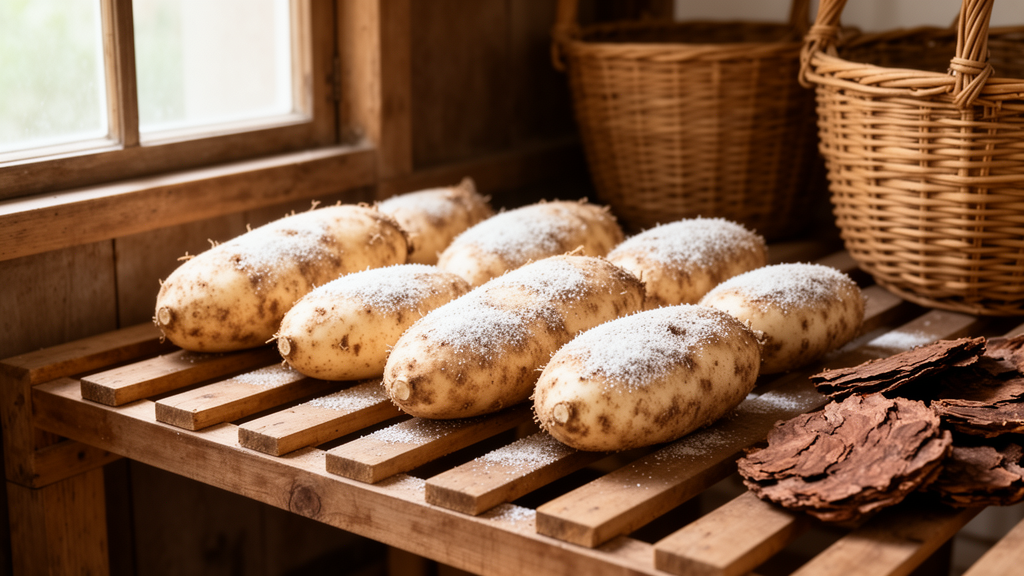
Neem Bark Extracts and Rack Storage Keep White Yam Tubers Fresh for Months

Neem Bark Extracts and Rack Storage Keep White Yam Tubers Fresh for Months

65
SHARES
587
VIEWS
Share on FacebookShare on Twitter
ADVERTISEMENT

A six-month factorial trial involving white yam tubers (Dioscorea rotundata) found that neem leaf or bark treatments combined with rack storage were associated with better preservation and marketability than several other treatment combinations. The study was summarized in the abstract of an accepted BMC Plant Biology article, whose publisher states that the early-access version may still undergo further edits before the final version of record.

For the experiment, researchers obtained yam tubers from farms in Makurdi and selected them according to size, the absence of physical damage, and the absence of visible symptoms of disease and defects. Neem leaves and bark were collected in Makurdi town and taken to the laboratory for the preservative experiment. The researchers used a 3 × 3 completely randomized design combining three treatments—neem leaf, neem bark and an untreated control—with three storage methods: racks, barns and trench silos. Measurements were recorded every 30 days throughout the six-month study.

Weight loss was similar across the three neem-treatment groups: 18.14% for bark-treated tubers, 17.98% for leaf-treated tubers and 18.05% for controls. Storage method showed more variation, with reported weight loss of 18.95% in barns, 15.12% on racks and 17.82% in trench silos. The largest weight loss among the nine combinations was 20.60% for bark-treated yams stored in barns. Marketability was highest for bark-treated yams on racks, at 4.00, while the lowest reported value, 2.50, occurred for controls in trench silos and for leaf- and bark-treated yams in barns.

Decay was highest for control yams stored in trench silos, at 32.86%, and lowest for bark-treated yams on racks, at 7.14%. Sprouting was reported as significantly higher in trench silos for both control and bark-treated yams, reaching 15.71%. Bark-treated yams stored on racks had the highest reported shelf life, 98.71%, while the abstract also gives 98.71% as the highest germination value for neem-treated yams on racks. The authors concluded from the abstract that neem leaf and bark could help preserve tuber weight and marketability during storage, with rack storage producing better-quality yams. They further stated that neem bark should be adopted for storage extending beyond four months, based on its reported preservative ability.

The available evidence is limited to the published abstract rather than a full assessment of the article, so it does not provide the numerical basis for every outcome, statistical details beyond the reported significance of sprouting and shelf life, or information about potential mechanisms. The trial also concerned tubers sourced from farms in Makurdi, and the abstract does not establish whether the observed treatment and storage effects would be reproduced elsewhere, over longer periods or under different local conditions.

Subject of Research: Effects of neem extracts and storage methods on post-harvest white yam quality in a six-month factorial trial.

Article Title: Comparative effects of neem extracts and storage methods on the quality of white yam (Dioscorea rotundata)

Article References: Iyaji, A. A., Teryila, S. S., Obasi, M. O., & Otebe, J. A. (2026). Comparative effects of neem extracts and storage methods on the quality of white yam (Dioscorea rotundata). BMC Plant Biology. https://doi.org/10.1186/s12870-026-09977-7

Image Credits: AI Generated

DOI: 10.1186/s12870-026-09977-7

Keywords: white yam, Dioscorea rotundata, neem leaf extract, neem bark, post-harvest storage, rack storage, trench silo, tuber weight loss, tuber decay, marketability, factorial trial, Comparative

Cite Scienmag News

Alan Morgan. (October 20, 2026). Six-month factorial trial links neem treatment and rack storage to better white yam quality. Scienmag. https://scienmag.com/six-month-factorial-trial-links-neem-treatment-and-rack-storage-to-better-white-yam-quality/


Alan Morgan. "Six-month factorial trial links neem treatment and rack storage to better white yam quality." Scienmag, 20 October 2026, https://scienmag.com/six-month-factorial-trial-links-neem-treatment-and-rack-storage-to-better-white-yam-quality/. Accessed 20 October 2026.

Alan Morgan. "Six-month factorial trial links neem treatment and rack storage to better white yam quality." Scienmag. October 20, 2026. https://scienmag.com/six-month-factorial-trial-links-neem-treatment-and-rack-storage-to-better-white-yam-quality/

Tags: comparativecomparison of storage techniques for yamsDioscorea rotundataeffects of neem on yam marketabilityfactorial experiment on yam storagefactorial trialfactors influencing yam weight lossimpact of neem leaf and bark on tuber qualitymarketabilitynatural preservatives for yam storageneem barkneem leaf extractNeem treatment for yam preservationpost-harvest storagepost-harvest yam quality improvementrack storagerack storage for yam preservationrole of neem in reducing yam spoilagesix-month yam storage trialtrench silotuber decaytuber weight losswhite yamwhite yam storage methods
Share26Tweet16
Previous Post

Mixed-method study links earthquake-related experiences with violence and psychological distress among mothers in Türkiye

Next Post

Study finds substantial state differences in U.S. men’s health across racial and ethnic groups

Related Posts

Golgi Manganese Transporter Holds the Key to Young Rice Tissue Growth
Agriculture

Rice PML3 knockout study links Golgi manganese disruption to changes in young tissues

October 20, 2026
Hairy Root Breakthrough Puts Forsythia suspensa on the Fast Track for Gene Editing
Agriculture

FsMP co-transformation achieves 95% leaf transformation in optimized Forsythia hairy-root protocol

October 20, 2026
Screening 90 Basil Genotypes Reveals Super-Yielders for Mediterranean Biomass Farming
Agriculture

Agronomic performance and leaf-morphological evaluation of basil (Ocimum basilicum L.) germplasm under the environmental conditions of Adana

October 20, 2026
Irradiated Water-Holding Polymers and Biostimulant Blends Boost Cactus Pear Growth Under Tight Water Limits
Agriculture

Greenhouse study finds treatment-specific responses in cactus pear under reduced soil-water target

October 20, 2026
Serotonin and 24-epibrassinolide boost saffron yield and quality under drought
Agriculture

Serotonin and 24-epibrassinolide enhance physiological performance and saffron quality under water deficit: evidence from two-year field and multivariate analyses

October 20, 2026
Vision Transformers and PCA Team Up to Diagnose Orange Diseases with 99% Accuracy
Agriculture

Single-dataset orange image benchmark reports 99.12% accuracy with ViT, PCA and SVM

October 20, 2026
Next Post
Where a Man Lives Can Steal Years From His Life, Landmark State-by-State Map Reveals

Study finds substantial state differences in U.S. men’s health across racial and ethnic groups

  • Mothers who receive childcare support from maternal grandparents show more optimized

    Mothers who receive childcare support from maternal grandparents show more parental warmth, finds NTU Singapore study

    27656 shares
    Share 11059 Tweet 6912
  • University of Seville Breaks 120-Year-Old Mystery, Revises a Key Einstein Concept

    1061 shares
    Share 424 Tweet 265
  • Bee body mass, pathogens and local climate influence heat tolerance

    682 shares
    Share 273 Tweet 171
  • Researchers record first-ever images and data of a shark experiencing a boat strike

    546 shares
    Share 218 Tweet 137
  • Groundbreaking Clinical Trial Reveals Lubiprostone Enhances Kidney Function

    531 shares
    Share 212 Tweet 133
Science

Embark on a thrilling journey of discovery with Scienmag.com—your ultimate source for cutting-edge breakthroughs. Immerse yourself in a world where curiosity knows no limits and tomorrow’s possibilities become today’s reality!

RECENT NEWS

  • Study finds substantial state differences in U.S. men’s health across racial and ethnic groups
  • Six-month factorial trial links neem treatment and rack storage to better white yam quality
  • Mixed-method study links earthquake-related experiences with violence and psychological distress among mothers in Türkiye
  • Review maps light-based strategies for reshaping cellular and immune responses

Categories

  • Agriculture
  • Anthropology
  • Archaeology
  • Athmospheric
  • Biology
  • Biotechnology
  • Blog
  • Bussines
  • Cancer
  • Chemistry
  • Climate
  • Earth Science
  • Editorial Policy
  • Marine
  • Mathematics
  • Medicine
  • Pediatry
  • Policy
  • Psychology & Psychiatry
  • Science Education
  • Science News
  • Social Science
  • Space
  • Technology and Engineering

Subscribe to Blog via Email

Enter your email address to subscribe to this blog and receive notifications of new posts by email.

Join 5,150 other subscribers

© 2025 Scienmag - Science Magazine

Welcome Back!

Login to your account below

Forgotten Password?

Retrieve your password

Please enter your username or email address to reset your password.

Log In
No Result
View All Result
  • HOME
  • SCIENCE NEWS
  • CONTACT US

© 2025 Scienmag - Science Magazine

Discover more from Science

Subscribe now to keep reading and get access to the full archive.

Continue reading