

Tuesday, October 20, 2026
Science
No Result
View All Result
  • Login
  • HOME
  • SCIENCE NEWS
  • CONTACT US
  • HOME
  • SCIENCE NEWS
  • CONTACT US
No Result
View All Result
Scienmag
No Result
View All Result
Home Science News Technology and Engineering

Review maps degradation and property changes in biodegradable polymer mulch films

October 20, 2026
in Technology and Engineering
Neil Sanderson
By Neil Sanderson Scienmag Editorial Profile - Materials Characterization
Reading Time: 2 mins read
0
How Biodegradable Mulch Films Break Down: A New Multiscale Framework for Predictable Plastic Degradation

How Biodegradable Mulch Films Break Down: A New Multiscale Framework for Predictable Plastic Degradation

65
SHARES
587
VIEWS
Share on FacebookShare on Twitter
ADVERTISEMENT

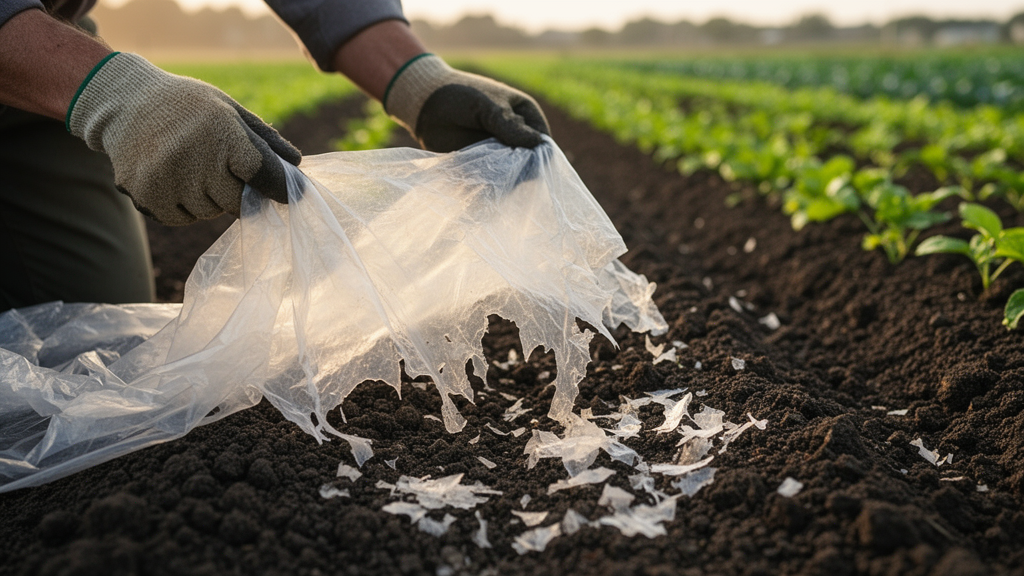
A review published in the Journal of Materials Science examines how biodegradable polymer mulch films change during agricultural use and after their intended service period. Based on the available abstract, the review focuses on the balance between maintaining film stability while in service and achieving controllable degradation after use. It covers material systems, aging environments, surface degradation, failure mechanisms, structure–property relationships and methods for assessing film performance. The review appears in volume 61, pages 34379–34411, with a publication date of 20 September 2026.

The abstract reports that environmental stressors can affect biodegradable mulch films through photo-oxidation, hydrolysis, microbial activity and interactions among these processes. It describes these stressors as driving chain scission, crystallinity evolution, interfacial debonding, and the formation of cracks and pores. These changes are associated with deterioration in mechanical, barrier, wettability and optical properties. The authors propose a multiscale framework intended to connect chemical and solid-state structure with surface defects, macroscopic properties and service functionality.

The review also highlights quantitative defect analysis and interpretable machine-learning-assisted assessment for classifying aging levels and predicting service performance. These are proposed assessment approaches rather than validated results from a new field trial or experiment reported in the available material. The authors identify field-relevant coupled aging, standardized defect metrics, mechanistic modeling and multiscale data fusion as priorities for future research aimed at predictable service life and controllable environmental fate. Because the source supplied here contains only the abstract and bibliographic preview, the extent to which the full review supports each conclusion, the evidence base for the machine-learning methods and the review’s detailed limitations cannot be independently assessed.

Subject of Research: Review of degradation and structure–property evolution in biodegradable agricultural mulch films

Article Title: Review: surface degradation and structure–property evolution of biodegradable polymer mulch films

Article References: Li, M., Wei, G., Cui, B., & Xiu, W. (2026). Review: surface degradation and structure–property evolution of biodegradable polymer mulch films. Journal of Materials Science, 61(44), 34379-34411. https://doi.org/10.1007/s10853-026-13764-y

Image Credits: AI Generated

DOI: 10.1007/s10853-026-13764-y

Keywords: biodegradable mulch films, polymer degradation, photo-oxidation, hydrolysis, microbial activity, surface defects, structure–property relationships, machine learning, multiscale analysis, agricultural plastics, Review, surface

Cite Scienmag News

Neil Sanderson. (October 20, 2026). Review maps degradation and property changes in biodegradable polymer mulch films. Scienmag. https://scienmag.com/review-maps-degradation-and-property-changes-in-biodegradable-polymer-mulch-films/


Neil Sanderson. "Review maps degradation and property changes in biodegradable polymer mulch films." Scienmag, 20 October 2026, https://scienmag.com/review-maps-degradation-and-property-changes-in-biodegradable-polymer-mulch-films/. Accessed 20 October 2026.

Neil Sanderson. "Review maps degradation and property changes in biodegradable polymer mulch films." Scienmag. October 20, 2026. https://scienmag.com/review-maps-degradation-and-property-changes-in-biodegradable-polymer-mulch-films/

Tags: agricultural plasticsbiodegradable mulch filmsbiodegradable polymer mulch film degradation mechanismschemical and solid-state structure changes in biodegradable mulch filmseffects of photo-oxidation and hydrolysis on biodegradable polymer degradationenvironmental stressors impact on biodegradable mulch filmshydrolysisMachine learningmachine learning approaches for predicting biodegradable film agingmethods for assessing biodegradable film performancemicrobial activitymicrobial activity influence on biodegradable mulch film deteriorationmultiscale analysismultiscale framework for biodegradable film stability analysisphoto-oxidationpolymer degradationproperty deteriorationreviewstructure-property relationshipsstructure–property relationships in biodegradable agricultural mulch filmssurfacesurface defectssurface degradation and failure mechanisms of biodegradable polymer films
Share26Tweet16
Previous Post

Qualitative study finds primary care and psychiatry differ in managing complex mental illness

Next Post

WHO-5 shows structural validity and cross-country measurement invariance among 10- to 14-year-olds in Moldova and North Macedonia

Related Posts

Nanofiltration membranes race to separate magnesium from lithium in brines
Technology and Engineering

Review maps nanofiltration strategies for separating magnesium and lithium from brines

October 20, 2026
Uranium in Drinking Water Stays Below Safety Limits, but Toddlers Face Highest Relative Risk, Study Finds
Technology and Engineering

Uranium levels in Iranian drinking water were below guidelines, with modeled health risks varying by age

October 20, 2026
Trust Beats Talent: What Really Drives Music Students to Compose With AI
Technology and Engineering

Chinese music students’ trust in GenAI linked most strongly to intention to use it for composition

October 20, 2026
Zn-Ti co-doping unlocks high-performance cordierite ceramics for 5G antennas
Technology and Engineering

Zn/Ti co-doped cordierite ceramics show improved microwave dielectric properties in experimental study

October 20, 2026
Plant Compound Quercetin Shows Promise Against Carbapenem-Resistant Superbug
Technology and Engineering

Quercetin showed in vitro promise as a carbapenem adjuvant against a carbapenem-resistant Klebsiella pneumoniae isolate

October 20, 2026
AI Sovereignty Without Owning the Stack: A New Blueprint for Governing Critical Dependencies
Technology and Engineering

Perspective proposes functional AI sovereignty framework based on conceptual synthesis, not empirical validation

October 20, 2026
Next Post
WHO-5 Well-Being Index Proves Reliable for Measuring Young Adolescent Wellbeing Across Southeastern Europe

WHO-5 shows structural validity and cross-country measurement invariance among 10- to 14-year-olds in Moldova and North Macedonia

  • Mothers who receive childcare support from maternal grandparents show more optimized

    Mothers who receive childcare support from maternal grandparents show more parental warmth, finds NTU Singapore study

    27656 shares
    Share 11059 Tweet 6912
  • University of Seville Breaks 120-Year-Old Mystery, Revises a Key Einstein Concept

    1061 shares
    Share 424 Tweet 265
  • Bee body mass, pathogens and local climate influence heat tolerance

    682 shares
    Share 273 Tweet 171
  • Researchers record first-ever images and data of a shark experiencing a boat strike

    546 shares
    Share 218 Tweet 137
  • Groundbreaking Clinical Trial Reveals Lubiprostone Enhances Kidney Function

    531 shares
    Share 212 Tweet 133
Science

Embark on a thrilling journey of discovery with Scienmag.com—your ultimate source for cutting-edge breakthroughs. Immerse yourself in a world where curiosity knows no limits and tomorrow’s possibilities become today’s reality!

RECENT NEWS

  • WHO-5 shows structural validity and cross-country measurement invariance among 10- to 14-year-olds in Moldova and North Macedonia
  • Review maps degradation and property changes in biodegradable polymer mulch films
  • Qualitative study finds primary care and psychiatry differ in managing complex mental illness
  • Retrospective machine learning models predict amputation risk in diabetic arterial disease

Categories

  • Agriculture
  • Anthropology
  • Archaeology
  • Athmospheric
  • Biology
  • Biotechnology
  • Blog
  • Bussines
  • Cancer
  • Chemistry
  • Climate
  • Earth Science
  • Editorial Policy
  • Marine
  • Mathematics
  • Medicine
  • Pediatry
  • Policy
  • Psychology & Psychiatry
  • Science Education
  • Science News
  • Social Science
  • Space
  • Technology and Engineering

Subscribe to Blog via Email

Enter your email address to subscribe to this blog and receive notifications of new posts by email.

Join 5,150 other subscribers

© 2025 Scienmag - Science Magazine

Welcome Back!

Login to your account below

Forgotten Password?

Retrieve your password

Please enter your username or email address to reset your password.

Log In
No Result
View All Result
  • HOME
  • SCIENCE NEWS
  • CONTACT US

© 2025 Scienmag - Science Magazine

Discover more from Science

Subscribe now to keep reading and get access to the full archive.

Continue reading