


A temporal diagnostic study of the Matai’an Creek landslide-dammed lake in eastern Taiwan found that authorities recognized and repeatedly monitored the evolving hazard, but governance actions remained concentrated in coordination and assessment before the natural dam collapsed. An Escalation Index, or EI, scored the pre-collapse hazard-formation phase at 1.36 and the monitoring-and-coordination phase at 1.61, both within the study’s procedural range. Scores rose to 3.38 during the collapse and 3.42 after collapse as structural mitigation, emergency measures and trigger-based intervention became prominent. The observed contrast identifies a temporal governance gap between recognizing warning signals and activating protective measures capable of changing exposure or response conditions.
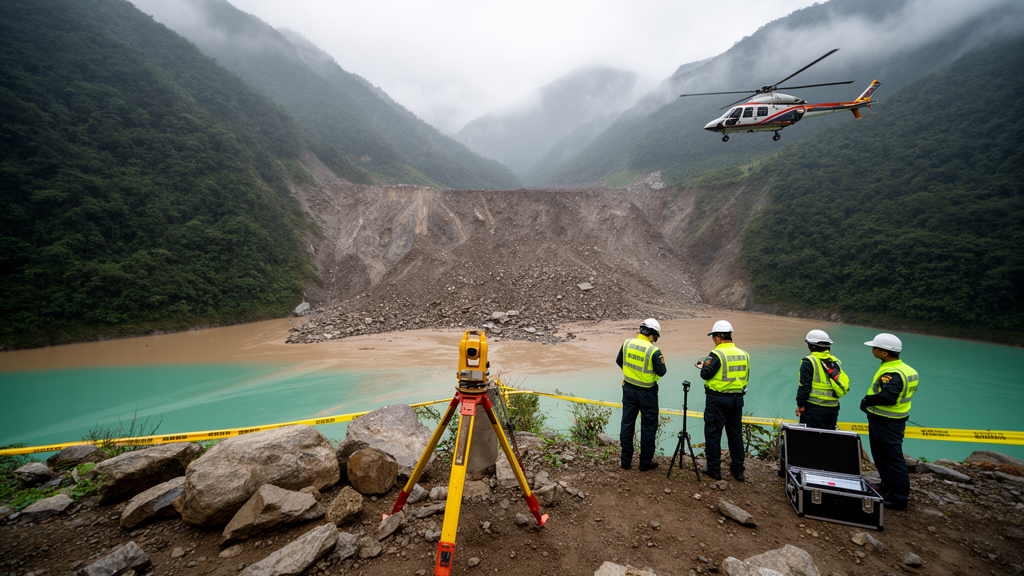
The analyzed lake formed in steep terrain susceptible to landslides and debris flows under extreme rainfall. Upstream slope instability blocked Matai’an Creek, creating a temporary natural dam and impounding water for several months before the natural dam breached on 23 September 2025. The researchers treated the site as a coupled slope–channel–lake system comprising the mass-movement source area, the natural dam and impounded reach, the upstream contributing drainage basin, and the downstream corridor potentially affected by a sudden water release. This was a single-case governance diagnosis rather than a hydraulic or geotechnical simulation, and it did not attribute the physical collapse to a single administrative cause. Its central question was when documented responses escalated and whether recognized signals produced action before the hazard was realized.
To reconstruct that sequence, the researchers combined documentary process tracing, case–policy evaluation, temporal segmentation and coding of 97 disaster risk reduction actions. The timeline was divided into four phases: hazard formation, monitoring and coordination, collapse, and post-collapse structural adjustment. Each action was assigned to one of four escalation levels: monitoring and assessment; coordination and advisory action; structural mitigation; or trigger-based intervention. An action counted as activated only when documentary evidence showed an observable administrative, technical, operational or structural measure, excluding general policy intentions, broad planning statements and institutional mandates without evidence of implementation. When evidence allowed more than one classification, the researchers applied the lower level unless structural mitigation, emergency intervention or trigger-based activation was explicit. This conservative rule was intended to make the dataset auditable and prevent overstatement of intervention depth.
Official records documented repeated aerial monitoring, hydrological assessment, technical review and cross-agency coordination before the collapse. The coded record did not show those outputs producing compulsory relocation, enforceable regulatory escalation or large-scale structural intervention during the first two phases. Of the 77 actions activated before collapse, only four were assigned to the two structural categories, while more than three-quarters were classified as monitoring, assessment, coordination or advisory communication. The researchers interpret this pattern as institutional signal absorption: warning information was not ignored, but it was absorbed into routine administrative processes that strengthened situational awareness without proportionately altering physical exposure or intervention conditions. The pre-collapse record therefore indicates institutional engagement and procedural activation rather than simple absence of awareness.
The EI summarized the relative depth of activated action by weighting Level 1 through Level 4 actions at one, two, three and four, then dividing the weighted total by the number of activated actions in the relevant scope. Across the entire case, there were 42 Level 1 actions, 31 Level 2 actions, 15 Level 3 actions and nine Level 4 actions. The resulting overall EI was 185 divided by 97, or 1.91, slightly below the study’s procedural–structural dividing point of 2 despite the inclusion of some stronger interventions. The phase values exposed a more pronounced temporal change. During hazard formation, 18 Level 1 and 10 Level 2 actions produced an EI of 1.36. During monitoring and coordination, 24 Level 1, 21 Level 2, three Level 3 and one Level 4 action produced an EI of 1.61. Governance activity expanded as the number of pre-collapse actions increased from 28 to 49, but its average depth remained below 2.
Monte Carlo uncertainty and sensitivity tests supported the main pre- and post-collapse contrast, although the study cautions that the EI is an ordinal diagnostic rather than an exact interval-scale measurement. The researchers ran 10,000 simulations in which the nominal level scores were perturbed within triangular distributions bounded at plus or minus 20 percent, while preserving their ordering and rescaling them to retain endpoints of one and four. A second scenario randomly reassigned 10 percent of activated actions by one adjacent escalation level, with equal probability of upward or downward movement where both were possible; 5 percent and 20 percent reassignment scenarios supplied additional bounds. These were constructed stress tests, not empirical estimates of coding error. In all 10,000 simulations, both post-collapse phases remained above both pre-collapse phases. T1 remained below an EI of 2 in 100 percent of simulations, T2 in 99.6 percent, and T3 and T4 remained above 2 in 100 percent. The ordering of T3 and T4 was less stable, so they should be read as a robust high-escalation cluster rather than evidence of a meaningful increase from collapse to post-collapse adjustment.
A second assessment assigned each action to the closest of the four Sendai Framework priorities: understanding disaster risk, strengthening disaster risk governance, investing in disaster risk reduction for resilience, or enhancing preparedness and recovery. Thirty-five actions concerned risk understanding and 28 concerned governance coordination, making procedural and knowledge-oriented activity the largest categories. Actions involving mitigation investment and recovery-oriented structural adjustment were fewer and became more prominent after collapse. This policy classification complements the EI: the EI measures how deeply actions escalated, while the priority assessment identifies their functional orientation. Together, the results show that the pre-collapse response was concentrated in monitoring, assessment, coordination and advisory communication, while more structurally oriented investment and recovery measures became prominent after hazard realization.
The physical setting contains several pathways through which the timing of escalation could matter, including rising lake levels, overtopping, seepage through or around the natural dam, progressive weakening, breach formation and downstream flooding or debris-flow amplification. The study treats these as hazard implications rather than modelled predictions because it did not perform hydraulic routing, dam-breach simulation or geotechnical stability modelling. Its spatial characterization also faces limits associated with image resolution, image acquisition dates, digital elevation model accuracy, boundary delineation and field verification. Those constraints limit the precision of morphometric reconstruction and prevent the study from quantifying the downstream inundation or reconstructing the physical failure mechanism. They do not alter the evidentiary basis of the governance diagnosis, which depends on documented action dates, coding rules and phase assignments rather than a numerical model of dam failure.
The case illustrates what the authors call temporal maladaptation: vulnerability can accumulate when institutions delay stronger intervention even though they recognize a progressively developing hazard and possess relevant intervention capacity. The authors avoid treating collapse as deterministic proof of governance failure. Instead, it serves as a diagnostic reference showing that stronger structural and trigger-based responses became prominent after the breach, when visible disruption could concentrate administrative attention, urgency and resources. The study draws on policy-learning research suggesting that catastrophic events can open windows for institutional change, while near misses may generate weaker learning because the absence of immediate visible losses can reinforce the belief that existing arrangements are adequate. The pre-collapse period is therefore treated not only as a time when disaster was temporarily avoided, but as a policy stress test of whether warning information was connected to decisions capable of reducing exposure before failure.
The framework’s main policy implication is to connect physical monitoring indicators to predefined operational thresholds and responsible decision authorities. For landslide-dammed lakes, the paper identifies repeated satellite or aerial-image comparison, field inspection of dam deformation and seepage, lake-level observation, rainfall–runoff tracking, digital-elevation-model change detection and assessment of downstream exposure as potentially relevant inputs. The authors discuss linking such observations to decisions about engineering reinforcement, controlled drainage, evacuation preparation, access restriction, road closure, downstream warning and emergency response. The proposal is not that one universal threshold can predict failure, nor does the study claim that any single indicator would have prevented the collapse. Rather, it argues that explicit trigger rules can reduce escalation latency and reliance on ad hoc discretion when risk conditions change. Because the evidence comes from one Taiwan case, the framework offers analytical rather than statistical transferability to other progressively evolving hazards, including dam instability, glacial lake outburst floods, coastal erosion and cascading hydrological risks. Future comparative studies would need to test how different systems define thresholds, allocate authority and activate protective action under uncertainty.
Subject of Research: Single-case analysis of pre- and post-collapse governance escalation in Taiwan’s Matai’an Creek landslide-dammed lake event
Article Title: From near-miss to collapse: diagnosing temporal governance gaps in landslide-dammed lake risk management
Article References: Lin, Y.-M., Lin, B.-C., Lee, C.-H., & Liou, Y.-S. (2026). From near-miss to collapse: diagnosing temporal governance gaps in landslide-dammed lake risk management. Natural Hazards, 122(22), Article 686. https://doi.org/10.1007/s11069-026-08462-6
Image Credits: AI Generated
DOI: 10.1007/s11069-026-08462-6
Keywords: landslide-dammed lakes, Taiwan, disaster risk governance, Escalation Index, near-miss events, temporal governance gap, early warning, structural mitigation, climate adaptation, landslide hazards, near-miss, collapse
Cite Scienmag News
Courtney Benton. (October 20, 2026). Taiwan landslide-dammed lake study exposes delayed governance escalation. Scienmag. https://scienmag.com/taiwan-landslide-dammed-lake-study-exposes-delayed-governance-escalation/
Courtney Benton. "Taiwan landslide-dammed lake study exposes delayed governance escalation." Scienmag, 20 October 2026, https://scienmag.com/taiwan-landslide-dammed-lake-study-exposes-delayed-governance-escalation/. Accessed 20 October 2026.
Courtney Benton. "Taiwan landslide-dammed lake study exposes delayed governance escalation." Scienmag. October 20, 2026. https://scienmag.com/taiwan-landslide-dammed-lake-study-exposes-delayed-governance-escalation/


