


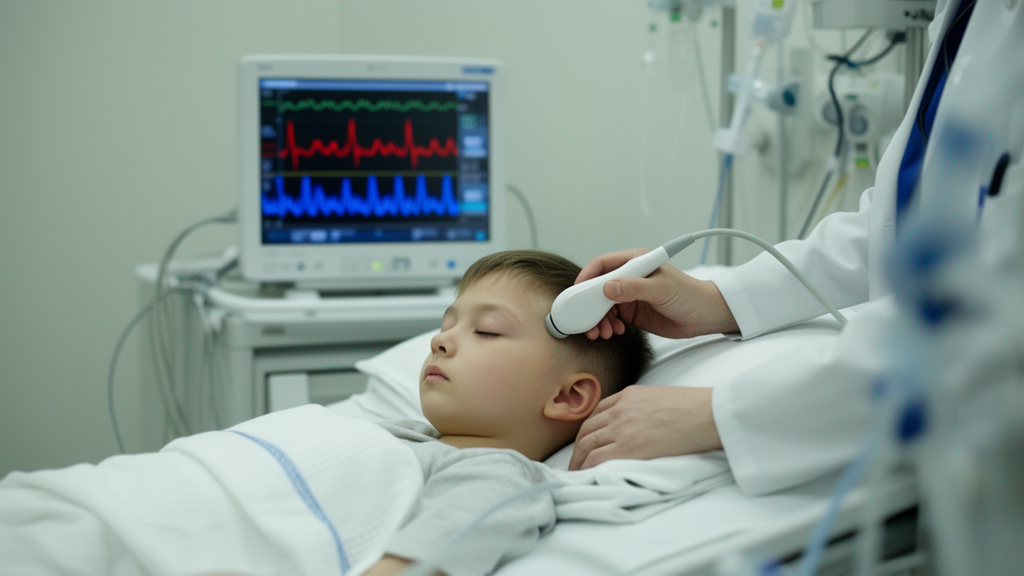
Transcranial Doppler ultrasound showed waveforms consistent with brain death or death by neurologic criteria in 38 of 47 children who met the clinical diagnosis, according to a 10-year retrospective study from Beijing Children’s Hospital. The result indicates that Doppler can provide strong supportive evidence when it demonstrates cerebral circulatory arrest, but the study also found persistent intracranial arterial flow in nine clinically confirmed cases, showing that the noninvasive bedside test is not infallible. Among 266 children in whom brain death or death by neurologic criteria was excluded because brain function was preserved, none had Doppler findings consistent with the diagnosis, giving an observed specificity of 100% in this cohort.
Because the work was retrospective, conducted at one center and used clinical determination as the reference standard, its estimates should not be interpreted as proof that Doppler can independently establish the diagnosis in every setting. The researchers reviewed 512 children admitted to the pediatric intensive care unit between 2016 and 2025. All had a Glasgow Coma Scale score of 3T, indicating no eye opening, no motor response and an unassessable verbal score because of endotracheal intubation, and all underwent Doppler on the same day.
Their median age was 81 months, with an interquartile range of 33 to 130 months and a range from one month to 17.6 years; 304 children, or 59.4%, were male. Major causes of severe brain injury included infection-related encephalopathy, which accounted for 21.9% of the cohort, hypoxic-ischemic brain injury, at 20.9%, and traumatic brain injury, at 13.7%. The children were divided into 47 who met Chinese criteria for brain death or death by neurologic criteria, 266 in whom the condition was excluded because preserved brain function meant no evaluation was initiated, and 199 whose evaluation remained incomplete.
Chinese pediatric criteria required a devastating brain injury, exclusion of confounders and two sets of examinations consistent with brain death or death by neurologic criteria. Each set combined clinical examination with confirmatory testing. The clinical assessment evaluated coma, brainstem reflexes and apnea, while the permitted ancillary tests included transcranial Doppler, electroencephalography and short-latency somatosensory evoked potentials.
At least two confirmatory tests had to support the diagnosis, or all three when a brainstem reflex could not be tested. The age-dependent interval between the two sets was at least 24 hours for children from 29 days to younger than one year and at least 12 hours for those aged one to 18 years. All 47 children in the confirmed group fulfilled the clinical criteria without confounders, and the final clinical determination was used as the reference standard for evaluating Doppler performance.
Doppler findings were considered consistent with the diagnosis when the anterior and posterior circulations on both sides showed reverberating flow, systolic spikes or loss of previously detectable intracranial flow signals on serial examinations. Reverberating flow consisted of forward systolic flow accompanied by reverse diastolic flow within one cardiac cycle. Systolic spikes were isolated systolic signals lasting less than 200 milliseconds and with peak systolic velocity below 50 centimeters per second.
The middle cerebral artery or terminal internal carotid artery was used to assess the anterior circulation, while the basilar or intracranial vertebral artery was used for the posterior circulation. Examinations used temporal, suboccipital and submandibular windows, with the carotid siphon assessed through the orbital window when the temporal window was inadequate. Two certified technicians performed the examinations, and a third certified investigator independently reinterpreted the stored waveforms while blinded to all other clinical and ancillary-test information; the independent interpretations were fully concordant with the original assessments of whether findings were consistent with brain death.
Among the 47 children who met the clinical criteria, 44 underwent Doppler before the first examination met those criteria. Thirty-four of them, or 77.3%, already had Doppler findings consistent with brain death a median of 28.4 hours before the clinical determination point. One additional child developed consistent waveforms on a repeat examination five hours later.
Three children were first examined two to 16 hours after the clinical criteria were met, and all had consistent Doppler findings. Four children retained inconsistent waveforms on follow-up scans, while five received no further Doppler examination. The researchers also noted that prior reports have found the rate of Doppler detection of cerebral circulatory arrest rising from 58% within six hours of clinical diagnosis to 100% after 24 to 36 hours.
In the present cohort, most Doppler examinations were performed early in the diagnostic sequence because Chinese protocol places confirmatory testing before apnea testing. The nine children with clinically confirmed brain death but Doppler findings inconsistent with the diagnosis had detectable intracranial arterial flow. The most common potential explanation was disruption of the normally closed intracranial system: four children had ventricular drainage, a patent anterior fontanelle or multiple skull fractures.
Such openings can reduce the rise in intracranial pressure, potentially delaying the characteristic Doppler pattern of cerebral circulatory arrest. One child had a suspected cerebrovascular malformation, which may have provided a low-resistance route for blood to bypass areas of critically elevated pressure. One child received venoarterial extracorporeal membrane oxygenation, whose driving pressure could maintain pulsatile or continuous flow despite absent brain function.
Another examination was delayed by 28 days after severe impairment of consciousness began, when resolution of cerebral edema may have reduced intracranial pressure. No definite explanation was found for the remaining two children. The researchers described these as potential contributing factors rather than experimentally established mechanisms.
Several observations illustrate why waveform character matters. In children with disrupted intracranial systems, Doppler sometimes detected continuous forward diastolic flow rather than the expected reverberating flow or systolic spikes. The child with suspected arteriovenous malformation had asymmetric perfusion, with residual forward flow on the affected side and markedly reduced or absent flow on the opposite side.
The child receiving venoarterial extracorporeal membrane oxygenation initially showed nonpulsatile flow and later pulsatile flow, but forward diastolic flow remained present; computed tomography angiography and perfusion imaging performed on day 13 of severe impairment of consciousness indicated cerebral circulatory arrest. Because no contemporaneous Doppler examination was available for that later imaging, the investigators could not determine whether the flow pattern had subsequently evolved. Another child’s scan was performed 28 days after severe impairment of consciousness and showed only reduced diastolic blood velocity, a pattern that may represent a transitional stage or residual perfusion below the level required to sustain brain function.
The study did not include consistent serial imaging or concurrent cerebral blood-flow measurements for every case. The incomplete-determination group requires a separate interpretation. Doppler findings consistent with brain death or death by neurologic criteria were observed in 117 of 199 children, or 58.8%, whose determination was not completed.
This included 83 of 157 whose evaluation was not initiated, 16 of 24 whose apnea testing was not completed and all 18 whose repeat examination was not completed. The inconsistent group included 74 children whose evaluation was not initiated, eight whose apnea testing was not completed and none whose repeat examination was not completed. Because these children did not receive a complete clinical determination, the distribution of Doppler findings in this group cannot establish diagnostic performance or a false-positive rate.
Doppler may also have influenced whether clinicians initiated or continued the determination process, introducing verification bias. The data are therefore best read as a description of the results in an unresolved clinical population, not as evidence that Doppler alone identified brain death in 117 children. The study has important limitations.
Doppler timing and frequency were not standardized, and missing repeat examinations may have underestimated how many children would eventually develop waveforms consistent with cerebral circulatory arrest. Clinical instability or family preference prevented some evaluations from being initiated or completed, leaving a large, uncertain population whose final status was unknown. The lack of concurrent validation with angiography or nuclear-medicine flow studies, together with incomplete longitudinal imaging, limited investigation of why residual flow persisted.
The nine discordant children were also a small subgroup, and their characteristics could not establish which factor was decisive in an individual case. The results support Doppler as an adjunct that is noninvasive, repeatable and feasible at the bedside, not as a substitute for a full clinical assessment and other required confirmatory evidence. When Doppler conflicts with strong clinical suspicion or established criteria, clinicians must examine the waveform and consider drainage devices, skull fractures, patent fontanelles, vascular malformations, mechanical circulatory support and examination timing rather than treating residual flow as an automatic reversal of the diagnosis.
Across the full cohort, the apparent strength of a Doppler result depended on what it showed. In the group whose evaluation remained incomplete, 58.8% also had consistent findings, but the absence of a final reference diagnosis prevents those observations from being converted into sensitivity or false-positive estimates. The study therefore adds evidence that Doppler can reinforce a pediatric brain-death or death-by-neurologic-criteria assessment when it shows the expected arrest pattern, while preserving a clinically important warning: residual arterial flow can remain detectable after the clinical criteria have been met.
That warning is most relevant in children with disrupted intracranial systems, suspected cerebrovascular malformations, extracorporeal circulatory support or delayed testing, circumstances in which the Doppler waveform may not tell the same story as the complete clinical evaluation.
Subject of Research: Diagnostic performance and limitations of transcranial Doppler for pediatric brain death or death by neurologic criteria
Article Title: Clinical utility and limitations of transcranial Doppler in evaluating pediatric brain death or death by neurologic criteria: a 10-year retrospective study
Article References: Tan, N., Li, Y., Xiao, N., Wang, Q., Wu, J., & Qian, S. (2026). Clinical utility and limitations of transcranial Doppler in evaluating pediatric brain death or death by neurologic criteria: a 10-year retrospective study. Frontiers in Pediatrics, 14, Article 1931129. https://doi.org/10.3389/fped.2026.1931129
Image Credits: AI Generated
DOI: 10.3389/fped.2026.1931129
Keywords: pediatric brain death, death by neurologic criteria, transcranial Doppler, cerebral circulatory arrest, intracranial arterial flow, pediatric intensive care, ancillary testing, intracranial pressure, extracorporeal membrane oxygenation, Clinical, utility, limitations
Cite Scienmag News
Cassandra Pierce. (October 20, 2026). Transcranial Doppler supports pediatric brain death but can miss persistent flow. Scienmag. https://scienmag.com/transcranial-doppler-supports-pediatric-brain-death-but-can-miss-persistent-flow/
Cassandra Pierce. "Transcranial Doppler supports pediatric brain death but can miss persistent flow." Scienmag, 20 October 2026, https://scienmag.com/transcranial-doppler-supports-pediatric-brain-death-but-can-miss-persistent-flow/. Accessed 20 October 2026.
Cassandra Pierce. "Transcranial Doppler supports pediatric brain death but can miss persistent flow." Scienmag. October 20, 2026. https://scienmag.com/transcranial-doppler-supports-pediatric-brain-death-but-can-miss-persistent-flow/


