


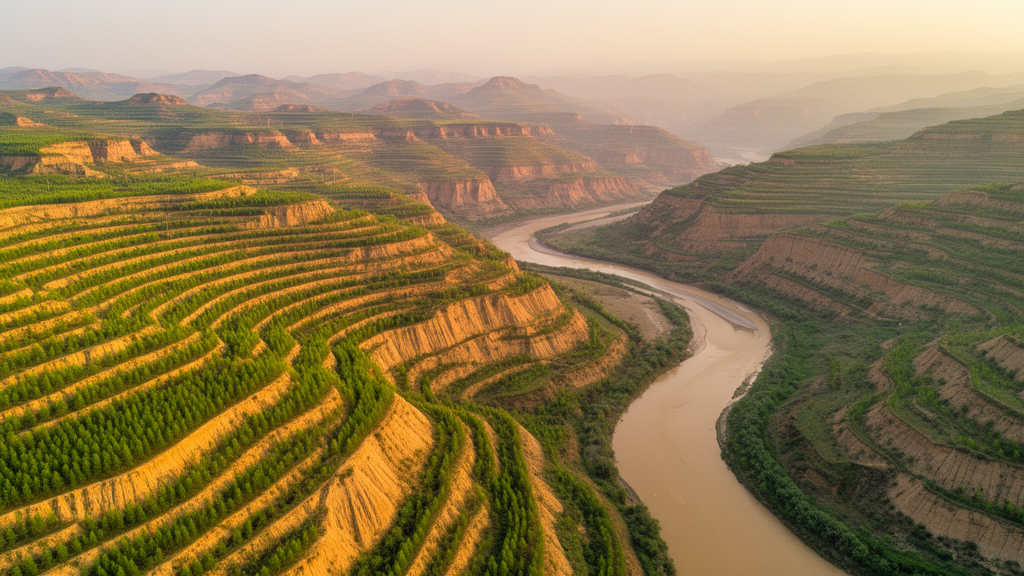
A regional satellite-observation study reports that China’s Grain for Green program was associated with expanded forest cover, stronger vegetation growth, increased carbon storage, and declining river runoff and terrestrial water storage anomalies across the Loess Plateau from 2000 to 2015. The findings summarize an observational analysis rather than establishing that the program alone caused all of the measured changes.
The researchers combined multiple satellite-based products with ground observations to assess vegetation growth and productivity, carbon sequestration and storage, and water availability over the Loess Plateau. The supplied abstract identifies the analysis as an integrated regional assessment of the program’s environmental effects, but does not provide details about the observation products, ground sites, statistical models, comparison areas, or uncertainty intervals. Forest cover increased by 53.2% relative to its 2000 level, a change the authors describe as closely associated with Grain for Green implementation. The normalized difference vegetation index and vegetation optical depth also showed marked improvement across the region during the study period.
Carbon indicators showed gains over the same period. Aboveground biomass carbon increased by 24.4%, while the study also recorded substantial gains in carbon sequestration and storage. These are satellite- and observation-based estimates for the Loess Plateau and are not direct measurements of the program’s net effect on greenhouse-gas emissions. The abstract does not specify the absolute amount of carbon gained or the uncertainty surrounding either the biomass estimate or the reported percentage changes.
Water responses were mixed. Remotely sensed evapotranspiration rose modestly, while surface soil moisture remained relatively stable, which the authors attribute likely to an upward precipitation trend. By contrast, river runoff and terrestrial water storage anomaly declined markedly. The authors state that enhanced evapotranspiration associated with afforestation under Grain for Green may have contributed to the runoff reduction, while also noting that agricultural irrigation and socioeconomic development may have influenced the hydrological changes. The available evidence therefore supports an association between afforestation, greater evapotranspiration, and lower runoff, rather than a quantified causal attribution. Because the supplied source is an abstract, the full study’s methods, results, and limitations cannot be independently evaluated from the material provided.
Subject of Research: Regional satellite assessment of vegetation, carbon, and water changes associated with China’s Grain for Green program on the Loess Plateau
Article Title: Satellite observations reveal carbon gains and water resource pressures associated with the grain for green program on the Chinese Loess Plateau
Article References: Yang, X., Shan, Y., Wang, Z., Zhang, S., & Zhao, F. (2026). Satellite observations reveal carbon gains and water resource pressures associated with the grain for green program on the Chinese Loess Plateau. Discover Sustainability. https://doi.org/10.1007/s43621-026-04985-x
Image Credits: AI Generated
DOI: 10.1007/s43621-026-04985-x
Keywords: Grain for Green, Loess Plateau, satellite observations, forest cover, carbon sequestration, evapotranspiration, river runoff, terrestrial water storage, afforestation, China, Satellite, observations
Cite Scienmag News
Violet Maxwell. (October 20, 2026). Satellite study links Grain for Green afforestation on China’s Loess Plateau to carbon gains and water pressures. Scienmag. https://scienmag.com/satellite-study-links-grain-for-green-afforestation-on-chinas-loess-plateau-to-carbon-gains-and-water-pressures/
Violet Maxwell. "Satellite study links Grain for Green afforestation on China’s Loess Plateau to carbon gains and water pressures." Scienmag, 20 October 2026, https://scienmag.com/satellite-study-links-grain-for-green-afforestation-on-chinas-loess-plateau-to-carbon-gains-and-water-pressures/. Accessed 20 October 2026.
Violet Maxwell. "Satellite study links Grain for Green afforestation on China’s Loess Plateau to carbon gains and water pressures." Scienmag. October 20, 2026. https://scienmag.com/satellite-study-links-grain-for-green-afforestation-on-chinas-loess-plateau-to-carbon-gains-and-water-pressures/


