


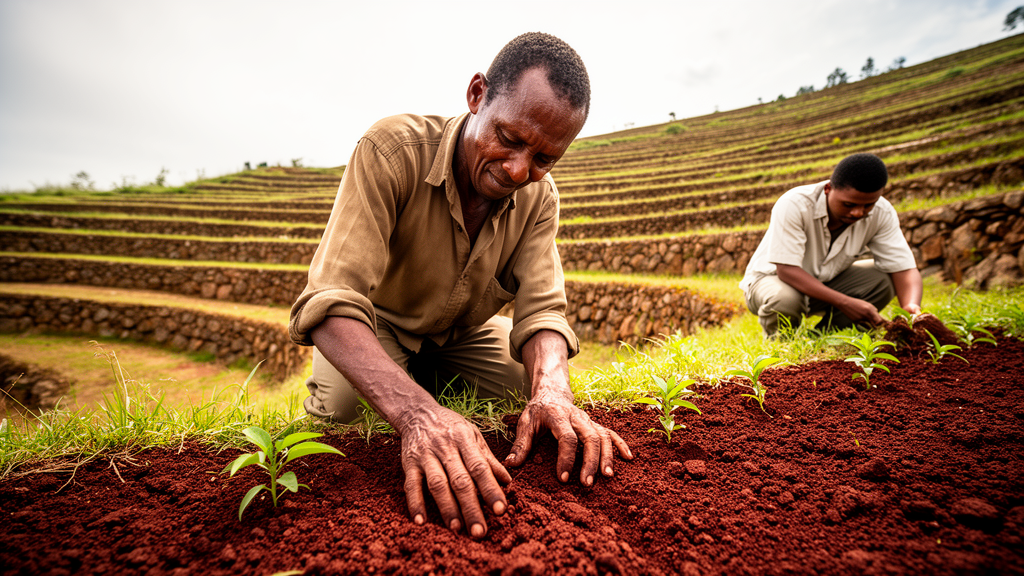
A household survey and key-informant interviews in northwestern Ethiopia’s Jema Watershed found that access to training, knowledge of soil and water conservation, sources of information, extension services and perceptions were positively associated with adoption of conservation practices. In the study’s multiple linear regression, the respective coefficients were 0.620, 0.496, 0.416, 0.336 and 0.108. Land-tenure insecurity, small farm size and greater distance from farmland were negatively associated with adoption.
The reported analysis assessed community knowledge through yes/no items and perceptions and practices through five-point Likert-scale items. Composite and mean scores were categorized using predefined intervals ranging from very low to very high. Most respondents received composite awareness and perception scores in the “good” category, defined as 50–75% of the maximum attainable score. The study used correlation and multiple linear regression to examine relationships between these measures and adoption of soil and water conservation practices.
The abstract reports strong positive correlations among the community measures. Knowledge was correlated with perception at r = 0.64, with practice at r = 0.83 and with perception and practice at r = 0.69; all reported p-values were below 0.05. These correlations and regression coefficients indicate statistical associations within the study area rather than demonstrating that any factor caused adoption. The authors identified institutional support, training, information access, extension services and land-tenure security as areas relevant to sustainable adoption, based on the study’s measured associations.
The findings are based on research conducted in one watershed in the highlands of northwestern Ethiopia, so their direct applicability beyond that setting is uncertain. The available abstract does not report the number of survey respondents or key informants, sampling procedures, confidence intervals, model diagnostics or detailed measures of adoption. It also does not establish whether the reported relationships persist over time. Accordingly, the results identify factors statistically associated with reported conservation practice in the Jema Watershed but do not quantify the effect of an intervention, establish causal mechanisms or demonstrate downstream environmental outcomes.
Subject of Research: Household determinants associated with soil and water conservation adoption in Ethiopia’s Jema Watershed
Article Title: Determinants of communities’ adoption and practice of soil and water conservation measures in the Jema Watershed, in the highlands of northwestern Ethiopia
Article References: Fentie, A. Y., & Assefa, Y. (2026). Determinants of communities’ adoption and practice of soil and water conservation measures in the Jema Watershed, in the highlands of northwestern Ethiopia. Discover Sustainability. https://doi.org/10.1007/s43621-026-04965-1
Image Credits: AI Generated
DOI: 10.1007/s43621-026-04965-1
Keywords: soil and water conservation, Ethiopia, Jema Watershed, adoption, household survey, key-informant interviews, multiple linear regression, extension services, land tenure security, rural livelihoods, Determinants, communities
Cite Scienmag News
Margaret Porter. (October 20, 2026). Household study identifies factors associated with soil and water conservation adoption in Ethiopia’s Jema Watershed. Scienmag. https://scienmag.com/household-study-identifies-factors-associated-with-soil-and-water-conservation-adoption-in-ethiopias-jema-watershed/
Margaret Porter. "Household study identifies factors associated with soil and water conservation adoption in Ethiopia’s Jema Watershed." Scienmag, 20 October 2026, https://scienmag.com/household-study-identifies-factors-associated-with-soil-and-water-conservation-adoption-in-ethiopias-jema-watershed/. Accessed 20 October 2026.
Margaret Porter. "Household study identifies factors associated with soil and water conservation adoption in Ethiopia’s Jema Watershed." Scienmag. October 20, 2026. https://scienmag.com/household-study-identifies-factors-associated-with-soil-and-water-conservation-adoption-in-ethiopias-jema-watershed/


