


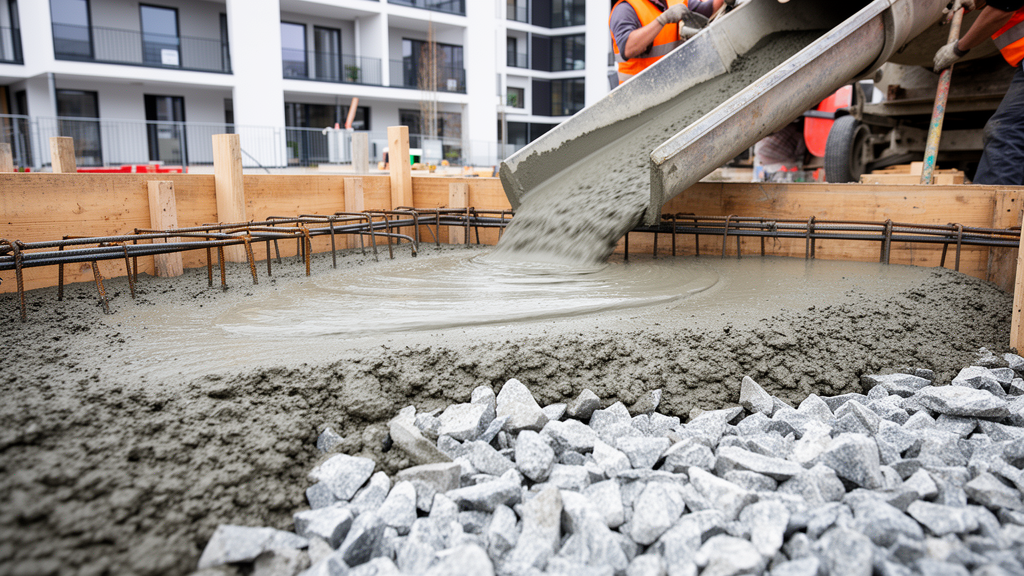
Crushed limestone sand can be used to produce high-fluidity concrete that flows through densely reinforced and geometrically complex forms, according to a laboratory study that optimized mortar rheology and the coating thickness around coarse aggregate. The researchers prepared concrete with measured slump flows of 618 to 705 mm, segregation rates of 2.94% to 5.01%, and 28-day compressive strengths ranging from 44.98 to 61.91 MPa. Their mix-design method replaced broad trial-and-error procedures with a mortar-centered framework linking initial yield shear stress, particle proportions, and mortar film thickness.
A mix-design-stage sustainability analysis also found that the combined use of crushed sand and 30% fly ash reduced embodied carbon by about 28% and embodied energy by 25% to 26% relative to a reference concrete containing natural sand and no fly ash. Natural sand is increasingly scarce, while crushed sand is widely available because it is produced by crushing and screening rocks into particles smaller than 4.75 mm. The material is already widely used, but its irregular shapes, rough surfaces, flaky particles, uneven gradation, and potentially excessive fine powder can increase friction and water demand.
These characteristics can reduce flow and make segregation more likely when crushed sand replaces natural sand in high-fluidity concrete. The present study focused on crushed limestone sand, and its authors said that the optimized ranges would need verification for sands from other lithologies. The researchers addressed that gap with a six-factor, five-level L25 orthogonal experiment evaluating crushed-sand mortar.
The tested variables were the water-to-binder ratio, polycarboxylate water-reducer dosage, sand volume fraction, fly ash content, silica fume content, and rock-powder content. Researchers measured mortar rheology with a rotational rheometer, determined spread with the truncated-cone slump-flow test, and tested 28-day compressive and flexural strengths. Scanning electron microscopy was also used to examine how fly ash, silica fume, and rock powder affected the mortar matrix.
The experimental materials included washed and dried crushed limestone sand with a fineness modulus of 3.2, limestone gravel, ordinary Portland cement, Class F fly ash, silica fume, limestone powder, and a polycarboxylate-based water reducer. Range analysis identified different requirements for fluidity, rheological stability, and strength, making it necessary to select useful ranges rather than one universal mixture. The researchers recommended a sand volume fraction of 0.38–0.44, fly ash of 10%–40%, silica fume of 0%–4%, and crushed-sand rock powder of 0%–9%.
The water-to-binder ratio was expected to follow the target concrete strength, while the water-reducer dosage would be adjusted jointly with it to obtain the required flow. These limits were narrower than several values available from standards or earlier studies, but the authors cautioned that crushed sand from different parent rocks can differ in morphology, packing, and powder adsorption. The recommended ranges therefore require verification for granite, diabase, and other sands before they can be assumed to apply outside the tested limestone material.
The rheological measurements showed why the particle proportions mattered. More free water from a higher water-to-binder ratio lowered both initial yield shear stress and plastic viscosity, while additional water reducer reduced the stress needed to initiate flow and caused only a slight rise in viscosity. Sand fraction showed a different pattern: increasing it initially improved packing and lowered yield stress, but beyond a critical level, more contact between particles increased friction.
Fly ash produced a peak in slump-flow behavior near 30% because its spherical particles reduced friction at moderate contents; at higher contents, its large surface area increased water demand. Silica fume had the strongest adverse effect on fluidity, with mortar slump flow falling 36.3% as its content rose from 0% to 8%. These trends were observed under the study’s laboratory conditions rather than as universal responses for all cementitious systems.
Scanning electron micrographs supported the proposed particle-level explanation. A moderate amount of fly ash produced a more compact microstructure, whereas excessive fly ash was associated with pores and microcracks. Silica fume could adsorb substantial water at early ages because of its very fine particles and high surface area, potentially restricting hydration and reducing compactness.
Rock powder similarly helped fill voids at an appropriate content, but excess powder increased friction and reduced fluidity. These observations connect the characteristics of crushed sand to measurable mortar properties, including particle morphology, gradation, and fine-powder content, rather than treating all crushed sand as interchangeable. The researchers also fitted a piecewise relationship between mortar initial yield shear stress and slump flow, obtaining an R-squared value of 0.853.
Under the materials and test conditions used in the study, the relationship indicated that an initial yield shear stress no greater than 63.2 Pa corresponded to mortar slump flow of at least 250 mm. Five additional mixtures were then prepared to test the optimized ranges and the prediction. Their measured slump-flow values differed from predictions by 1% to 18%.
Two mixtures within the recommended range combined favorable flow, rheology, and mechanical properties. The other three deliberately moved outside one of those ranges: replacing 30% fly ash with 6% silica fume reduced measured slump flow by 58.8% and increased yield stress by a factor of 8.5; raising fly ash to 48% reduced slump flow slightly while increasing yield stress by 49% and plastic viscosity by 44.1%; and raising the sand volume fraction to 0.46 reduced slump flow by 69% and increased yield stress by a factor of 35.1. For concrete production, the mortar was treated as part of a two-phase suspension system containing mortar and coarse aggregate.
Some mortar fills the voids between aggregate particles, while an excess layer coats their surfaces. The design used a nominal mortar film thickness of 2.1 mm and recommended an optimized range of 1.9–2.3 mm. Increasing the film thickness provides greater spacing between coarse aggregate particles, reducing direct contact and interlocking.
After the mortar and aggregate are designed, the method calls for calculating their volume fractions from aggregate gradation, density, void ratio, and the selected film thickness. Because the calculation approximates aggregate particles as spheres with uniform coatings, the researchers stated that the film thickness may be adjusted to compensate for real aggregate morphology and mortar dispersion. Three concrete grades were produced from mortars with the same optimized sand fraction, fly ash content, and rock-powder content but different water-to-binder ratios and water-reducer dosages.
The resulting C30, C40, and C50 mixes achieved slump flows of 618, 660, and 705 mm, respectively. Their passing ability indices improved as the mortar’s initial yield shear stress declined, while segregation rates increased with rising yield stress. The 28-day compressive strengths were 44.98 MPa for C30, 54.76 MPa for C40, and 61.91 MPa for C50; flexural strengths were 3.81, 5.49, and 6.43 MPa, while splitting strengths were 4.56, 4.71, and 5.20 MPa.
The findings support the proposed physical model: once mortar film thickness separates the aggregate skeleton sufficiently, concrete flow is governed largely by the rheology of the mortar medium. The sustainability comparison was limited to raw materials and mix design rather than a full life-cycle assessment. It used published unit values for embodied carbon and energy and considered the materials in each mix, but it did not evaluate transport, construction, durability, demolition, recycling, or service life.
Within that boundary, the crushed-sand mixes with 30% fly ash produced 310.25, 346.50, and 379.11 kg CO2-eq per cubic meter for C30, C40, and C50 concrete, compared with 432.63, 482.92, and 527.09 kg CO2-eq per cubic meter for the natural-sand, zero-fly-ash reference. Their embodied energy was also lower: 1979.88, 2231.38, and 2516.78 MJ per cubic meter, compared with 2689.60, 3017.60, and 3366.00 MJ per cubic meter. The authors identified an unresolved need to quantify how plastic viscosity governs segregation resistance, while noting that the 63.2-Pa threshold and optimized ranges remain specific to the tested raw materials, laboratory conditions, and mix-design space.
The results therefore provide a laboratory-validated design framework, not a field trial or a general claim about every crushed-sand source.
Subject of Research: Laboratory optimization of crushed-limestone-sand mortar for high-fluidity concrete using rheological thresholds and film thickness.
Article Title: Optimization of crushed sand mortar for the preparation of high-fluidity concrete
Article References: Zhang, Y., Xiao, J., Zhen, Q., Zhou, Y., & He, X. (2026). Optimization of crushed sand mortar for the preparation of high-fluidity concrete. Case Studies in Construction Materials, 25, Article e06636. https://doi.org/10.1016/j.cscm.2026.e06636
Image Credits: AI Generated
DOI: 10.1016/j.cscm.2026.e06636
Keywords: crushed limestone sand, high-fluidity concrete, mortar rheology, yield shear stress, fly ash, mix design, concrete workability, segregation resistance, embodied carbon, construction materials, Optimization, crushed
Cite Scienmag News
Denise Maddox. (October 20, 2026). Crushed-sand mortar enables high-fluidity concrete with lower carbon footprint. Scienmag. https://scienmag.com/crushed-sand-mortar-enables-high-fluidity-concrete-with-lower-carbon-footprint/
Denise Maddox. "Crushed-sand mortar enables high-fluidity concrete with lower carbon footprint." Scienmag, 20 October 2026, https://scienmag.com/crushed-sand-mortar-enables-high-fluidity-concrete-with-lower-carbon-footprint/. Accessed 20 October 2026.
Denise Maddox. "Crushed-sand mortar enables high-fluidity concrete with lower carbon footprint." Scienmag. October 20, 2026. https://scienmag.com/crushed-sand-mortar-enables-high-fluidity-concrete-with-lower-carbon-footprint/


