


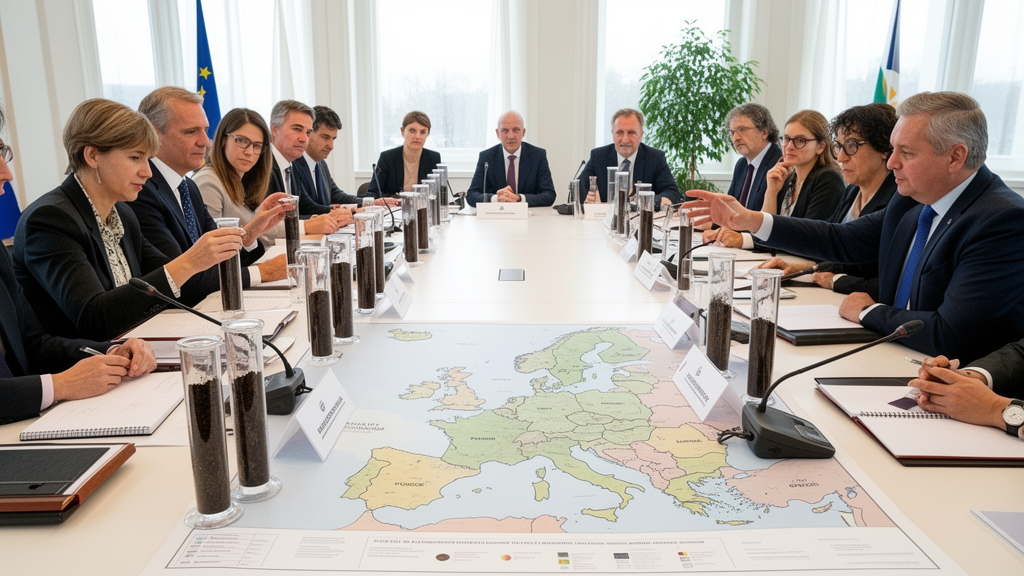
A European research consortium has launched a 42-month programme designed to make soil science more accessible to policymakers and to strengthen the structures through which scientific evidence can inform soil policy. The Horizon Europe-funded PSOILICY project brings together 15 partners from 10 European countries and will assess science–policy interfaces in more than 20 EU countries. Its planned activities include supporting national Soil Health Hubs, testing collaborative approaches in four countries, creating a knowledge-exchange network and developing digital tools for finding and using soil information.
Coordinated by France’s INRAE with almost €6 million in funding, the project is intended to support evidence-based implementation of the EU Soil Monitoring Law. The initiative formally began with a kick-off meeting held from 7 to 9 October 2026 at the Université de Lorraine campus in Vandœuvre-lès-Nancy, France. Representatives of the European Commission’s Directorate-General for Environment and Directorate-General for Agriculture and Rural Development attended alongside the French Ministry for the Environment and the project’s 15 partners.
The opening included a roundtable on policy and the European Commission’s Mission Soil. Over the following two days, partners started the project’s work packages, mapped the connections among its research strands, held the first General Assembly and agreed a roadmap for the first eight months. The meeting therefore marked both the formal start of the consortium and the beginning of its coordinated work, rather than the completion of a research programme.
PSOILICY addresses a problem of access and coordination rather than a shortage of scientific knowledge. Europe has extensive research on soil health, soil functioning and the ecosystem services provided by soils, but that knowledge is not always readily accessible, tailored to policymakers’ needs or available at the appropriate time for decisions. The places where soil research meets policymaking are also fragmented.
Responsibilities are distributed across multiple levels of government, while agriculture, forestry, urban planning and environmental work often proceed separately. One project objective is to assess existing interfaces in more than 20 EU countries, identify their strengths, gaps and needs, and share practices that may be useful in other national settings. Christophe Schwartz, professor of urban soil science at Université de Lorraine and president of the INRAE Grand Est research centre, said the project seeks to create the conditions for easier and more timely access to policy-relevant soil science.
He described the intended relationship between research and government as a two-way dialogue. Preserving or restoring healthy soils requires interfaces in which policymakers can access scientific knowledge and scientific actors can receive information arising from policy implementation, rather than relying exclusively on the movement of findings from laboratories to government offices. The consortium’s approach is therefore intended to connect national experience and emerging research with European-level decisions, while also supporting communication of European priorities back to member states.
National Soil Health Hubs form a central part of the proposed structure. PSOILICY will support the creation of new hubs, strengthen existing national groups and connect the resulting bodies through an EU-wide network. Luis Sanchez Alvarez, head of sector in the Research and Innovation unit of the Directorate-General for Agriculture and Rural Development, said the hubs could transmit information from Mission Soil to member states and help support implementation of the Soil Monitoring Law, the Common Agricultural Policy and other soil-related policies.
He also said that many existing national soil groups currently lack official recognition, sufficient resources and political support. These statements identify gaps in the present national arrangements that the proposed hubs are intended to address; the kick-off announcement does not yet provide evidence about how the new structures will perform. The project will also establish multi-stakeholder Soil Health Policy Labs, with initial tests planned in Austria, Denmark, France and Italy.
These labs are designed to bring policymakers, scientists and practitioners into a shared setting where they can co-design and test approaches to soil policy. Their role within the project is collaborative experimentation, with the specific approaches to be tested expected to emerge through participation by the different groups. The consortium will separately co-design a Knowledge Exchange Network, described as a self-sustaining community for continuous dialogue, exchange and collaborative problem-solving on soil health.
During the kick-off meeting, partners considered lessons from existing science–policy mechanisms, including the EU Science Service for Biodiversity, as they prepared the new network and the other planned components of PSOILICY. PSOILICY will also develop an AI-enabled Policy Guidance Platform intended to make soil knowledge, data and policy documents easier for users to find and apply. This is a planned digital tool, not a completed system, and the announcement reports no tests of its accuracy, usefulness or effects on policy decisions.
A related objective is to explore options for a future European Science Service for Soil Health, including the identification, testing and refinement of a possible central entry point through which policymakers could request scientific support. Together, the platform and prospective service are intended to make scattered scientific resources more accessible and to connect them with the practical needs of soil decision-makers. Their performance and contribution to policy implementation remain questions for the project’s later evaluation.
The planned work is divided into three phases across the 42-month schedule. During the first eight months, the consortium will build a common foundation by assessing science–policy interfaces, mapping needs and developing the main structures for national hubs, policy labs and knowledge exchange. Prototyping of the key results will then continue until month 23.
In the final phase, the partners will consolidate and deliver those results by the end of the project. The roadmap for the first eight months was agreed at the October meeting, while subsequent prototyping, consolidation and delivery remain planned activities. A further objective is to support the European Commission, member states and relevant stakeholders in translating the Soil Monitoring Law into concrete, evidence-based action by maintaining connections among scientific evidence, policy instruments and implementation across the project.
The project is funded through the European Union’s Horizon Europe programme under grant agreement 101296560 and is part of the Mission “A Soil Deal for Europe.” Its stated contribution is to bring scientific knowledge, digital resources and governance structures into closer alignment with the EU goal of having 75% of soils healthy or improving by 2030. That objective is separate from the project’s 42-month timetable, and the launch announcement does not demonstrate progress toward the 2030 target. Instead, PSOILICY has begun a programme whose immediate outputs include an assessment of science–policy interfaces, support for new or reinforced national hubs, initial policy-lab tests and early digital prototypes.
Whether these mechanisms will ultimately make knowledge more accessible or support more effective implementation remains to be evaluated during the project.
Subject of Research: A European project designed to connect soil science, national policy hubs and digital tools with EU soil policy.
Article Title: PSOILICY kicks off: 15 European partners join forces to bridge the gap between soil science and policy
Article References: PSOILICY kicks off: 15 European partners join forces to bridge the gap between soil science and policy. Original publication (Bibliographic details unavailable.)
Image Credits: AI Generated
DOI: Not provided
Keywords: soil health, science-policy interfaces, EU Soil Monitoring Law, national soil hubs, soil policy labs, knowledge exchange, AI guidance platform, Horizon Europe, Mission Soil, PSOILICY, kicks, European
Cite Scienmag News
Sadie Cross. (October 20, 2026). PSOILICY links soil science with European policymaking across 15 partners. Scienmag. https://scienmag.com/psoilicy-links-soil-science-with-european-policymaking-across-15-partners/
Sadie Cross. "PSOILICY links soil science with European policymaking across 15 partners." Scienmag, 20 October 2026, https://scienmag.com/psoilicy-links-soil-science-with-european-policymaking-across-15-partners/. Accessed 20 October 2026.
Sadie Cross. "PSOILICY links soil science with European policymaking across 15 partners." Scienmag. October 20, 2026. https://scienmag.com/psoilicy-links-soil-science-with-european-policymaking-across-15-partners/


