


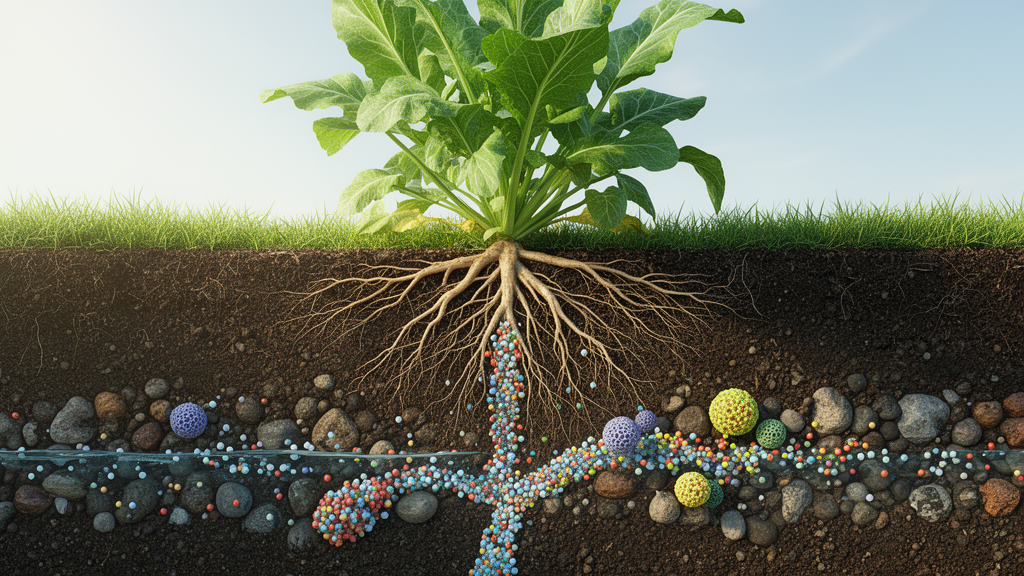
A collection of studies published in Frontiers in Soil Science shows that pharmaceuticals, microplastics, and herbicides behave differently as they pass through interconnected water–soil–plant systems. Treated wastewater can introduce pharmaceutical residues into agricultural soil, where some compounds or their transformation products may be taken up by crops. Other work found that irrigation volume and beneficial microbial inoculation affected residues in durum wheat, while a separate incubation study showed that atrazine concentration influenced microbial community responses and the estimated persistence of the herbicide. The editorial describes a research topic rather than a single clinical or field trial, and the evidence covers a review, crop experiments, a tomato–durum wheat rotation study under Mediterranean conditions, and a long soil incubation.
Emerging contaminants are a heterogeneous group of chemical substances that were historically excluded from, or only partly included in, routine monitoring and regulatory frameworks. Advances in analytical methods have made it possible to detect many of these substances at low concentrations in environmental matrices, helping researchers investigate their occurrence, environmental fate, and potential effects. The category includes pharmaceutically active compounds, personal care products, disinfection by-products, persistent organic pollutants, heavy metals, and microplastics. Their shared status does not imply that they behave alike: differences in chemical properties and interactions with soil, water, microorganisms, and plants can produce very different pathways and patterns of accumulation.
Wastewater treatment plant effluents are among the main reported sources of emerging contaminants, alongside agricultural and urban runoff, landfill leachate, and improper disposal. Such compounds are widely reported in groundwater, surface water, and wastewater, allowing aquatic systems to serve as transport pathways into other environmental compartments. In agricultural settings, irrigation with contaminated or treated wastewater may deliver residues directly to soil. Once present, those residues may persist, form transformation products, interact with microbial communities, or become available for plant uptake. The research assembled under the topic therefore treats the water–soil–plant pathway as a connected system, but the individual contributions address distinct contaminant classes and processes rather than demonstrating one uniform movement pattern.
A review by Rustagi and colleagues examined the sources, environmental pathways, and ecotoxicological implications of microplastics in agroecosystems. Its soil–microplastic–microorganism–plant framework links the presence and behavior of plastic particles with soil functioning, microbial processes, plant uptake, crop productivity, and food safety. The authors also identified substantial gaps in the evidence: long-term field studies remain limited, detection methods need greater standardization, and microplastic behavior under realistic environmental conditions is still insufficiently understood. Because those gaps constrain what can be inferred about long-term persistence and agricultural risk, the review identifies questions that laboratory observations alone cannot fully resolve. It does not establish that every combination of microplastic, soil organism, and crop produces the same response.
Tortorici and colleagues investigated how irrigation regimes and beneficial microbial inoculation affected pharmaceutical fate and uptake in durum wheat irrigated with treated wastewater. At the end of the experiment, carbamazepine and clarithromycin were the only parent pharmaceutical compounds detected in soil, together with transformation products mainly associated with carbamazepine. Carbamazepine was the only pharmaceutical detected in plant tissues. All pharmaceuticals measured in grain were below their respective limits of quantification, indicating negligible transfer to the edible fraction under the conditions tested. Lower irrigation volumes reduced contaminant inputs to soil, while microbial inoculation reduced residues, including some transformation products. These observations come from one experimental setup and do not establish that the same reduction will occur in every soil, crop, or production system.
A separate study by Denora and colleagues assessed pharmaceutical fate and uptake in a tomato–durum wheat rotation under Mediterranean conditions in southern Italy. The research compared freshwater irrigation with treated wastewater containing pharmaceutical concentrations represented as an average of one times and three times European wastewater levels. Fluconazole and carbamazepine showed the greatest uptake, with accumulation detected in plant tissues and grain, particularly under the higher exposure level. By contrast, the fate of several other pharmaceutical compounds was less clearly defined, which the authors linked to differences in soil degradation processes and crop-specific behavior. The supplied evidence describes a rotation study conducted under Mediterranean conditions but does not establish that it was a field experiment. Together with the durum wheat study, the findings indicate that pharmaceutical transfer can vary with contaminant load, irrigation management, soil processes, and crop characteristics.
Elgaber and colleagues examined concentration-dependent effects of atrazine on culturable soil microbial communities and its biodegradation in semi-arid soil during a long incubation. Atrazine significantly altered microbial populations, with responses varying according to contaminant concentration and exposure time. Initial inhibition of bacterial and fungal groups was followed by recovery of some populations and enrichment of atrazine-tolerant taxa, particularly Mycobacterium species. That pattern was consistent with microbial adaptation during prolonged herbicide exposure, although it did not mean that every group had recovered or that the community was unaffected overall. Atrazine degradation increased over time but slowed at higher concentrations, with estimated half-lives reaching as long as 125 days. The study links herbicide concentration with both microbial dynamics and contaminant persistence in the tested soil.
Across the topic, the authors call for integrated mitigation rather than reliance on a single intervention. The proposed framework combines upstream removal technologies at wastewater treatment plants with downstream agronomic practices intended to limit contaminant persistence, bioavailability, and transfer within agroecosystems. Beneficial microorganisms and carefully selected irrigation regimes were among the measures supported by the reported studies. Other proposed possibilities include alternating contaminated and conventional irrigation water, restricting contaminated water to early stages of annual crop cycles, or using it for non-food or perennial crops. Increasing soil organic matter or applying organic amendments may also reduce contaminant bioavailability and plant uptake. These are proposed management directions rather than demonstrated outcomes across all of the studies, and their long-term effectiveness still requires field evaluation.
The strongest conclusion from the collection is that emerging contaminants require compound-specific monitoring and coordinated management of the connected water–soil–plant pathway. The durum wheat experiment found pharmaceuticals below their quantification limits in grain even though carbamazepine was detected in plant tissues, whereas fluconazole and carbamazepine accumulated in tissues and grain in the tomato–durum wheat rotation study. Microplastics, atrazine, and pharmaceuticals also displayed distinct patterns requiring different analytical and ecological approaches. Priorities for future work include long-term field studies, standardized detection methods, realistic exposure conditions, and assessment of complete mitigation strategies. Until those data are available, the evidence supports continued monitoring and risk assessment without establishing universal rates of movement, uniform risks across crops and soils, or proven field-scale control of emerging contaminants.
Subject of Research: Environmental fate, plant uptake, and microbial effects of emerging contaminants in water–soil–plant agroecosystems
Article Title: Editorial: Emerging contaminants in water-soil-plant systems
Article References: De Mastro, F., Farrag, K., Mininni, A., & Brunetti, G. (2026). Editorial: Emerging contaminants in water-soil-plant systems. Frontiers in Soil Science, 6, Article 2021027. https://doi.org/10.3389/fsoil.2026.2021027
Image Credits: AI Generated
DOI: 10.3389/fsoil.2026.2021027
Keywords: emerging contaminants, water–soil–plant systems, treated wastewater, pharmaceutical residues, microplastics, atrazine biodegradation, plant uptake, soil microbiology, agroecosystems, irrigation management, Editorial, Emerging
Cite Scienmag News
Morgan Morrow. (October 20, 2026). Research topic links contaminant pathways to crop uptake and soil microbial effects. Scienmag. https://scienmag.com/research-topic-links-contaminant-pathways-to-crop-uptake-and-soil-microbial-effects/
Morgan Morrow. "Research topic links contaminant pathways to crop uptake and soil microbial effects." Scienmag, 20 October 2026, https://scienmag.com/research-topic-links-contaminant-pathways-to-crop-uptake-and-soil-microbial-effects/. Accessed 20 October 2026.
Morgan Morrow. "Research topic links contaminant pathways to crop uptake and soil microbial effects." Scienmag. October 20, 2026. https://scienmag.com/research-topic-links-contaminant-pathways-to-crop-uptake-and-soil-microbial-effects/


