

Tuesday, October 20, 2026
Science
No Result
View All Result
  • Login
  • HOME
  • SCIENCE NEWS
  • CONTACT US
  • HOME
  • SCIENCE NEWS
  • CONTACT US
No Result
View All Result
Scienmag
No Result
View All Result
Home Science News Science Education

Blended telehealth course raises health students’ confidence and acceptance

October 20, 2026
in Science Education
Courtney Benton
By Courtney Benton Scienmag Editorial Profile - Science and Technology Policy
Reading Time: 2 mins read
0
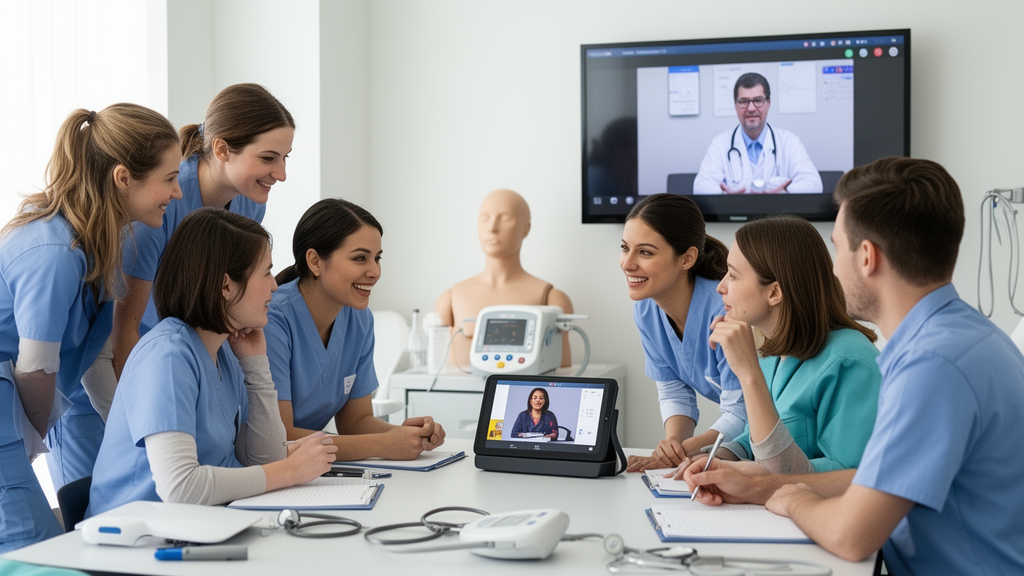
Blended telehealth course raises health students’ confidence and acceptance

Blended telehealth course raises health students’ confidence and acceptance

65
SHARES
587
VIEWS
Share on FacebookShare on Twitter
ADVERTISEMENT

A seven-module blended telehealth course was associated with modest improvements in technology confidence, broader gains in telehealth acceptance and stronger intentions to use remote consultations among multidisciplinary health professions students. In the large pre-post evaluation, 267 students completed the initial assessment and 111 completed the follow-up, a retention rate of 41.2%. Among those assessed twice, mean technology confidence rose from 14.9 to 16.3 points, while the total score on a technology-acceptance model increased from 14.1 to 18.5 points.

The study evaluated a course combining self-paced online modules with a live telehealth simulation workshop. All seven modules were embedded in the university’s learning management system, allowing the course to mix independent study with simulated remote encounters. Participants came from four health professions: physiotherapy represented 61.4% of the pre-assessment cohort, audiology 19.1%, speech pathology 16.1% and nursing 3.4%. Women accounted for 73.5% of the initial group, and 94.0% of participants were aged 29 or younger.

Researchers measured technology self-efficacy with a 22-item scale adapted from the Technology Proficiency Self-Assessment Questionnaire for 21st Century Learning. In the group completing both assessments, mean technology confidence increased from 14.9, with a standard deviation of 4.4, to 16.3, with a standard deviation of 4.0; the change was statistically significant at p less than 0.001. The investigators also used subscales of the Unified Theory of Acceptance and Use of Technology model, or UTAUT2, to assess telehealth acceptance. Its total score increased from 14.1, with a standard deviation of 7.0, to 18.5, with a standard deviation of 7.2, with p equal to 0.007. Scores improved on all nine UTAUT2 dimensions by at least p less than 0.05.

Intentions to use telehealth also shifted after the course. The proportion of follow-up participants reporting that they intended to conduct live synchronous consultations frequently or always rose from 36.4% to 54.1%, with p less than 0.01. For asynchronous client monitoring, the corresponding proportion increased from 63.2% to 76.2%, also with p less than 0.01. These findings concern students’ reported intentions, not observed clinical behavior, and the pre-post evaluation does not establish whether graduates will retain the changes or use telehealth similarly in professional practice.

The principal limitation is the substantial loss of participants between assessments: only 111 of the 267 students who completed the pre-assessment supplied post-course data. Students who returned may have differed from those who did not, affecting how broadly the results represent the original cohort. The measured score increases support the authors’ conclusion that the brief blended curriculum can improve foundational telehealth self-efficacy, acceptance and intended future use among the students studied. The research does not, however, demonstrate long-term retention, improved patient care or clinical benefits after graduation.

Subject of Research: Pre-post evaluation of a blended telehealth course for multidisciplinary health professions students

Article Title: Evaluating telehealth self-efficacy and acceptance in multi-disciplinary health professions students: a large-scale pre-post evaluation

Article References: Merolli, M., & Mariño, R. (2026). Evaluating telehealth self-efficacy and acceptance in multi-disciplinary health professions students: a large-scale pre-post evaluation. BMC Medical Education. https://doi.org/10.1186/s12909-026-10310-x

Image Credits: AI Generated

DOI: 10.1186/s12909-026-10310-x

Keywords: telehealth, health professions education, technology self-efficacy, technology acceptance, UTAUT2, simulation training, digital health education, remote consultations, asynchronous monitoring, Evaluating, self-efficacy, acceptance

Cite Scienmag News

Courtney Benton. (October 20, 2026). Blended telehealth course raises health students’ confidence and acceptance. Scienmag. https://scienmag.com/blended-telehealth-course-raises-health-students-confidence-and-acceptance/

Courtney Benton. "Blended telehealth course raises health students’ confidence and acceptance." Scienmag, 20 October 2026, https://scienmag.com/blended-telehealth-course-raises-health-students-confidence-and-acceptance/. Accessed 20 October 2026.

Courtney Benton. "Blended telehealth course raises health students’ confidence and acceptance." Scienmag. October 20, 2026. https://scienmag.com/blended-telehealth-course-raises-health-students-confidence-and-acceptance/


Tags: acceptanceasynchronous monitoringblended learning in health professionsdigital health educationEvaluatinghealth professions educationhealthcare students' technology confidenceimpact of telehealth training on student attitudesmultidisciplinary health professions educationonline learning modules in healthcareremote consultation trainingremote consultationsself-efficacySimulation trainingTechnology Acceptancetechnology self-efficacytechnology self-efficacy in health educationtelehealthtelehealth acceptance among studentstelehealth curriculum evaluationtelehealth educationtelehealth simulation workshopsUTAUT2virtual clinical skills development
Share26Tweet16
Previous Post

PCP, not bacterial co-infection, linked to pulmonary cryptococcosis mortality

Next Post

Research report: Molecular representation of benzene and phenol secondary organic aerosols

Related Posts

Flexible Screen-Time Limits Link to Stronger Teen Digital Skills
Science Education

Flexible Screen-Time Limits Link to Stronger Teen Digital Skills

October 20, 2026
Justin Lui Receives 2026 CHEST Network Rising Star Award
Science Education

Justin Lui Receives 2026 CHEST Network Rising Star Award

October 20, 2026
Qualitative study finds gaps in trauma-informed perinatal care
Science Education

Qualitative study finds gaps in trauma-informed perinatal care

October 20, 2026
EPA ratings reveal self-assessment differences among Chinese cardiology residents
Science Education

EPA ratings reveal self-assessment differences among Chinese cardiology residents

October 20, 2026
Principal reports flag serious student absenteeism in 43% of Moroccan schools
Science Education

Principal reports flag serious student absenteeism in 43% of Moroccan schools

October 20, 2026
Research report: Gender-transformative action as a strategy for health system strengthening: a framework for advancing equity, accountability, and resilience
Science Education

Research report: Gender-transformative action as a strategy for health system strengthening: a framework for advancing equity, accountability, and resilience

October 20, 2026
Next Post
Research report: Molecular representation of benzene and phenol secondary organic aerosols

Research report: Molecular representation of benzene and phenol secondary organic aerosols

  • Mothers who receive childcare support from maternal grandparents show more optimized

    Mothers who receive childcare support from maternal grandparents show more parental warmth, finds NTU Singapore study

    27656 shares
    Share 11059 Tweet 6912
  • University of Seville Breaks 120-Year-Old Mystery, Revises a Key Einstein Concept

    1061 shares
    Share 424 Tweet 265
  • Bee body mass, pathogens and local climate influence heat tolerance

    682 shares
    Share 273 Tweet 171
  • Researchers record first-ever images and data of a shark experiencing a boat strike

    546 shares
    Share 218 Tweet 137
  • Groundbreaking Clinical Trial Reveals Lubiprostone Enhances Kidney Function

    531 shares
    Share 212 Tweet 133
Science

Embark on a thrilling journey of discovery with Scienmag.com—your ultimate source for cutting-edge breakthroughs. Immerse yourself in a world where curiosity knows no limits and tomorrow’s possibilities become today’s reality!

RECENT NEWS

  • Whey protein-cellulose nanofiber emulsion improves capsaicin bioaccessibility in laboratory study
  • Fish study links aged PLA microplastics to blood-cell changes
  • Research report: Molecular representation of benzene and phenol secondary organic aerosols
  • Blended telehealth course raises health students’ confidence and acceptance

Categories

  • Agriculture
  • Anthropology
  • Archaeology
  • Athmospheric
  • Biology
  • Biotechnology
  • Blog
  • Bussines
  • Cancer
  • Chemistry
  • Climate
  • Earth Science
  • Editorial Policy
  • Marine
  • Mathematics
  • Medicine
  • Pediatry
  • Policy
  • Psychology & Psychiatry
  • Science Education
  • Science News
  • Social Science
  • Space
  • Technology and Engineering

Subscribe to Blog via Email

Enter your email address to subscribe to this blog and receive notifications of new posts by email.

Join 5,150 other subscribers

© 2025 Scienmag - Science Magazine

Welcome Back!

Login to your account below

Forgotten Password?

Retrieve your password

Please enter your username or email address to reset your password.

Log In
No Result
View All Result
  • HOME
  • SCIENCE NEWS
  • CONTACT US

© 2025 Scienmag - Science Magazine

Discover more from Science

Subscribe now to keep reading and get access to the full archive.

Continue reading