


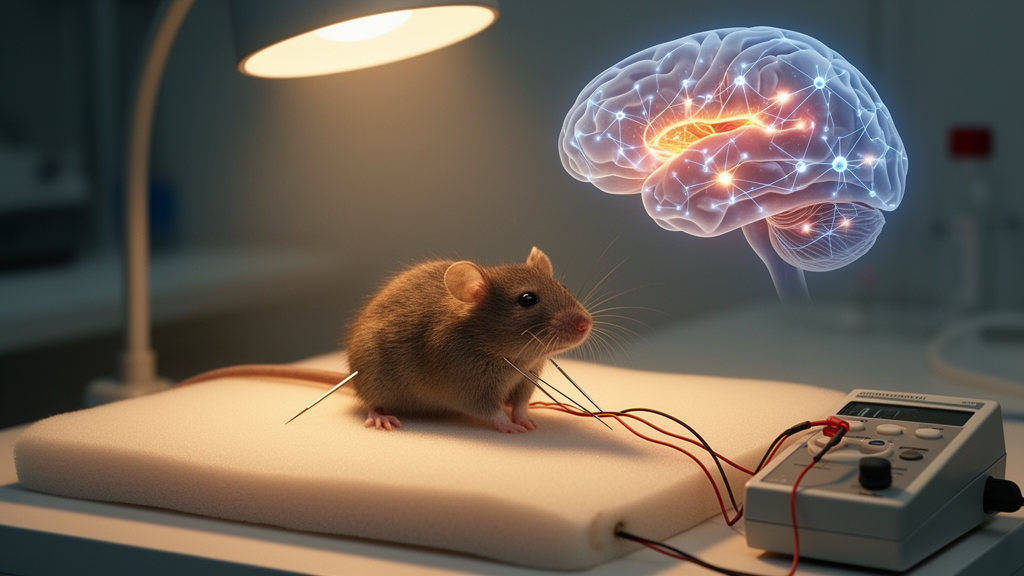
Electroacupuncture delivered at the Taichong acupoint lowered blood pressure and reduced behavioral inhibition in male mice with high-salt-induced hypertension, according to a new study. The treatment was also associated with lower firing activity in two hypothalamic autonomic pathways and partial restoration of mitochondrial proteins in the paraventricular nucleus, or PVN. The findings provide preclinical evidence for a central mechanism that may explain the treatment response, but the experiments do not establish that adenine nucleotide translocator 1, or ANT1, causes the effects or that the same response will occur in people.
Researchers used 48 male C57BL/6J mice to create a model of salt-associated hypertension. After a one-week acclimatization period, animals received 2% sodium chloride as their only drinking water for four weeks. Blood pressure was measured noninvasively with a tail-cuff system based on volume-pressure recording. Mice entered the hypertensive model when systolic blood pressure reached at least 140 mmHg or diastolic blood pressure reached at least 80 mmHg. Hypertensive mice were then randomly assigned either to remain untreated or to receive electroacupuncture at the bilateral Taichong, or LR3, acupoint on the foot. Stimulation was applied once daily for three weeks at 2 Hz, an intensity of 1 mA and for 15 minutes per session. All groups underwent repeated isoflurane anesthesia, while only the electroacupuncture group received electrical stimulation, helping separate the acupuncture intervention from effects associated with repeated anesthesia.
Salt exposure produced a progressive rise in blood pressure. Systolic pressure in the model group increased to approximately 136.55 ± 2.76 mmHg in week 3 and 142.32 ± 2.88 mmHg in week 4, significantly higher than in controls, while diastolic pressure also diverged from the control group. Heart rate remained within the normal physiological range in both groups, and high-salt intake did not promote a significant increase in body weight. The behavioral effect was more selective than the cardiovascular response. Model mice traveled less and spent more time immobile in an open field, but did not show statistically significant changes in the elevated plus maze, forced swim test or novel object recognition test. The model therefore primarily produced psychomotor inhibition rather than clear evidence of broad anxiety-like, despair-like or short-term memory deficits. In a separate validation experiment, captopril reduced blood pressure compared with the untreated model group, supporting the model’s responsiveness to antihypertensive intervention.
Three weeks of electroacupuncture reversed the upward trajectory of blood pressure in the treated animals. By the final week, systolic pressure in the electroacupuncture group averaged 137.07 ± 4.89 mmHg, significantly below the untreated model group, although it remained different from the control group. Diastolic pressure showed the same general pattern, while heart rate remained comparable across groups. The intervention also reduced time spent immobile in the open field to a level similar to that of controls. Total distance traveled moved in the same favorable direction but did not reach statistical significance. These outcomes support an effect on the observable behavioral inhibition produced by the model, rather than a correction of every behavioral domain that can accompany hypertension.
To investigate how electroacupuncture might act on the brain, the researchers combined retrograde tracing with whole-cell patch-clamp recordings of PVN neurons. PVN neurons were labeled after tracer injections into the rostral ventrolateral medulla, called the RVLM, or the nucleus tractus solitarius, called the NTS. The PVN integrates autonomic and neuroendocrine signals, while the RVLM and NTS are involved in cardiovascular regulation. High-salt hypertension increased the firing frequency of both PVN-to-RVLM and PVN-to-NTS projection neurons when the same currents were injected. Electroacupuncture brought firing in both populations back toward control levels. Resting membrane potential, membrane resistance, membrane capacitance, action-potential threshold, amplitude, afterhyperpolarization and waveform slopes did not differ significantly among the groups. The principal electrophysiological finding was therefore a change in the number of action potentials generated, rather than a broad alteration in passive membrane properties or single-spike shape.
The results support the interpretation that electroacupuncture modulates intrinsic excitability within PVN autonomic circuits, but they do not directly measure sympathetic or parasympathetic output. The increased excitability of PVN-to-RVLM neurons is consistent with the established role of that pathway in sympathetic drive, and the PVN-to-NTS pathway is anatomically connected with cardiovascular regulation. However, the study did not record sympathetic nerve activity, vagal activity, heart-rate variability or baroreflex sensitivity in vivo. The altered NTS-projecting neurons likewise cannot be interpreted as a direct measurement of parasympathetic activity. The recordings establish that firing frequency changed in the two identified projection populations; they do not show that selective manipulation of either pathway would cause the fall in blood pressure.
Tandem mass tag quantitative proteomics provided a molecular view of the PVN. Compared with controls, hypertensive mice had reduced levels of proteins associated with mitochondrial oxidative phosphorylation, ATP production, ATP and ADP transport, and transmembrane transport, including Cox7b, Vdac1, Uqcrb, Uqcrc2, Atp5pb, Ndufa4, Atp5f1b, Cox4i1, Slc25a5 and Atp5f1a. Proteins linked to inflammation, stress and neural injury were increased, among them S100b, Mif, Ppp3r1, Cfl1, Ncdn, Gda and Ptgds. Electroacupuncture did not erase every molecular difference, but it selectively reversed parts of the disease-associated pattern: 10 proteins reduced in the model group rose after treatment, while 6 elevated proteins declined. Mitochondrial proteins involved in the electron transport chain, ATP synthesis and nucleotide transport were restored, whereas several inflammation- and stress-associated signals were reduced. Gene Ontology analysis placed the altered proteins mainly in proton, ATP and ADP, and nucleotide transport, ATP synthesis, intracellular pH regulation and energy metabolism. These are associations within the experimental model and do not by themselves demonstrate improved mitochondrial function in vivo.
One candidate protein, ANT1, also known as SLC25A4, received particular attention. ANT1 is located in the inner mitochondrial membrane and mediates exchange of ATP and ADP between the mitochondrial matrix and cytosol, making it relevant to cellular energy balance. Its abundance was reduced in the PVN of hypertensive mice and increased after electroacupuncture, approaching the control level. Western blotting independently confirmed the proteomic pattern. Immunofluorescence showed predominantly cytoplasmic and perinuclear ANT1 staining, with weaker signal after high-salt exposure and partial recovery after treatment. ANT1 signal was detected in subsets of cells marked by the astrocyte marker GFAP and the microglial marker IBA1, while the overall distribution appeared concentrated in neuronal-enriched PVN regions. The proportion of GFAP-positive, ANT1-positive cells increased after electroacupuncture, whereas the corresponding IBA1-positive proportion did not differ significantly among groups. Because NeuN staining was not reliable enough for quantitative assessment in some PVN neurons, particularly magnocellular neurons, the study could not definitively determine which cell type was the principal source of ANT1.
Several limitations constrain how far the results can be generalized. The experiment included only young adult male mice, and continuous access to 2% sodium chloride for four weeks represents an early, severe model of salt-induced hypertension rather than the full course of chronic human disease. High salt can independently affect renal sodium handling, vascular function, inflammatory signaling and neural activity, so the observed molecular and electrical changes cannot be assigned exclusively to elevated blood pressure. The study also used a specific acupoint, stimulation regimen and treatment duration. Most importantly, it demonstrated associations rather than causality: ANT1 was not experimentally manipulated, and no loss- or gain-of-function test established that it was necessary for the electrophysiological or cardiovascular response. The data identify ANT1-associated mitochondrial remodeling as a potential correlate for further testing, not a proven mediator. The results do not establish clinical efficacy, provide clinical recommendations or show that electroacupuncture would produce the same effects in patients with hypertension.
Subject of Research: Preclinical mouse study of electroacupuncture effects on salt-induced hypertension, PVN neuronal excitability and mitochondrial proteomic changes
Article Title: Electroacupuncture attenuates high-salt-induced hypertension by modulating neuronal excitability and proteomic signatures in the paraventricular nucleus of mice
Article References: Qiu, G., Fan, M., Li, K., Wang, B., & Zhang, M. (2026). Electroacupuncture attenuates high-salt-induced hypertension by modulating neuronal excitability and proteomic signatures in the paraventricular nucleus of mice. Frontiers in Medicine, 13, Article 1955943. https://doi.org/10.3389/fmed.2026.1955943
Image Credits: AI Generated
DOI: 10.3389/fmed.2026.1955943
Keywords: electroacupuncture, high-salt hypertension, male mice, paraventricular nucleus, neuronal excitability, autonomic circuits, mitochondrial proteins, ANT1, proteomics, Taichong acupoint, attenuates, high-salt-induced
Cite Scienmag News
Ophelia Keating. (October 20, 2026). Electroacupuncture lowers salt-induced hypertension in mice and alters PVN excitability. Scienmag. https://scienmag.com/electroacupuncture-lowers-salt-induced-hypertension-in-mice-and-alters-pvn-excitability/
Ophelia Keating. "Electroacupuncture lowers salt-induced hypertension in mice and alters PVN excitability." Scienmag, 20 October 2026, https://scienmag.com/electroacupuncture-lowers-salt-induced-hypertension-in-mice-and-alters-pvn-excitability/. Accessed 20 October 2026.
Ophelia Keating. "Electroacupuncture lowers salt-induced hypertension in mice and alters PVN excitability." Scienmag. October 20, 2026. https://scienmag.com/electroacupuncture-lowers-salt-induced-hypertension-in-mice-and-alters-pvn-excitability/


