


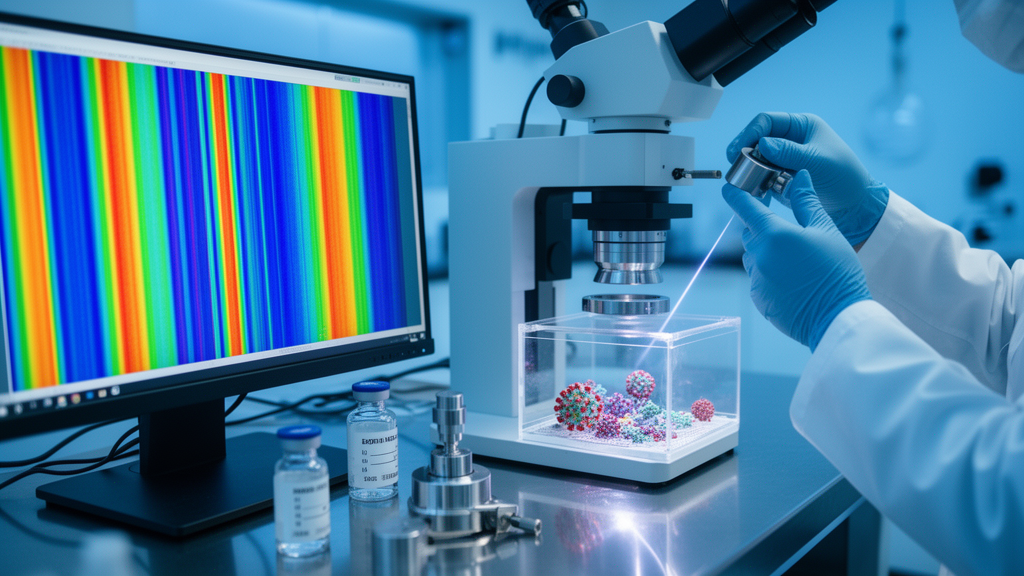
A laboratory study led by Giuseppe Pezzotti at Kansai Medical University has shown that Raman spectroscopy can distinguish 20 SARS-CoV-2 strains and subvariants by detecting structural characteristics of their RNA rather than directly determining the viruses’ complete nucleotide sequences. The researchers converted characteristic patterns of molecular vibrations into what they call “Raman barcodes,” which separated every strain and subvariant in the tested collection. The experimental findings were published online in Advanced Science on September 30, 2026, and establish an initial foundation for a proposed “Raman genome” approach to molecular identification.
The study addresses the fact that viral RNA contains information beyond the order and abundance of its four nucleotide bases. RNA molecules fold into complex three-dimensional structures through interactions between neighboring nucleotides and complementary bases. These secondary structures can include hairpins, stems and paired regions, and they can differ among viruses even when their overall nucleotide composition appears remarkably similar. Raman spectroscopy detects characteristic molecular vibrations when a sample interacts with light. In the experiment, the resulting signals reflected contributions from the RNA backbone, ribose rings, phosphate linkages and nitrogenous bases, allowing the investigators to characterize patterns associated with RNA organization rather than reading the sequence letter by letter.
For the experiment, the team extracted RNA nucleotide strands from 20 SARS-CoV-2 strains. The panel comprised the original Japanese isolate, seven named non-Omicron variants—Alpha, Beta, Gamma, Delta, Lambda, Theta and Mu—and 12 Omicron subvariants. The researchers systematically acquired the Raman spectra of these samples and mathematically deconvoluted them to identify their individual molecular components. All samples shared characteristic signals associated with common RNA chemistry, including the backbone, ribofuranose rings, phosphate groups and nitrogenous bases. At the same time, subtle but reproducible differences emerged among the strains and subvariants.
Those differences were then encoded as Raman barcodes, defined in the study as characteristic patterns of Raman signals that capture distinctive molecular features of viral RNA. The approach was intended to preserve structural information that might not be apparent from a simple comparison of nucleotide composition. In the authors’ conception, a “Raman genome” represents an RNA genome through its molecular architecture and spectral fingerprint rather than through a direct reading of its nucleotide sequence. This is a conceptual extension of genome characterization: the barcode captures molecular features associated with RNA folding and conformation, including the physical contributions of the sugar-phosphate framework, ribose and the bases.
A central finding was that the observed spectral distinctions could not be explained only by variation in the relative abundance of the four RNA bases. When the genome sequences were used to assess those proportions, the investigated strains had highly similar base fractions. Their Raman spectra nevertheless exhibited markedly different molecular signatures. This separation between sequence-based composition and measured spectra indicates that the Raman measurement was sensitive to information beyond base abundance. The authors investigated the molecular origins of the differences by relating particular Raman bands to features of RNA secondary structure, including backbone conformation, nucleotide-chain characteristics, ribofuranose dynamics, hairpin formation, stem length and base-pairing environments.
The resulting barcodes discriminated all 20 strains and subvariants examined, including multiple Omicron subvariants. Conventional principal component analysis, by comparison, provided only limited separation among the same material. The distinction between these two analyses is important to the reported result: the successful classification was based on explicitly encoded Raman spectral features, rather than on the limited discrimination produced by the conventional PCA approach. The finding also shows why the spectral differences matter. They were not merely an incidental effect of broad base composition; instead, selected bands could be associated with interpretable structural features of the RNA strands and used to distinguish the tested panel.
Technical interpretation of the spectra depends partly on changes in Raman signal intensity caused by molecular interactions. Hyperchromic and hypochromic responses involving nitrogenous bases provide clues about pairing environments and RNA secondary structure. Bands associated with ribose vibrations, phosphate linkages and RNA backbone conformation also contribute to the encoded barcode. These physically interpretable features connect the classification result to molecular architecture rather than leaving it as an unexplained statistical separation. The work therefore combines two aspects of the proposed method: a Raman fingerprint capable of differentiating samples and an analysis linking parts of that fingerprint to secondary-structure characteristics such as stem formation, hairpins and the environments in which bases are paired.
The researchers present the result as a first step toward a broader strategy for characterizing viral RNA through spectroscopy. They propose that future development could combine physically interpretable Raman markers with automated spectral analysis, theoretical calculations and artificial intelligence. Such systems could potentially provide a rapid layer of molecular information alongside sequencing, particularly during outbreaks, epidemics and emergency or critical-care situations where timely characterization may be important. The release does not report the implementation of such a clinical system. The reported evidence concerns an experimental comparison of RNA strands from a defined set of 20 strains and subvariants, not prospective surveillance or routine diagnostic validation.
Several limitations follow directly from that experimental scope. The panel was limited to 20 SARS-CoV-2 strains and subvariants, so the result demonstrates discrimination within the tested collection rather than universal performance across the full diversity of SARS-CoV-2 or other viruses. The researchers used RNA nucleotide strands extracted from the strains, meaning the measurements were performed downstream of sample preparation and did not by themselves demonstrate direct identification in unprocessed patient material. The news release also does not report prospective clinical comparisons, blinded diagnostic performance, turnaround time, cost, sensitivity, specificity or reproducibility across laboratories. It likewise does not describe testing under changing sample conditions or a clinical workflow for detecting newly emerging variants.
Even with these qualifications, the experiments offer a technically distinct route for viral science. Conventional sequencing determines the order of nucleotides, whereas the proposed Raman method captures a molecular fingerprint associated with RNA structure and conformation. By successfully discriminating 20 strains and subvariants whose evaluated base fractions were highly similar, the study shows that structural variation supplied information that was not captured by simple composition estimates alone. The authors do not claim that Raman analysis will replace RNA sequencing. Instead, they describe it as a complementary approach that may eventually support faster variant screening and broaden molecular surveillance. The work was financially supported by a Japan Society for the Promotion of Science grant, and the authors declared no conflicts of interest.
Subject of Research: Experimental Raman spectroscopy of SARS-CoV-2 RNA secondary structure for distinguishing variants and subvariants
Article Title: “Raman Genome” for SARS-CoV-2: new Raman technology distinguishes viral variants by their molecular RNA architecture
Article References: “Raman Genome” for SARS-CoV-2: new Raman technology distinguishes viral variants by their molecular RNA architecture. Original publication (Bibliographic details unavailable.)
Image Credits: AI Generated
DOI: Not provided
Keywords: SARS-CoV-2, Raman spectroscopy, Raman barcodes, RNA structure, viral variants, Omicron subvariants, molecular diagnostics, viral surveillance, secondary structure, Advanced Science, Raman, Genome
Cite Scienmag News
Kristina Jarvis. (October 20, 2026). Raman barcodes distinguish 20 SARS-CoV-2 variants in laboratory study. Scienmag. https://scienmag.com/raman-barcodes-distinguish-20-sars-cov-2-variants-in-laboratory-study/
Kristina Jarvis. "Raman barcodes distinguish 20 SARS-CoV-2 variants in laboratory study." Scienmag, 20 October 2026, https://scienmag.com/raman-barcodes-distinguish-20-sars-cov-2-variants-in-laboratory-study/. Accessed 20 October 2026.
Kristina Jarvis. "Raman barcodes distinguish 20 SARS-CoV-2 variants in laboratory study." Scienmag. October 20, 2026. https://scienmag.com/raman-barcodes-distinguish-20-sars-cov-2-variants-in-laboratory-study/


