


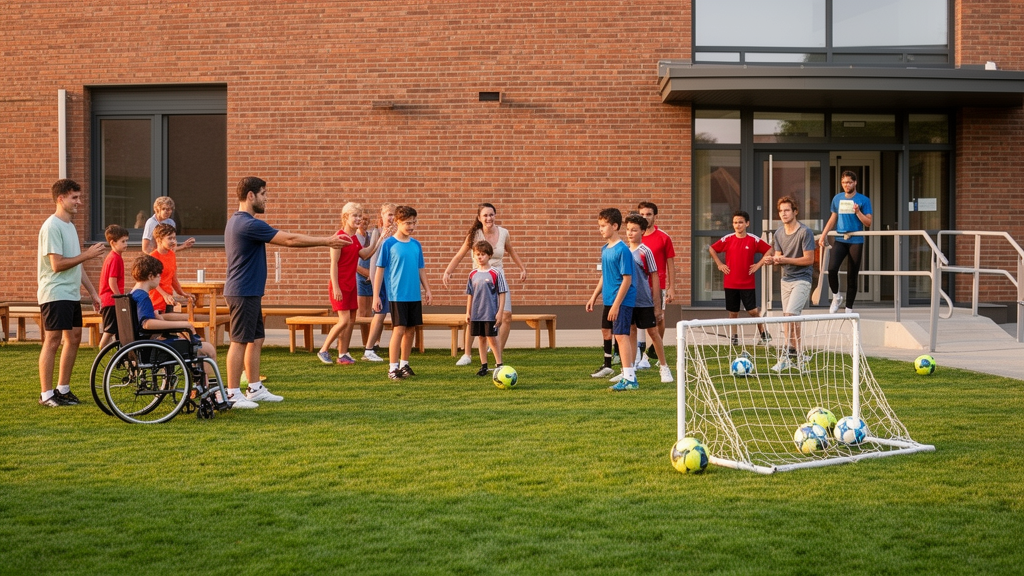
In a cross-sectional survey of 1,298 Hungarian children and adolescents with disabilities, liking sport, knowing that integrated sports clubs exist, and awareness of relevant local opportunities were associated with how young people answered a question about joining an integrated club. The responses divided almost evenly between “yes” and “no,” with 23.6% choosing “not interested.” The findings identify patterns in stated openness rather than causes of inclusion or evidence that any young person subsequently joined a club.
Participants were aged 8 to 18, with a mean age of 13.97 years, and 55.7% were boys. Most, 69.4%, attended segregated special-education institutions, while 30.6% attended mainstream or integrative institutions. Physical or motor impairment was the most common diagnosis, accounting for 52.4% of the sample, followed by multiple disabilities, visual impairment, intellectual disability, autism spectrum disorder, speech impairment, learning disability and hearing impairment. Recruitment through the National Federation of Disabled Students’ Sports, schools and community organisations provided broad access but was not based on a population sampling frame.
Researchers asked whether respondents would like to take part in a sports club where people with and without disabilities exercised together. They retained all three original response categories rather than combining “no” and “not interested” into a binary outcome. Because no separate questions established whether respondents had considered the offer, understood it in the same way or refused after active deliberation, the labels remain nominal. In particular, “not interested” cannot be interpreted as passive disengagement from sport, a distinction challenged by the finding that this group had the highest rate of participation outside physical education.
The survey also assessed seven domains in which disability might limit daily life: mobility, making friends, everyday tasks, leisure, learning, sport and social integration. These items had good internal consistency, with a Cronbach’s alpha of 0.851, and their correlations were moderate and consistently positive. A latent profile analysis divided respondents into low-, moderate- and high-limitation groups, representing 39.3%, 29.2% and 31.5% of classified cases. The groups differed mainly in overall severity rather than in the pattern of affected domains, indicating a gradient rather than distinct functional types.
A categorical latent class model provided a sensitivity check by treating the five-point limitation items as ordinal rather than Gaussian variables. It again produced an ordered low-to-high structure, assigning 87.6% of respondents to the same ordered category as the Gaussian analysis, with an adjusted Rand index of 0.689. Average posterior classification probabilities in the Gaussian model were high: 0.953 for the low-limitation group, 0.902 for the moderate group and 0.938 for the high group. Even so, three classes were selected for parsimony and interpretability rather than as a uniquely optimal statistical solution.
The main multinomial logistic regression modelled “yes” and “not interested” separately against “no.” Its explanatory power was modest, with McFadden’s R-squared of 0.088, meaning that most differences among the three responses remained unexplained. Liking sport was the strongest individual correlate: compared with young people who disliked sport, those who liked it had nearly three times the relative odds of saying “yes” rather than “no” and more than four times the odds of selecting “not interested” rather than “no.” These figures are not causal effects, however, and liking sport is conceptually close to willingness to enter a sport setting.
Awareness of provision was also associated with the responses. Knowing that integrated sport existed was linked to both “yes” and “not interested” rather than “no,” while knowing a relevant club showed the same general pattern. The relationship with perceived local availability was unexpectedly non-monotonic. Compared with respondents who did not know what was available locally, those who believed no integrated option existed had 2.73 times the relative odds of saying “yes” and 2.81 times the odds of saying “not interested.” Respondents who said an option did exist were more likely to choose “not interested” than “no.” The cross-sectional data cannot determine whether local provision changes interest or whether perceptions of availability are shaped by other factors.
Impairment type contributed to the model mainly in the contrast between “not interested” and “no.” Relative to young people with physical or motor impairments, those with learning disabilities, autism spectrum disorder, multiple disabilities or intellectual disabilities had higher relative odds of selecting “not interested.” Estimates for the smallest groups were imprecise: hearing impairment included only nine participants and learning disability 30, producing wide confidence intervals. Continuous activity-limitation severity showed a weaker association with “not interested” than with “no,” but it did not significantly improve the full model, and adding the three limitation profiles also failed to produce a statistically significant overall gain.
Stated openness did not match actual sporting behaviour in a straightforward way. Overall, 59.4% of respondents took part in sport outside compulsory physical education, with similar proportions in the low-, moderate- and high-limitation groups. Among the three openness categories, 48.5% of those saying “no,” 61.5% of those saying “yes” and 73.9% of those saying “not interested” reported sport outside physical education. Among active respondents, however, participation frequency did not differ significantly across the categories. The results therefore show that a young person’s willingness to join an integrated club cannot be inferred from whether that person plays sport elsewhere.
The study’s practical message is exploratory rather than a tested prescription. Its results make visibility and signposting plausible subjects for future intervention research, especially because awareness of integrated sport and relevant clubs was associated with responses other than “no.” They also motivate evaluation of opportunities designed around enjoyment, competence, predictable structure and adaptation for young people with different support needs. None of those measures has yet been shown by this survey to cause greater openness. The authors emphasise that shared physical presence is not the same as inclusion, and that openness is not participation. Longitudinal and experimental research using validated measures will be needed to determine whether changes in awareness, access and the design of provision actually affect inclusion and sustained involvement.
Subject of Research: Correlates of stated openness to integrated sport among Hungarian youth with disabilities
Article Title: What is associated with openness to integrated sport among school-aged youth with disabilities? A cross-sectional study from Hungary
Article References: Müller, A., Lengyel, A., Mező, K., Bácsné Bába, É., Czimbalmos, N. L., Židek, P., & Mező, F. (2026). What is associated with openness to integrated sport among school-aged youth with disabilities? A cross-sectional study from Hungary. Frontiers in Sports and Active Living, 8, Article 1922255. https://doi.org/10.3389/fspor.2026.1922255
Image Credits: AI Generated
DOI: 10.3389/fspor.2026.1922255
Keywords: integrated sport, youth with disabilities, Hungary, sport participation, disability inclusion, latent profile analysis, multinomial regression, survey research, physical activity, associated, openness, integrated
Cite Scienmag News
Courtney Benton. (October 20, 2026). Hungarian survey links sport interest and awareness to integrated-club openness. Scienmag. https://scienmag.com/hungarian-survey-links-sport-interest-and-awareness-to-integrated-club-openness/
Courtney Benton. "Hungarian survey links sport interest and awareness to integrated-club openness." Scienmag, 20 October 2026, https://scienmag.com/hungarian-survey-links-sport-interest-and-awareness-to-integrated-club-openness/. Accessed 20 October 2026.
Courtney Benton. "Hungarian survey links sport interest and awareness to integrated-club openness." Scienmag. October 20, 2026. https://scienmag.com/hungarian-survey-links-sport-interest-and-awareness-to-integrated-club-openness/


