


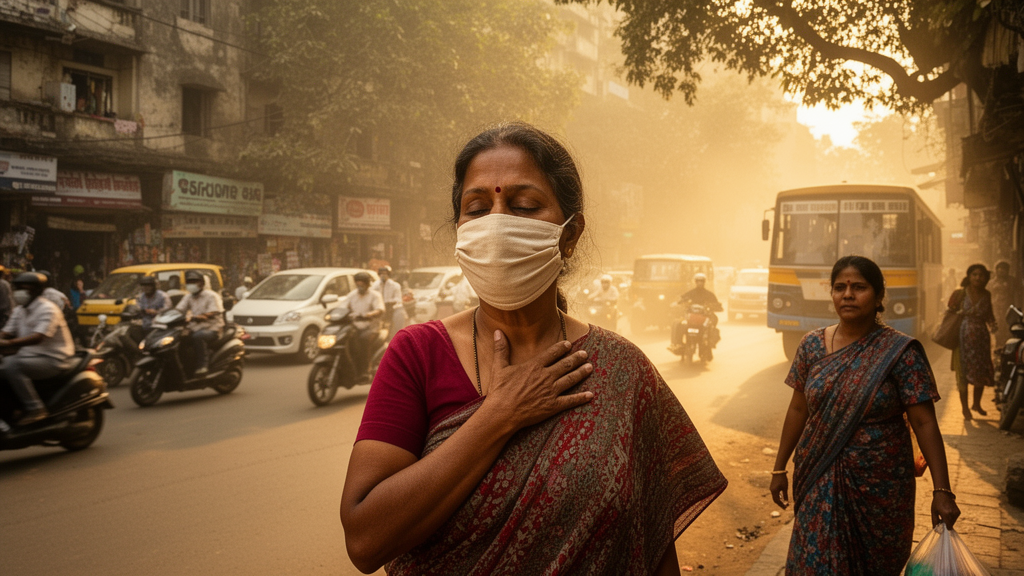
An observational analysis of 153,980 women across urban India found that morbidity was more prevalent in areas with higher temperatures, heavier rainfall and greater fine-particle pollution, while residence above 200 metres was associated with lower odds of illness. The study also identified associations between morbidity and household indoor air pollution, age, overweight status, tobacco use, alcohol consumption and wealth group. These are statistical relationships in survey and environmental data, not evidence that the measured factors caused illness.
Researchers combined urban cluster-level data from the fifth National Family Health Survey, or NFHS-5, with gridded climatic and environmental indicators from NASA. The analysis assessed the prevalence, geographic clustering and correlates of morbidity among urban women. Chi-square tests and logistic regression were used to examine associations, while Moran’s I, cluster-outlier analysis and bivariate local indicators of spatial association, including biLISA, evaluated geographic patterns. The resulting odds ratios describe the likelihood of morbidity after adjustment for variables included in the study’s model; the supplied abstract does not specify the full adjustment set or provide the clinical composition of the morbidity outcome.
Temperature showed a statistically significant association with morbidity in the multivariable model. Women living in areas where temperatures exceeded 25 °C had 11.9% higher adjusted odds of morbidity than women in comparison areas. The reported adjusted odds ratio was 1.119, with a confidence interval of 1.057–1.185. By contrast, residence at altitudes above 200 metres was associated with 20.6% lower adjusted odds, represented by an adjusted odds ratio of 0.794 and a reported confidence interval of 0.765–0.824. These estimates come from an observational analysis and should not be interpreted as demonstrating direct effects of altitude or temperature on individual health.
Rainfall was also significantly associated with morbidity. Urban areas receiving more than 150 millimetres of rainfall had 8.8% higher adjusted odds of morbidity than comparison areas, with an adjusted odds ratio of 1.088 and a reported confidence interval of 1.045–1.132. The strongest environmental association involved ambient PM2.5: women living where concentrations exceeded 40 µg/m³ had 24.3% higher adjusted odds of morbidity. That estimate had an adjusted odds ratio of 1.243 and a reported confidence interval of 1.185–1.305. Household indoor air pollution, designated HIAP in the study, was associated with 9.3% higher adjusted odds, with an adjusted odds ratio of 1.093 and a reported confidence interval of 1.026–1.164.
Spatial analysis placed morbidity hotspots in northern, eastern, central and southern India. The biLISA results showed positive local spatial association between morbidity and rainfall, temperature, PM2.5 and household indoor air pollution, indicating that locations with relatively high values of a given indicator tended to occur near other locations with relatively high morbidity. The demographic and behavioural analysis also found higher odds among women aged 40–49 years, women with overweight, tobacco users, alcohol consumers and women from higher wealth groups. Together, the findings present a broad national view of environmental and social correlates of morbidity, with cluster-level exposure measures and observational associations limiting direct interpretation for individual risk.
Subject of Research: Environmental and sociodemographic correlates of morbidity among urban women in India
Article Title: Linkages between climatic, environmental, sociodemographic and behavioural factors with morbidity among women in urban India
Article References: Sarkar, S., & Dolui, M. (2026). Linkages between climatic, environmental, sociodemographic and behavioural factors with morbidity among women in urban India. Discover Sustainability. https://doi.org/10.1007/s43621-026-04817-y
Image Credits: AI Generated
DOI: 10.1007/s43621-026-04817-y
Keywords: urban women’s health, morbidity, air pollution, PM2.5, household air pollution, temperature, rainfall, spatial analysis, NFHS-5, India, Linkages, between
Cite Scienmag News
Violet Maxwell. (October 20, 2026). Observational study links urban Indian women’s morbidity to heat and pollution. Scienmag. https://scienmag.com/observational-study-links-urban-indian-womens-morbidity-to-heat-and-pollution/
Violet Maxwell. "Observational study links urban Indian women’s morbidity to heat and pollution." Scienmag, 20 October 2026, https://scienmag.com/observational-study-links-urban-indian-womens-morbidity-to-heat-and-pollution/. Accessed 20 October 2026.
Violet Maxwell. "Observational study links urban Indian women’s morbidity to heat and pollution." Scienmag. October 20, 2026. https://scienmag.com/observational-study-links-urban-indian-womens-morbidity-to-heat-and-pollution/


