


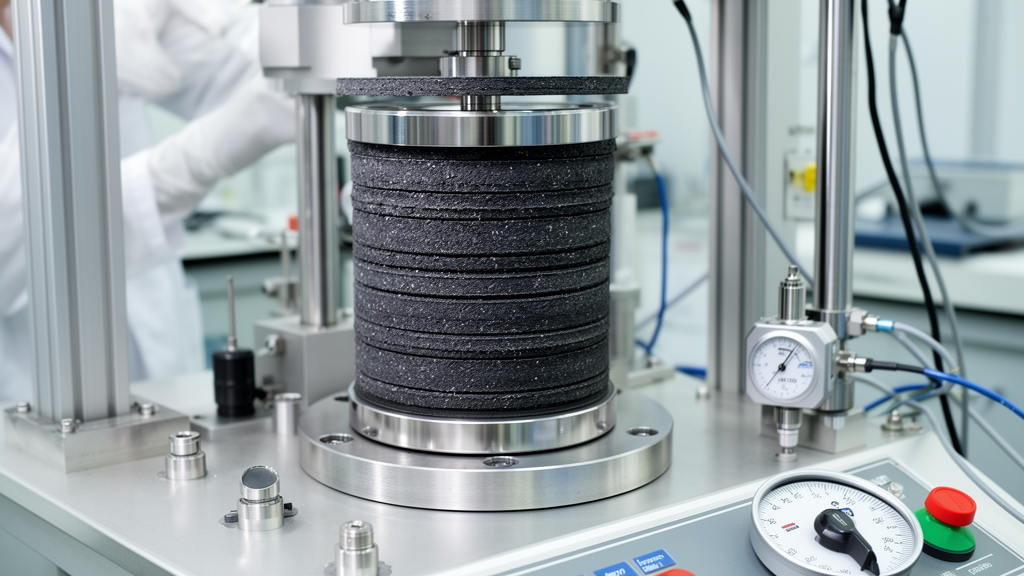
A recycled-rubber composite damper retained load-transfer continuity after embedded steel bars fractured and, in quasi-static laboratory comparisons, developed greater cyclic resistance and energy dissipation than corresponding steel-bar dampers. Among the three composite specimens tested, the device with a 100 mm core dissipated a maximum of 1,241.04 kN·mm in one cycle and 8,978.66 kN·mm cumulatively, the highest measured totals among the composites. These findings concern component-level cyclic performance, not earthquake loading or full structural systems, and the study did not examine environmental aging or long-term durability.
The proposed design combines the strength and plastic energy dissipation of steel with the flexibility and shear damping of rubber. Steel bars were welded between rigid upper and lower plates to form the principal load-bearing framework, while compounded recycled rubber filled the spaces around them. Before assembly, steel surfaces were treated with Chemlok 205 primer and Chemlok 220 rubber-to-metal adhesive.
Rubber sheets and the steel framework were then placed in a mould and joined by hot-compression vulcanization at 128–130 °C for 2–2.5 hours under pressure. The resulting continuous rubber core was intended to coordinate deformation among the bars and preserve a load path after local steel fracture, unlike a conventional steel bar damper whose response can be abruptly interrupted by fracture. The experimental matrix contained nine specimens: three steel bar dampers, designated BD; three rubber-only dampers, designated RD; and three recycled rubber–steel bar composites, designated RBD.
Each steel and composite specimen contained eight bars, each 10 mm in diameter, arranged in a 2 × 4 layout. The rubber and composite cores had a projected area of 26,250 mm², and the connection plates measured 200 × 250 mm and were 10 mm thick. Core heights of 75, 100 and 125 mm allowed configuration type and height to be evaluated separately.
The selected rubber contained 20% devulcanized rubber from truck-tread powder and 80% Standard Malaysian Rubber Constant Viscosity 60. Material tests gave it a tensile strength of 21.5 MPa, elongation at break of 530%, compressive modulus of 6.0 MPa at 20% strain and damping ratio of 6.31%. Each specimen underwent 13 displacement-controlled loading steps with three complete cycles at each step, allowing as many as 39 cycles.
Displacement amplitude increased from 2 to 50 mm, and loading rates ranged from 0.25 to 0.80 mm/s. Testing stopped when severe visible damage occurred or the maximum resisting force in the current cycle fell below 85% of the peak resisting force. The vertical arrangement generated cyclic shear deformation in each energy-dissipation core.
Because the loading path kept the distance between the connection plates essentially constant, geometric elongation of the steel bars could produce secondary axial tension at large displacements, although axial force was not independently applied or measured. All three configurations were tested with the same installation and boundary conditions. Damage observations showed a pronounced change in failure evolution.
Steel-only specimens fractured after pronounced bending of their bars: BD8–75 failed on cycle 19 at about 14 mm displacement, while the 100 and 125 mm versions failed on cycles 28 and 31 at amplitudes of 27.5 and 35 mm. The longer core increased the effective bending length and delayed fracture. Rubber-only specimens completed all 39 cycles and reached 50 mm, although they developed varying degrees of interface debonding and edge warping without through-thickness tearing of the rubber core.
The composites combined bar yielding and fracture with rubber shear deformation and interfacial debonding. Their continuous rubber core continued to connect the upper and lower plates after local bar fracture, limiting the sudden load degradation seen in the steel-only devices. The largest benefit occurred in the shortest composite core.
RBD8–75 reached its major failure on cycle 25 at approximately 22.5 mm, compared with cycle 19 and 14 mm for BD8–75. Its peak load was 33.12 kN, 35.2% above the steel specimen’s 24.49 kN. Peak loads for the 100 and 125 mm composites were respectively 30.5% and 43.0% higher than those of their steel-only counterparts.
After local steel damage, the taller composites retained residual load capacity and overall connectivity, and no through-thickness tearing occurred in their rubber cores. Numerical results showed that the height of the composite core reduced bar curvature and end plastic-strain concentration; at peak load, maximum equivalent plastic strains in the 100 and 125 mm models were 12.5% and 15.8% lower than in the 75 mm model. Stiffness declined as cyclic deformation accumulated, but the steel framework continued to support the composite after the bars began yielding.
Across displacement amplitudes of approximately 2–50 mm, effective stiffness decreased by about 62–64% for the rubber-only dampers and 73.3–82.6% for the steel dampers. Increasing the height from 75 to 125 mm reduced the rubber-only device’s maximum load by 40.2% while leaving its maximum displacement near 50 mm. For the steel damper, the same change reduced maximum load by 41.8% but increased maximum displacement by about 150%, from 14.01 to 35.02 mm.
The results expose a design trade-off: a taller steel core accommodates more distortion but generally develops less peak force because the bars bend over a longer length. Energy measurements showed that the composite produced more than a modest increase in resistance. Final cumulative dissipation by RBD8–75 was 217.5% higher than that of BD8–75, while RBD8–100 exceeded its steel counterpart by 29.0%.
At 125 mm, the final cumulative difference was only 0.4%, although the composite dissipated more over most of the displacement range shared by the two specimens. Maximum single-cycle energy dissipation was respectively 104.8%, 21.9% and 2.3% higher for the 75, 100 and 125 mm composites than for their steel counterparts. The rubber therefore made its largest contribution when short bars were especially vulnerable to concentrated deformation.
RBD8–100 provided the best balance among the tested composites, combining a peak load of 25.14 kN with the highest single-cycle and cumulative dissipation values. The researchers also developed a three-dimensional ABAQUS model with geometric nonlinearity, bilinear elastoplastic steel, ductile steel damage and a Neo-Hookean hyperelastic rubber. The model was validated against the three RBD specimens, not all nine experimental specimens.
Numerical-to-experimental peak-force ratios ranged from 0.941 to 1.095. Predicted stiffness degradation differed from the measurements by 0.30–2.10%, and errors for single-cycle energy dissipation ranged from 5.09% to 8.71%. The model was less accurate for the 75 mm composite’s cumulative energy dissipation and residual deformation, with errors of 37.07% and 34.52%, respectively.
It also omitted rubber viscoelasticity, the Mullins effect, rate dependence and progressive rubber damage, limiting its direct representation of dynamic or long-term behaviour. Separate numerical parameter studies indicated that increasing the steel-to-rubber area ratio from 1.53% to 4.69% raised the maximum absolute force at 10 mm displacement by about 249% and average energy dissipation per cycle by about 439%. The equivalent damping ratio increased more modestly, from 11.97% to 18.63%.
Raising steel yield strength from 250 to 500 MPa increased maximum absolute load at 22.5 mm by 42.9%, average single-cycle energy dissipation by 67.0% and equivalent damping ratio by 17.8%. Within the explored ranges, the researchers identified a 3.45% steel-to-rubber area ratio and yield strength near 400 MPa as balanced choices, not universal optimum values. A simplified bilinear backbone model based on the experiments and parametric models linked core height, area ratio and yield strength to initial stiffness, characteristic strength and post-yield stiffness; characteristic-parameter errors for the three experimental composites were below 5.1%, and backbone-curve errors ranged from 3.68% to 5.40%.
The work points toward a way to combine metal yielding with rubber shear deformation while reusing waste tyre rubber, but the evidence remains limited to laboratory-scale quasi-static component tests and numerical models. Repeated experiments over broader parameter ranges, full-scale and structural-subassembly tests, dynamic cyclic loading, realistic earthquake records, and evaluations of temperature, aging, environmental exposure and interface durability are still needed before the performance or practical deployment of the damper can be assessed beyond the studied conditions.
Subject of Research: Component-level cyclic performance of recycled-rubber–steel bar composite dampers
Article Title: Mechanical performance of novel recycled rubber–steel bar composite dampers: Experimental and numerical investigation
Article References: Alhokabi, A. A., Tan, C. G., Zou, C., Ibrahim, Z., Bunnori, N. M., El‑Shafie, A., Nazri, F. M., Ghaedi, K., & Gordan, M. (2026). Mechanical performance of novel recycled rubber–steel bar composite dampers: Experimental and numerical investigation. Case Studies in Construction Materials, 25, Article e06629. https://doi.org/10.1016/j.cscm.2026.e06629
Image Credits: AI Generated
DOI: 10.1016/j.cscm.2026.e06629
Keywords: recycled rubber, steel–rubber composite, cyclic loading, energy dissipation, hysteretic response, damage tolerance, finite element analysis, seismic dampers, waste tyre rubber, structural resilience, Mechanical, performance
Cite Scienmag News
Denise Maddox. (October 20, 2026). Recycled rubber–steel dampers improve cyclic resistance in laboratory tests. Scienmag. https://scienmag.com/recycled-rubber-steel-dampers-improve-cyclic-resistance-in-laboratory-tests/
Denise Maddox. "Recycled rubber–steel dampers improve cyclic resistance in laboratory tests." Scienmag, 20 October 2026, https://scienmag.com/recycled-rubber-steel-dampers-improve-cyclic-resistance-in-laboratory-tests/. Accessed 20 October 2026.
Denise Maddox. "Recycled rubber–steel dampers improve cyclic resistance in laboratory tests." Scienmag. October 20, 2026. https://scienmag.com/recycled-rubber-steel-dampers-improve-cyclic-resistance-in-laboratory-tests/


