


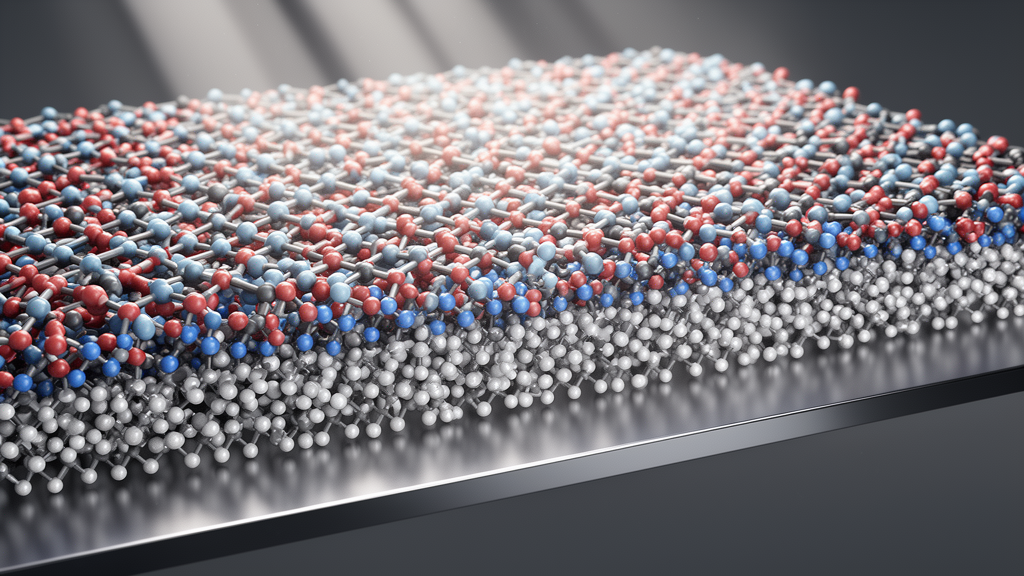
Binary organic solar cells achieved a certified power conversion efficiency of 20.65% and a certified fill factor of 82.7% after researchers used a methanol-assisted, stepwise deposition process to control the orientation of cathode-interlayer molecules. The treated interface produced a stronger surface potential and lower charge-transport resistance in devices based on PDISNN and a PM6:Y6 active layer. Sum-frequency generation vibrational spectroscopy showed that the procedure changed the mean molecular tilt at the interface, supporting the conclusion that directing interlayer assembly can improve charge extraction without replacing the binary donor–acceptor combination.
The work focuses on the electrode-facing coating in an organic photovoltaic device, known as the cathode interlayer. Such layers can create interfacial dipoles and affect the electrical properties of the junction between the photoactive material and the metal electrode. Their performance, however, depends strongly on how their molecules are oriented, and that arrangement has been difficult to control during film deposition. The researchers addressed this problem by exploiting the amphiphilic character of the interlayer compounds and separating the deposition process into stages rather than applying the layer as a single conventional coating.
Under the reported Method III procedure, the researchers first spin-coated methanol onto the active layer before depositing the cathode-interlayer solution. The interlayer materials, dissolved in trifluoroethanol, were then applied at 3,000 revolutions per minute for 30 seconds. The authors described this as a methanol-templated film-deposition strategy that controls molecular packing orientation while overcoming the solubility limitations associated with conventional orthogonal deposition. Two comparison procedures were also tested: direct deposition of the interlayer onto the active layer, known as Method I, and methanol post-treatment after deposition, known as Method II.
Three related perylene diimide cathode-interlayer materials were evaluated: PDINN, PDISNN and PDI2SNN. The best certified result came from a binary device containing the PDISNN interlayer and a PM6:Y6 photoactive layer. For the orientation measurements, the investigators examined a representative device stack consisting of indium tin oxide, a 100-nanometre PM6:Y6 active layer and an approximately 11-nanometre PDI interlayer. Sum-frequency generation measurements on this full stack were intended to characterize the interlayer in a configuration relevant to an operating device rather than only as an isolated film.
Using several polarization combinations, including ssp, ppp and sps, the researchers derived tilt angles for the transition dipoles of the interlayer molecules relative to the substrate. The conventional Method I procedure gave a tilt angle of 31.6 ± 1.9°, while the hexane-pretreated case discussed in the analysis gave 35.8 ± 1.2°. The study concluded that the methanol-templated procedure produced a preferred perpendicular orientation for the ordered PDISNN molecules. Standard error propagation was used to estimate uncertainty from variations in the measured signal intensities, and agreement among the different polarization combinations supported the orientation analysis.
Other characterization methods examined why the altered molecular arrangement affected device operation. Surface-energy calculations based on contact angles with liquids of known dispersive and polar components were used to characterize the films. Ultraviolet photoelectron spectroscopy was applied to determine work-function-related properties, while molecular dynamics simulations and density functional theory were used to investigate molecular interactions, fragment dipoles and adsorption behavior. The results showed that the amphiphilic interlayer molecules interacted with the treated active-layer surface in a way that favored an ordered, more upright molecular arrangement and a stronger interfacial dipole.
According to the researchers’ interpretation of these measurements, orienting PDISNN more perpendicular to the substrate enhanced the surface potential and lowered the work function. They associated these electrostatic changes with a reduced interfacial Schottky barrier and an enhanced built-in electric field. The treated cathode interface also had lower charge-transport resistance. Electrical measurements on interlayer films used a defined electrode width of 11,000 micrometres and spacing of 500 micrometres, with conductivity calculated from current, voltage, electrode geometry and a film thickness of approximately 100 nanometres.
The photovoltaic measurements showed that the electrical and interfacial changes were accompanied by higher performance in devices made with the methanol-assisted deposition sequence than in the corresponding controls. The authors linked the improvement to reduced interfacial charge accumulation, which they identified as a primary source of trap-assisted non-radiative recombination. Suppression of that recombination was associated with a higher open-circuit voltage, while the reduced transport resistance contributed to the stronger fill factor. Devices were tested under simulated AM 1.5 illumination calibrated to 100 milliwatts per square centimetre, and external quantum efficiency was measured with wavelength-by-wavelength calibration against a standard single-crystal silicon cell.
The devices used either an approximately 30-nanometre PEDOT:PSS layer on indium tin oxide or a 2PACz layer deposited from ethanol, followed by the photoactive film, cathode interlayer and thermally evaporated silver electrode. The active layer was spin-coated at 4,000 revolutions per minute and thermally annealed at 100 degrees Celsius for 10 minutes to remove residual chloroform and control morphology. Small-area photovoltaic measurements used a masked aperture of 0.0256 square centimetres, while large-area measurements used 1 square centimetre. These details place the certified result within the study’s reported laboratory device structure rather than implying a commercial module or panel.
The researchers also reported that the stepwise deposition method was applicable to different cathode-interlayer and active-layer combinations, with the tested interlayers producing higher efficiencies than their conventional-processing counterparts. The architecture could be extended to ternary active-layer formulations. The principal certified performance remained the 20.65% efficiency and 82.7% fill factor of the binary PDISNN system, so the broader results should not be read as evidence that every material combination reached the same performance. Encapsulated devices were also prepared for operational-stability testing under continuous white light from a 410-to-850-nanometre LED array, operating at the maximum power point under 100 milliwatts per square centimetre in air near 25 degrees Celsius.
Subject of Research: Control of cathode-interlayer molecular orientation for high-efficiency binary organic solar cells
Article Title: Directed assembly of cathode interlayers enables efficient binary organic solar cells
Article References: Yao, J., Zhang, R., Zhang, M., Wang, T., Jain, N., Liu, Y., Liu, C., Liu, X., Zhang, Z., Meng, S., Song, A., Wang, Q., Chen, Q., Gao, F., Zhang, Z.-G., & Li, Y. (2026). Directed assembly of cathode interlayers enables efficient binary organic solar cells. Nature Energy. https://doi.org/10.1038/s41560-026-02148-w
Image Credits: AI Generated
DOI: 10.1038/s41560-026-02148-w
Keywords: organic solar cells, cathode interlayers, molecular orientation, power conversion efficiency, fill factor, interfacial dipole, PDISNN, PM6:Y6, sum-frequency spectroscopy, charge extraction, Directed, assembly
Cite Scienmag News
Denise Maddox. (October 20, 2026). Directed assembly of cathode interlayers enables efficient binary organic solar cells. Scienmag. https://scienmag.com/directed-assembly-of-cathode-interlayers-enables-efficient-binary-organic-solar-cells/
Denise Maddox. "Directed assembly of cathode interlayers enables efficient binary organic solar cells." Scienmag, 20 October 2026, https://scienmag.com/directed-assembly-of-cathode-interlayers-enables-efficient-binary-organic-solar-cells/. Accessed 20 October 2026.
Denise Maddox. "Directed assembly of cathode interlayers enables efficient binary organic solar cells." Scienmag. October 20, 2026. https://scienmag.com/directed-assembly-of-cathode-interlayers-enables-efficient-binary-organic-solar-cells/


