


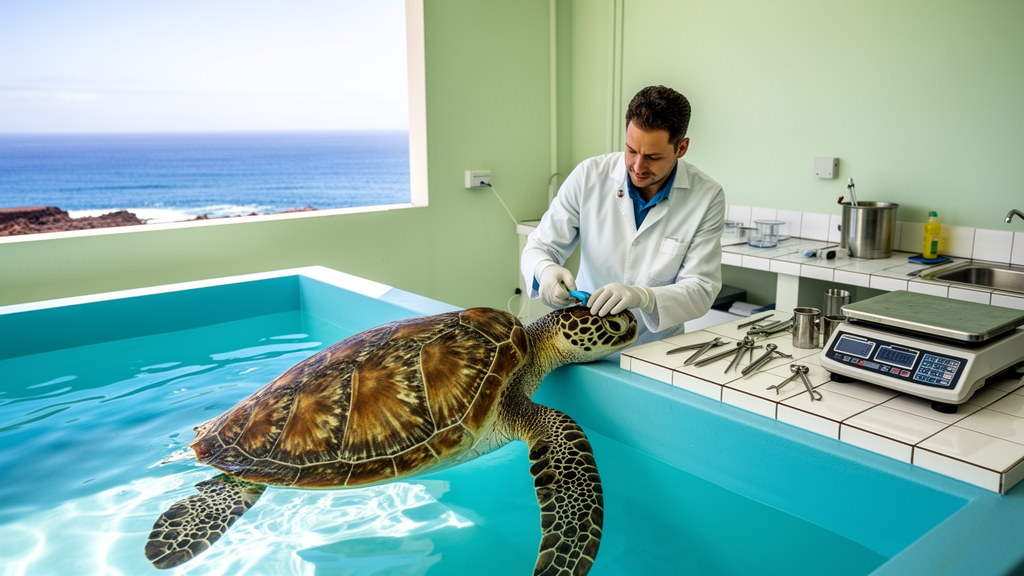
A retrospective analysis of 2,270 sea turtles treated at the La Tahonilla Wildlife Rehabilitation Center on Tenerife, Spain, from April 1982 through December 2025 found that 86% of the 1,813 turtles alive at their first admission were released back into the wild. The study also identified substantial differences in final disposition, rehabilitation duration, post-release readmission and estimated cost depending on why each animal needed care, producing a practical set of benchmarks that could help other centres compare their performance. Loggerhead turtles accounted for 2,216 animals, while 54 were green turtles; most loggerheads with carapace measurements were pelagic juveniles, reflecting the dominance of this life stage among stranded turtles in the Canary Islands.
Entanglement in fishing gear, plastic materials or synthetic raffia was the leading reason for admission, accounting for 42.8% of first admissions. Unknown or undetermined causes ranked second at 21.5%, followed by other causes at 13% and infectious disease at 9.6%. Among 457 turtles that arrived dead, 63.9% had an unknown cause of death and 18.6% were classified as entanglement-related. The researchers attributed part of the large unknown category to decomposition, limited diagnostic resources and major advances in diagnostic tools over the four decades, while noting that retrospective classification could not be independently checked for agreement among clinicians. Infectious disease was recorded only when a pathogenic microorganism was demonstrated through microbiological testing, polymerase chain reaction or histopathological examination, rather than from presumptive clinical diagnoses alone.
The two species differed in the reasons they reached the centre. Loggerheads had significantly greater odds of admission because of entanglement than green turtles, with an odds ratio of 9.7 and a 95% confidence interval of 3.5 to 26.9. Green turtles, represented by a much smaller sample, had greater odds of hook or monofilament ingestion and vessel-collision trauma. The study did not formally compare rehabilitation outcomes between the species because only 34 green turtles were alive at first admission, leaving several cause-specific categories with too few animals for reliable statistical testing. Among loggerheads for which measurements were available, 76.1% were classified as pelagic juveniles, compared with 89.3% of measured green turtles. Straight carapace length was missing for 51.6% of all turtles, however, and body weight and carapace length were available together for only 1,000 animals, limiting life-stage and body-condition analyses.
Initial condition was strongly associated with final disposition. Among all 1,813 turtles alive at first admission, the euthanasia rate was 1.4%, the unassisted mortality rate during hospitalisation was 12.5% and the release rate was 86%. Entanglement cases had a 90.2% release rate and an 8.4% unassisted mortality rate. By contrast, unassisted mortality reached 26.6% for hook or monofilament ingestion, 28.1% for vessel trauma and 24.3% for infectious disease; corresponding release rates were 71.1%, 63.2% and 75.2%. All 42 turtles admitted after crude-oil exposure were released. Cause was significantly associated with both unassisted mortality and release, with moderate effect sizes quantified by Cramér’s V of 0.22 and 0.23, respectively. These cause-specific associations remained largely unchanged in sensitivity analyses that included admission period, although they do not establish that the cause of injury itself produced the different outcomes.
Treatment duration also varied markedly. Among released turtles, median rehabilitation lasted 10 days for crude-oil exposure, 23 days for entanglement, 21 days for hook or monofilament ingestion, 22 days for infectious disease and 37 days for trauma. The 90th percentile for trauma reached 213 days, showing that although many collision cases had relatively short rehabilitation periods, a small group required prolonged hospitalisation. Median time to unassisted death ranged from two days for trauma to 11 days for entanglement. The researchers described these figures as descriptive benchmarks rather than adjusted estimates of the independent effects of age, injury severity or other clinical variables. They also noted that release, unassisted death and euthanasia are mutually exclusive outcomes, meaning conventional survival analysis would not directly estimate their observed cumulative incidence without an approach designed to account for competing outcomes.
Post-release readmission was uncommon, but the finding requires caution because a turtle can be returned to the centre only if its injury is noticed and its identity is recognised. Sixteen of the 1,560 turtles released after their first admission were later readmitted, a proportion of 1.0%, generating 22 readmission events. Buoyancy disorder and infectious disease were the most frequent causes of readmission, each accounting for 27.3% of events, and 63.6% involved a cause different from that of the preceding admission. Two turtles were dead on their first readmission, while all 20 readmission events involving animals admitted alive ended in another release. The interval from release to readmission ranged from zero to 1,425 days, with a median of 24.5 days. The readmission data therefore measure recorded returns to the centre, not post-release survival in the wider population.
The study’s standardised economic analysis estimated rehabilitation costs per turtle of €1,498.4 for crude-oil cases, €1,634.4 for other causes, €1,732.3 for entanglement, €1,905.5 for infectious disease, €1,905.8 for unknown or undetermined causes, €2,128.6 for hook or monofilament ingestion and €2,358.1 for trauma. Fixed costs accounted for €974 per animal, admission-related costs for another €250 and the remainder for feeding, diagnostics and treatment. Feeding was estimated at €1.84 per turtle per day, making differences in hospitalisation length less influential than expected. Diagnostic and therapeutic procedures were the main source of variation between causes, particularly for trauma and hook ingestion. Fixed costs represented 41.3% to 65% of the total depending on the case category, illustrating how admission volume affects cost comparisons. These were estimates based on current centre prices, median stay for each cause and assumed treatment frequencies, not reconstructions of historical expenditure or universal values for other facilities.
Taken together, the findings provide a framework built around three core measures: the rate of euthanasia, the rate of unassisted death during hospitalisation and the rate of release, each calculated for turtles alive on admission and stratified by the primary cause. The analysis adds benchmarks for time to final disposition, post-release readmission and standardised costs. It is among the largest and longest-running evaluations of sea turtle rehabilitation, covering 43 years and eight months, but it remains a single-centre observational study conducted at a multidisciplinary facility that treats many wildlife species. Missing morphometric data, changes in diagnostic capacity over time, sparse green-turtle cases and limited post-release surveillance restrict generalisation. The results offer reference values and a reproducible framework rather than proof that every centre with similar overall release performance delivers equivalent care.
The results also connect rehabilitation data to the visible threats facing sea turtles around Tenerife. Entanglement was both the most common reason for admission and the second most common recorded cause among turtles dead on arrival, while vessel-related trauma accounted for 28.1% of unassisted deaths during hospitalisation among turtles admitted alive. The authors argue that the epidemiological patterns can help managers identify preventable hazards and plan resources, but they emphasize that rehabilitation has additional roles that these clinical and economic indicators cannot capture, including disease surveillance, public education, professional training and scientific research. For conservation policy, the central message is that many stranded turtles recovered at the centre: among those alive at first admission, most were released, and subsequent readmissions were both infrequent and generally successful.
Subject of Research: Long-term retrospective evaluation of sea turtle rehabilitation outcomes, readmissions and costs at a wildlife rehabilitation centre in Tenerife, Spain
Article Title: Benchmark indicators for evaluating sea turtle rehabilitation outcomes at a wildlife rehabilitation center on Tenerife island, Spain (1982–2025)
Article References: Trujillo-Camejo, F., Montesdeoca, N., Capelli, S., Méndez-Corona, C. D., & Orós, J. (2026). Benchmark indicators for evaluating sea turtle rehabilitation outcomes at a wildlife rehabilitation center on Tenerife island, Spain (1982–2025). Frontiers in Veterinary Science, 13, Article 1948954. https://doi.org/10.3389/fvets.2026.1948954
Image Credits: AI Generated
DOI: 10.3389/fvets.2026.1948954
Keywords: sea turtles, wildlife rehabilitation, rehabilitation outcomes, loggerhead turtles, green turtles, entanglement, vessel trauma, post-release readmission, rehabilitation costs, Tenerife, Benchmark, indicators
Cite Scienmag News
Margaret Porter. (October 20, 2026). Tenerife study benchmarks sea turtle rehabilitation outcomes. Scienmag. https://scienmag.com/tenerife-study-benchmarks-sea-turtle-rehabilitation-outcomes/
Margaret Porter. "Tenerife study benchmarks sea turtle rehabilitation outcomes." Scienmag, 20 October 2026, https://scienmag.com/tenerife-study-benchmarks-sea-turtle-rehabilitation-outcomes/. Accessed 20 October 2026.
Margaret Porter. "Tenerife study benchmarks sea turtle rehabilitation outcomes." Scienmag. October 20, 2026. https://scienmag.com/tenerife-study-benchmarks-sea-turtle-rehabilitation-outcomes/


