


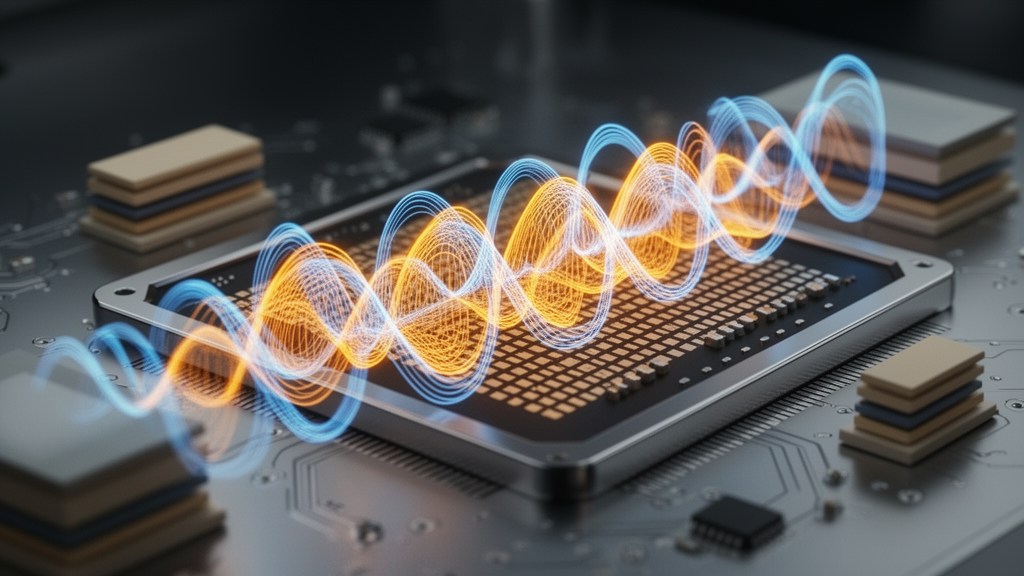
A University of Michigan-led research team is developing a multiferroic device that uses magnetic and sound waves to represent information, with projections that the resulting processors could operate 100 to 1,000 times faster and more energy-efficiently than conventional systems. The project combines a ferroelectric crystal with a magnetic alloy in a device the researchers call M3BOLT. The performance figures are estimates presented by the researchers, rather than measurements from a completed processor, and the technology remains an early-stage research effort.
The work is backed by up to $6 million from the Defense Advanced Research Projects Agency through its Fast and Curious program. University of Michigan Engineering leads the project, with the University of Wisconsin–Madison contributing physics-based computer simulations intended to guide device design. The team describes M3BOLT as a magnetoelectric multiferroic device, bringing together ferroelectric and ferromagnetic behavior in a layered structure.
Its central aim is to move and process information with collective waves rather than relying on the controlled movement of individual electrons, potentially changing the physical limits that constrain conventional electronics. Improvements have historically come from placing chip components closer together and reducing transistor dimensions, allowing electrons to travel shorter distances and requiring lower switching voltages. At scales of only a few nanometers, however, quantum tunneling allows electrons to pass through supposedly closed transistors, producing leakage and wasting energy.
The release cites an expectation that today’s transistors will reach their maximum energy efficiency by 2037, even as artificial intelligence, edge computing and other applications continue to increase demand for processing capacity. Researchers at the University of Michigan say the M3BOLT concept is intended to address that constraint by changing the physics of the device rather than simply making an existing transistor smaller. Roozbeh Tabrizian, an associate professor of electrical and computer engineering who leads the device design, said the goal is not to claim that transistors will be replaced everywhere.
Instead, the project asks what computing speed and efficiency may become possible when an alternative device is no longer constrained by the same operating principles. Mellor Professor of Engineering Wei Lu leads the design of M3BOLT circuits. The device is built around two materials developed in Heron’s laboratory.
Its lower layer is a crystal of lead magnesium niobate-lead titanate, abbreviated PMN-PT using the chemical symbols of its constituent elements. The upper layer is a film of magnetic iron-gallium alloy. PMN-PT is ferroelectric: its charged components have a natural alignment that can reverse when exposed to an electric field, and the reversed alignment remains after the field is removed.
This electrically switchable polarization provides a way to control the magnetic layer above it without requiring a continuous current to hold a particular state. When the PMN-PT polarization changes, its atoms shift, causing magnetic poles in the iron-gallium film to oscillate in a wave-like pattern. That collective magnetic excitation is called a magnon.
Magnons can travel through the magnetic film with very little resistance, meaning that less energy is dissipated as heat than in conventional conductive pathways. Their motion can also occur at terahertz frequencies, far above the gigahertz clock rates of many present-day consumer processors. The researchers estimate that this frequency range could allow data to be processed hundreds of times faster, although that potential remains to be demonstrated in an integrated M3BOLT processor.
The two information states in the proposed device are created by converting magnetic waves into ordinary sound waves. In one state, the poles of the iron-gallium layer continue to oscillate, supporting magnons. Flipping the orientations of those poles stops the magnetic oscillation, leaving sound waves.
The presence or absence of the magnetic state could therefore function as a binary 1 or 0, replacing the two voltage levels used by conventional transistors. The design is not intended as a simple one-for-one replacement for an electronic switch: Tabrizian said new architectures may also be needed to realize additional efficiency improvements beyond the projected gain associated with changing the device physics. Another potential advantage is that the orientation of the magnetic poles is retained when the device is powered down, allowing the iron-gallium layer to serve as nonvolatile memory as well as a processing medium.
Combining memory and computation can reduce the amount of data that must move between separate processor and memory components, an activity that consumes energy and requires physical space. The project therefore targets not only higher switching speed but also a different organization of computing hardware. Lu said the near-term emphasis is on extremely low-power devices, while the broader vision includes more capable autonomous and mobile systems that could perform substantial processing without large power supplies.
The University of Wisconsin–Madison team, led by materials science and engineering associate professor Jiamian Hu, will provide simulations that predict how architectural choices affect performance. These models will also examine the effects of defects within the PMN-PT and iron-gallium materials and at the interface between them. Such analysis is important because the device depends on coupling charge-driven structural changes in a ferroelectric crystal to collective oscillations in a magnetic film.
The work remains an early-stage research program rather than a finished computing technology. Its most striking claims—up to 1,000 times greater efficiency, processing hundreds of times faster than consumer processors and the possibility of using the same material for logic and memory—describe the potential of the design and its modeling, not measured performance from a complete processor. The DARPA funding is intended to support further investigation of that potential, including device construction, circuit design and simulation.
If M3BOLT can preserve its expected switching behavior, low-loss wave propagation and information retention while operating at practical scales, it could offer a route beyond the energy constraints facing increasingly dense transistor-based systems. Until those properties are demonstrated in integrated hardware, the projections remain possibilities rather than established capabilities.
Subject of Research: DARPA-funded multiferroic device research for low-power computing and nonvolatile memory
Article Title: Beyond transistor limits: Hybrid magnetic-sound waves could boost computing speed and efficiency
Article References: Beyond transistor limits: Hybrid magnetic-sound waves could boost computing speed and efficiency. Original publication (Bibliographic details unavailable.)
Image Credits: AI Generated
DOI: Not provided
Keywords: M3BOLT, multiferroics, magnons, ferroelectricity, transistor alternatives, energy-efficient computing, nonvolatile memory, terahertz electronics, DARPA, magnetoelectric devices, Beyond, transistor
Cite Scienmag News
Bethany Barker. (October 20, 2026). Beyond transistor limits: Hybrid magnetic-sound waves could boost computing speed and efficiency. Scienmag. https://scienmag.com/beyond-transistor-limits-hybrid-magnetic-sound-waves-could-boost-computing-speed-and-efficiency/
Bethany Barker. "Beyond transistor limits: Hybrid magnetic-sound waves could boost computing speed and efficiency." Scienmag, 20 October 2026, https://scienmag.com/beyond-transistor-limits-hybrid-magnetic-sound-waves-could-boost-computing-speed-and-efficiency/. Accessed 20 October 2026.
Bethany Barker. "Beyond transistor limits: Hybrid magnetic-sound waves could boost computing speed and efficiency." Scienmag. October 20, 2026. https://scienmag.com/beyond-transistor-limits-hybrid-magnetic-sound-waves-could-boost-computing-speed-and-efficiency/


