


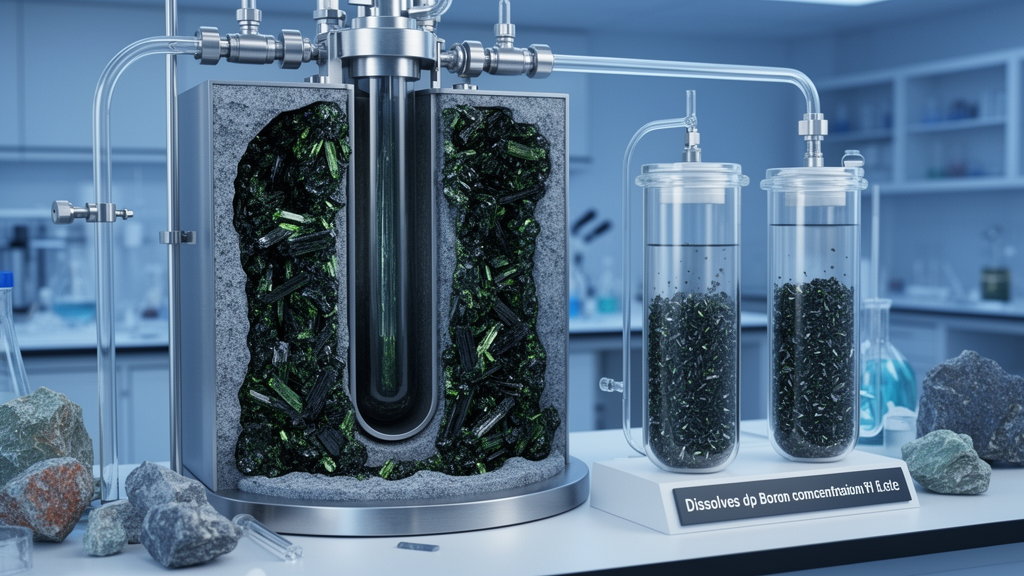
Experiments at 200 MPa show that magnesium-rich tourmaline can begin forming in hydrothermal fluids containing only a few weight percent of boron, with the threshold changing systematically between 400 and 600 °C. Researchers equilibrated mixtures of natural cordierite, albite, quartz and andalusite with water–boron solutions under controlled oxygen fugacity, finding that tourmaline appeared at fluid B₂O₃ concentrations above approximately 3.4 wt % at 600 °C and 2.1 wt % at 500 °C in moderately oxidizing conditions. At 400 °C, the corresponding threshold was above about 2.0 wt %, although smectite replaced cordierite in the reacting assemblage. The results provide an experimental calibration for a mineral reaction that can buffer boron in hydrothermal systems and magmatic–hydrothermal environments.
The research team carried out six experimental runs for 336 to 361 hours at 600 °C, roughly one month at 500 °C and as long as 1,379 hours at 400 °C. Pressure remained fixed at 200 MPa, while the oxygen fugacity ranged from NNO + 0.8 to NNO + 5.3, where NNO denotes the nickel–nickel oxide oxygen buffer. Experiments used either gold or platinum capsules, and duplicate runs indicated no systematic difference between the two materials. Products were identified by X-ray diffraction, scanning electron microscopy and electron microprobe analysis. The investigators did not recover the experimental fluids for chemical analysis, so the equilibrium boron concentrations were constrained from the initial B₂O₃ contents of charges that either developed or lacked tourmaline.
Both forward and reversal approaches were used. Forward experiments began without tourmaline and tested whether it would nucleate as boron content increased. Reversal experiments began with tourmaline and were intended to determine whether the mineral would dissolve in boron-free fluid and regenerate boron-free phases. Instead, quartz, albite and andalusite partly dissolved, but tourmaline remained and cordierite was not produced. The authors therefore could not demonstrate the full reversibility of the tourmalinization reactions. The brackets instead represent minimum and maximum limits on the equilibrium fluid concentration rather than direct measurements of boron after experimental equilibration, an important limitation for applying the results quantitatively.
Three lines of evidence nevertheless suggest that the charges approached equilibrium. Tourmaline appeared systematically once the starting fluid exceeded a concentration threshold, and the distribution of major phases evolved as expected: andalusite and albite disappeared first, cordierite declined next, and tourmaline plus quartz became dominant. The measured tourmalines were also compatible with the proposed reactions, forming solid solutions dominated by magnesio-foitite and dravite, with lesser foitite, schorl and uvite components. At the highest initial boron concentrations, fibrous and radiating tourmaline replaced much of the starting assemblage. The absence of a demonstrable reverse reaction was attributed to tourmaline’s refractory character, which can preserve metastable assemblages over the experimental timescale.
The mineral textures revealed two broad crystallization regimes. Close to the apparent threshold, dissolution of the reactant phases was limited and the fluid was only weakly supersaturated. Tourmaline then grew principally as sheaf-like crystals on albite or cordierite, accompanied by a few coarser grains at 600 °C. At higher initial boron concentrations, strongly supersaturated conditions promoted acicular aggregates composed of radiating fibers. Some fibers occurred within the solid charge, while others formed a thin layer floating at the surface of the fluid. Tourmaline overgrowths on natural seed crystals developed preferentially at one end of the crystals’ long axes. These fine-grained forms dominated in the most boron-rich charges, whereas coarser textures were associated with conditions closer to the inferred equilibrium threshold.
Increasing boron also changed the chemical composition of the experimental tourmaline. At 600 °C, higher initial B₂O₃ concentrations produced crystals closer to the dravite end-member, while lower temperatures yielded more varied sodium and calcium proportions. Most of the tourmalines contained slightly more iron relative to magnesium than the starting cordierite, indicating a modest preference for iron during partitioning between the two minerals. Calcium abundances exceeded those expected from the starting albite alone, consistent with an additional calcium source in apatite inclusions. A large tourmaline aggregate from one 600 °C charge displayed a systematic core-to-rim change from iron- and calcium-rich compositions toward magnesium- and sodium-rich rims, supporting a fractional crystallization process in which the fluid evolved as tourmaline grew.
Temperature affected the stability threshold, but oxygen fugacity did not produce a detectable change in the boron concentration required for tourmaline to appear. At 600 °C, charges progressed from tourmaline-free assemblages to tourmaline plus quartz as boron increased under both moderately and strongly oxidizing conditions. The two oxidation regimes yielded broadly similar phase relations and tourmaline compositions, with minor textural differences. Experiments in platinum and gold capsules also produced compatible results. By contrast, reducing the temperature from 600 to 400 °C lowered the threshold for the appearance of tourmaline and favored a tourmaline-plus-quartz assemblage at progressively lower initial boron contents. At 400 °C, however, cordierite was replaced by smectite, making direct comparison with the modeled cordierite–tourmaline reaction inappropriate at that temperature.
Thermodynamic calculations broadly supported the experimental brackets while emphasizing the importance of mineral composition. Model reactions involving dravite required a higher equilibrium B₂O₃ concentration than those involving alkali-deficient magnesio-foitite, and the schorl-bearing reaction required more boron than the dravite reaction at the same temperature. Calculations for the actual tourmaline solid solutions produced higher values than calculations based only on pure end-members, substantially improving their agreement with the experiments. Nevertheless, the models were preliminary: they used estimated thermodynamic properties for tourmaline, represented the fluid as water and boric acid, and did not include dissolved aluminosilicate components or other borate species. Their broad agreement with the observed thresholds supports the experimental approach, but the authors caution that a more complete activity model is needed for precise predictions.
The results have implications for interpreting natural hydrothermal fluids, whose reported B₂O₃ concentrations can be considerably lower than the experimental thresholds. A compilation of fluid inclusions from ore deposits spans approximately 0.00003 to 2.5 wt % B₂O₃, while examples from Cornwall and Panasqueira generally remain below the new experimental brackets. The authors attribute part of this contrast to lower natural temperatures, which can depress equilibrium boron concentrations, and to dilution, mixing with meteoric water and fluid–rock interaction. The experimental system also omitted mica, even though biotite, muscovite and sericite commonly participate in natural tourmalinization. Furthermore, real fluids contain chloride, potassium, calcium, lithium, hydrogen and other components that may alter tourmaline stability. Experiments with more complex mineral assemblages and saline, acidic or otherwise multicomponent fluids will therefore be needed before the thresholds can be applied directly to specific deposits or mineralizing processes.
Subject of Research: Experimental controls on magnesium-rich tourmaline stability and boron concentration in hydrothermal fluids
Article Title: Experimental constraints on the stability of Mg-rich tourmaline and the boron concentration of hydrothermal fluids
Article References: Fort, J., Sizaret, S., Pichavant, M., Lassin, A., Tuduri, J., & Blein, O. (2026). Experimental constraints on the stability of Mg-rich tourmaline and the boron concentration of hydrothermal fluids. European Journal of Mineralogy, 38(5), 635-654. https://doi.org/10.5194/ejm-38-635-2026
Image Credits: AI Generated
Keywords: tourmaline, hydrothermal fluids, boron, B₂O₃, cordierite, experimental petrology, metamorphism, magmatic–hydrothermal systems, oxygen fugacity, thermodynamic modeling, Experimental, constraints
Cite Scienmag News
Bethany Barker. (October 20, 2026). Experiments reveal boron threshold for hydrothermal tourmaline growth. Scienmag. https://scienmag.com/experiments-reveal-boron-threshold-for-hydrothermal-tourmaline-growth/
Bethany Barker. "Experiments reveal boron threshold for hydrothermal tourmaline growth." Scienmag, 20 October 2026, https://scienmag.com/experiments-reveal-boron-threshold-for-hydrothermal-tourmaline-growth/. Accessed 20 October 2026.
Bethany Barker. "Experiments reveal boron threshold for hydrothermal tourmaline growth." Scienmag. October 20, 2026. https://scienmag.com/experiments-reveal-boron-threshold-for-hydrothermal-tourmaline-growth/


