


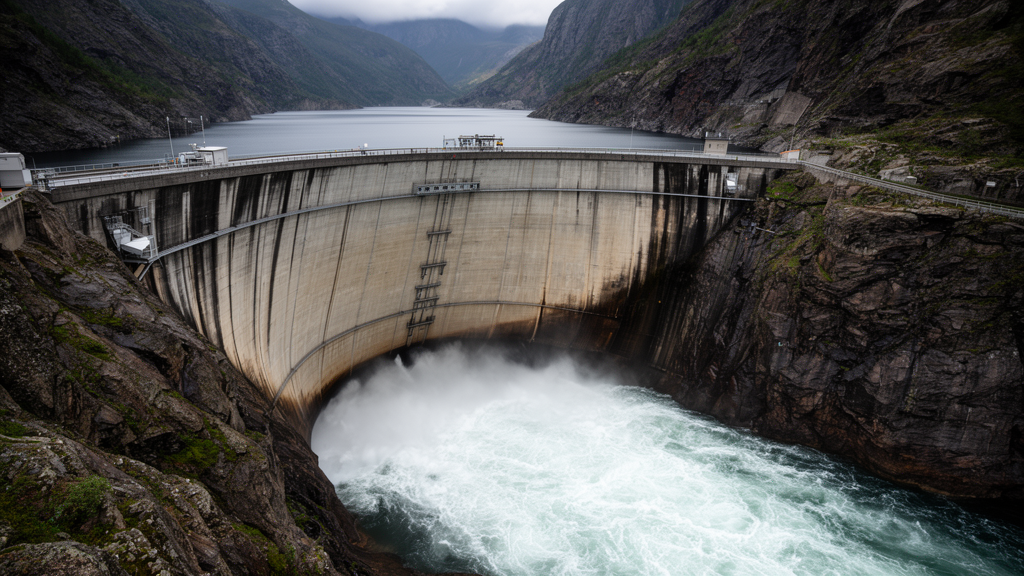
A concrete arch dam in southern China experienced a reported peak inflow of 3,440 cubic metres per second during intense rainfall on 22 May 2025, but the reservoir remained below its check flood level. A descriptive reassessment of the available monitoring archive found manual deformation surveys, plotted piezometric observations, project-derived uplift coefficients and partial automatic stress, strain and temperature records. Those sources document aspects of the event, yet an approximately 18-day interruption in automatic acquisition spanning the flood peak prevents determination of the dam’s peak response, separation of hydraulic and thermal effects or assessment of post-flood recovery. The evidence also does not establish piping, elastic recovery or overall structural safety.
The distinction between inflow and reservoir elevation is central to the case. Project records identify a peak inflow of 3,440 m³/s, 530 m³/s or 18.2% above the reported reference inflow of 2,910 m³/s for a 1,000-year event. The reservoir reached 160.29 metres at 14:00 on 22 May, 0.29 metres above the design flood level of 160.00 metres but 0.13 metres below the check flood level of 160.42 metres. It was also 1.21 metres below the reported historical maximum of 161.50 metres. Inflow magnitude describes the hydrological challenge, whereas reservoir elevation provides the hydraulic boundary condition governing part of the load on the dam. The researchers therefore characterize the episode as an extreme inflow event with a near-check reservoir level, not as an over-check hydrostatic condition or a probable maximum flood. The supplied archive did not include synchronized rainfall, inflow and outflow series, so the causes and rates of the subsequent reservoir recession could not be quantified.
The structure is a 71.50-metre-high, double-curvature concrete arch dam classified in its design documentation as a Class III water-resources structure. Its crest is at elevation 162.00 metres and its lowest foundation elevation is 90.50 metres. The project includes a surface hydropower-plant intake, a water-conveyance tunnel and two generating units rated at 10 MW each. Its monitoring programme combined manual surface surveys with automatic measurements of hydraulic and structural variables. Seven crest control points, two downstream gate-pier points and four upstream thrust-block points were included in the surface network. Three piezometers on each downstream abutment represented left- and right-abutment conditions, while four additional piezometers covered the downstream thrust-block and foundation zone. Electronic workbooks contained stress-cell, structural-strain, stress-free strain and concrete-temperature channels. The investigators separated values reported in the manuscript from engineering values and timestamps extracted from the workbooks, preserving their original identifiers, units, chronological order and sign conventions. Missing observations were neither interpolated nor smoothed.
Manual surveys indicated that the largest radial differences were concentrated near the central crest and gate-pier region. Survey-to-survey differences at D1, BD4 and D2 ranged from 5.65 to 5.99 millimetres and generally decreased toward the abutments, while tangential differences were visibly smaller in the source plots. In the final before-and-after interval, vertical survey increments ranged from −0.15 millimetres at BD1 to +0.87 millimetres at BD5; D2 and BD6 had the next-largest positive differences, at +0.79 and +0.77 millimetres, respectively. These are interval differences between two manual surveys, not continuous measurements or a directly observed value at 14:00 on 22 May. The archive did not preserve the exact dates of the flood-related surveys, measurement uncertainty or the transformation used to resolve radial and tangential components. It therefore cannot isolate a flood-induced component or determine peak, residual and recovered deformation.
The central position of the radial differences is qualitatively compatible with deformation of an arch dam under changing reservoir head, but the records do not demonstrate that hydraulic loading caused the observed pattern. The surveys were not corrected for temperature or time-dependent behaviour, and monthly vertical increments ranged from settlement to uplift, including −0.89 millimetres in February and as much as +1.52 millimetres in March. Because the table contains neither regularly spaced repeated observations nor an uncertainty model, the study makes no claim of statistical significance, elastic recovery, permanent deformation or foundation consolidation. Statistical and data-based approaches used to separate hydrostatic, seasonal, thermal and time effects require long, synchronized and quality-controlled records. Those prerequisites were absent, so the researchers did not fit a hydrostatic–seasonal–time regression or another event coefficient that would have depended on interpolation across missing data.
Foundation-zone measurements nevertheless provided one quantitative comparison that could be retained from the project archive. Project-derived uplift-pressure coefficients at P1–P4 were 0.15, 0.21, 0.07 and 0.13 when the upstream reservoir level was 160.29 metres. All four were below the project-specific design reference of 0.25, with relative margins calculated as (0.25 − α)/0.25 ranging from 16% to 72%. P2 had the largest coefficient and smallest margin within the four-point set. At the second reported reservoir condition of 158.02 metres, the coefficients were 0.15, 0.20, 0.07 and 0.13, with relative margins of 20% to 72%. The coefficient is a dimensionless head ratio based on piezometric pressure head, upstream water-surface elevation and instrument elevation, rather than a direct measurement of foundation movement. Missing sensor elevations, downstream reference head and calibration records prevented independent reconstruction of the values, so the comparisons do not constitute a standalone structural-safety assessment. P2 was identified as a priority for continued trend review, not as evidence of abnormal uplift or damage.
Abutment piezometric plots raised a separate data-verification problem. The April 2025 plots report left- and right-abutment piezometric elevations of 132.69–151.54 metres, with changes of −4.04 to +0.07 metres relative to the local series reference. For the flood-period plots, the stated combined range was 131.70–165.28 metres. The upper plotted value stood 3.28 metres above the 162.00-metre dam crest and 4.99 metres above the reported reservoir peak. It could reflect a different elevation datum, a conversion problem or a sensor anomaly, but the raw abutment-seepage workbook contained only headers, and sensor elevations and datum-conversion records were unavailable. The researchers consequently retained 165.28 metres only as a value transcribed from the original plot and assigned it no physical interpretation. Although the plotted series varied with reservoir level over parts of the record, synchronized raw observations were unavailable for correlation, lag or change-point analysis. The archive does not establish 150 metres as a threshold, identify a preferential seepage path or demonstrate bypass seepage, internal erosion or piping.
Automatic monitoring supplied the study’s most consequential limitation. Stress-cell, strain and temperature records generally stopped at 08:00 on 21 May and resumed at 08:00 on 8 June, creating an approximately 18-day interval that included the reservoir peak and early recession. Most structural-strain channels resumed on 8 June, while four S01 directions and all stress-free gauges resumed on 23 June. None of the automatic series sampled the 22 May peak, and the pre-gap and post-gap observations therefore could not be treated as a before–peak–after recovery sequence. At 08:00 on 21 May, the signed E01–E07 stress-cell outputs ranged from −17.1912 kilopascals at E02 to +41.1092 kilopascals at E05. At 08:00 on 8 June, they ranged from −15.1412 to +59.3157 kilopascals. Across the same common endpoints, 14 active temperature channels changed by −1.2993 to +1.5815°C. Because both the peak and the intervening thermal history were missing, these endpoint differences could not be attributed uniquely to hydraulic loading or used to test recovery. Stress-free strain channels recorded free deformation rather than load-induced stress and could not be converted to stress without a validated constitutive model and the required thermal and material parameters.
Quality control also flagged a discontinuity in stress cell E08. Its output changed from −84.6223 kilopascals on 21 May to +6.0923 kilopascals on 8 June, a step of 90.7146 kilopascals, and its temperature field on 8 June was blank. The retained metadata could not distinguish structural behaviour, recalibration or instrument error, so E08 was excluded from the representative E01–E07 range. That exclusion was a quality-control decision, not evidence of abnormal behaviour at the instrument location. More broadly, the archive lacked complete manufacturer and model information, nominal resolution and accuracy, calibration coefficients and dates, maintenance logs, detailed installation elevations, measured concrete properties, and site-specific geological and grout-curtain sections. It therefore could not support metrological revalidation, formal uncertainty propagation, strength-based safety evaluation or generalization to other arch dams. This was a descriptive, single-event case study based on records collected for operational monitoring, not a prospectively designed experiment.
The case identifies specific ways in which future event-focused monitoring could preserve evidence that the May 2025 archive lost. Event-triggered acquisition should synchronize reservoir level, rainfall, inflow, outflow, concrete temperature, deformation, piezometric head, structural strain and stress-cell output to a common clock, supported by redundant power, local buffering, communication-status logs and explicit missing-data flags. Manual surveys should retain exact timestamps, benchmark checks, coordinate transformations, instrument precision and environmental conditions. Abutment piezometers require verified datums and sensor elevations before plotted elevations can be interpreted, while E08 requires comparison with calibration, maintenance, power and acquisition records before it can rejoin a representative stress-cell range. The available evidence supports these verification priorities but not claims of piping, permanent damage, elastic recovery or overall dam failure. Its central lesson is that an exceptional inflow can leave the most informative structural response unobserved when acquisition, metadata and survey documentation are not prepared before the event.
Subject of Research: Evidence-constrained reassessment of deformation, seepage, uplift and stress monitoring during an extreme inflow event at a Chinese concrete arch dam
Article Title: Field-monitored deformation, seepage, and stress response of a concrete arch dam during an extreme inflow event
Article References: Chen, Y., Wang, X., Jiang, C., Liang, J., & Li, W. (2026). Field-monitored deformation, seepage, and stress response of a concrete arch dam during an extreme inflow event. Frontiers in Earth Science, 14, Article 1943967. https://doi.org/10.3389/feart.2026.1943967
Image Credits: AI Generated
DOI: 10.3389/feart.2026.1943967
Keywords: concrete arch dam, extreme inflow, field monitoring, dam deformation, piezometric response, uplift pressure, data completeness, structural monitoring, reservoir hydraulics, monitoring gap, Field-monitored, deformation
Cite Scienmag News
Violet Maxwell. (October 20, 2026). Field-monitored deformation, seepage, and stress response of a concrete arch dam during an extreme inflow event. Scienmag. https://scienmag.com/field-monitored-deformation-seepage-and-stress-response-of-a-concrete-arch-dam-during-an-extreme-inflow-event/
Violet Maxwell. "Field-monitored deformation, seepage, and stress response of a concrete arch dam during an extreme inflow event." Scienmag, 20 October 2026, https://scienmag.com/field-monitored-deformation-seepage-and-stress-response-of-a-concrete-arch-dam-during-an-extreme-inflow-event/. Accessed 20 October 2026.
Violet Maxwell. "Field-monitored deformation, seepage, and stress response of a concrete arch dam during an extreme inflow event." Scienmag. October 20, 2026. https://scienmag.com/field-monitored-deformation-seepage-and-stress-response-of-a-concrete-arch-dam-during-an-extreme-inflow-event/


