

Tuesday, October 20, 2026
Science
No Result
View All Result
  • Login
  • HOME
  • SCIENCE NEWS
  • CONTACT US
  • HOME
  • SCIENCE NEWS
  • CONTACT US
No Result
View All Result
Scienmag
No Result
View All Result
Home Science News Earth Science

Seven challenges constrain urban informal businesses in Ethiopia’s Wallaga Zones

October 20, 2026
in Earth Science
Violet Maxwell
By Violet Maxwell Scienmag Editorial Profile - Natural Hazards
Reading Time: 2 mins read
0
Seven challenges constrain urban informal businesses in Ethiopia’s Wallaga Zones

Seven challenges constrain urban informal businesses in Ethiopia’s Wallaga Zones

65
SHARES
587
VIEWS
Share on FacebookShare on Twitter
ADVERTISEMENT

A cross-sectional study of 404 urban households engaged in informal-sector activities in the Wallaga Zones of Oromia National Regional State, Ethiopia, identified seven challenges affecting operators: income instability, limited access to finance, unfavorable government policies, unfair competition, inadequate legal support, insufficient social support and lack of access to relevant information. Together, these factors explained 59.69% of the variation in the challenges reported by participants.

The research used a multi-stage random sampling technique to select the 404 participating households. Investigators collected primary data through structured questionnaires containing five-point Likert-scale items and also reviewed secondary sources and relevant literature. The study design provides a cross-sectional assessment of the challenges reported by urban informal-sector operators in the Wallaga Zones, rather than a longitudinal analysis of how those conditions change over time.

The researchers used Principal Component Analysis to identify the factors represented in the reported challenges. The analysis distinguished seven components: income instability, limited access to finance, unfavorable government policies, unfair competition, inadequate legal support, insufficient social support and lack of access to relevant information. The supplied findings do not rank these factors or identify a single most prominent challenge. They instead show that the measured variation was distributed across seven dimensions, which together accounted for 59.69% of the total variation identified in the analysis.

A one-way analysis of variance found that mean scores for the seven challenges differed significantly across the types of urban informal sectors included in the study. This result indicates that operators in different sectors did not report the same average pattern of constraints. The abstract does not provide sector-specific scores, so the supplied evidence does not establish which informal activities experienced each challenge most severely. It nevertheless shows that treating all informal-sector operators as a single homogeneous group would conceal statistically significant differences among sector types.

The authors report that the challenges constraining growth and sustainability were shaped by demographic, socioeconomic and enterprise-related characteristics. They identify targeted policy responses: facilitating access to credit, improving infrastructure and simplifying business registration to support urban livelihoods and broader urban development in Ethiopia. These are the study’s policy recommendations rather than evidence that any intervention has already been tested. The cross-sectional design, sample of 404 households and geographic focus limit conclusions about causality, trends and experiences outside the Wallaga Zones. Within those boundaries, the study documents a multi-dimensional set of reported constraints facing urban informal-sector operators and shows that their measured severity varies by sector type.

Subject of Research: Cross-sectional assessment of challenges facing urban informal-sector households in Ethiopia’s Wallaga Zones

Article Title: An assessment of the challenges facing the urban informal sector in the Wallaga Zones of Oromia Regional State, Ethiopia

Article References: Bishe, H. B., Sajitha, O. G., & Ayana, I. D. (2026). An assessment of the challenges facing the urban informal sector in the Wallaga Zones of Oromia Regional State, Ethiopia. Discover Sustainability. https://doi.org/10.1007/s43621-026-04808-z

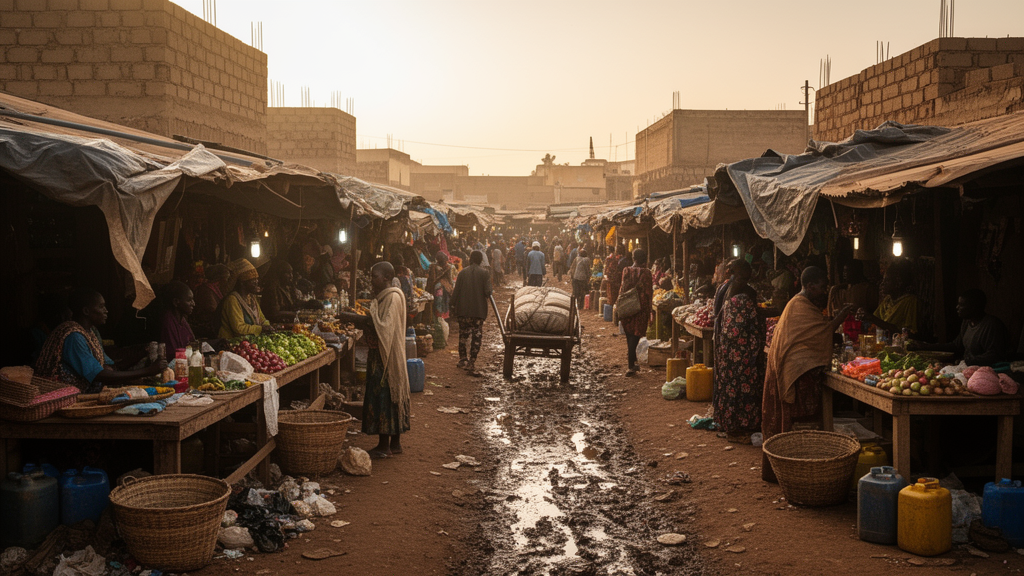
Image Credits: AI Generated

DOI: 10.1007/s43621-026-04808-z

Keywords: urban informal sector, Wallaga Zones, Ethiopia, Oromia Regional State, cross-sectional study, urban livelihoods, access to finance, income instability, business registration, household survey, assessment, challenges

Cite Scienmag News

Violet Maxwell. (October 20, 2026). Seven challenges constrain urban informal businesses in Ethiopia’s Wallaga Zones. Scienmag. https://scienmag.com/seven-challenges-constrain-urban-informal-businesses-in-ethiopias-wallaga-zones/


Violet Maxwell. "Seven challenges constrain urban informal businesses in Ethiopia’s Wallaga Zones." Scienmag, 20 October 2026, https://scienmag.com/seven-challenges-constrain-urban-informal-businesses-in-ethiopias-wallaga-zones/. Accessed 20 October 2026.

Violet Maxwell. "Seven challenges constrain urban informal businesses in Ethiopia’s Wallaga Zones." Scienmag. October 20, 2026. https://scienmag.com/seven-challenges-constrain-urban-informal-businesses-in-ethiopias-wallaga-zones/

Tags: access to financeaccess to finance for informal entrepreneursassessmentbusiness registrationchallengescross-sectional studycross-sectional study of informal sectorEthiopiaEthiopia Wallaga Zonesgovernment policy impact on informal businesseshousehold surveyincome instabilityincome instability in informal economyinformal sector challengesinformation access barriers in informal economylegal support for informal enterprisesOromia Regional Stateprincipal component analysis in economic researchsocial support for informal workersunfair competition in urban informal marketsUrban informal businessesurban informal sectorurban livelihoodsWallaga Zones
Share26Tweet16
Previous Post

Commentary frames tumor microenvironment as a driver of metastasis and resistance

Next Post

Wuhan ozone variability modeled with interpretable machine learning, 2019–2025

Related Posts

Wuhan ozone variability modeled with interpretable machine learning, 2019–2025
Earth Science

Wuhan ozone variability modeled with interpretable machine learning, 2019–2025

October 20, 2026
Terrain corrections reveal hidden geoid variations across Kalimantan
Earth Science

Terrain corrections reveal hidden geoid variations across Kalimantan

October 20, 2026
Research report: Mantle deformation patterns beneath the Central India Tectonic Zone: evidence from SK(K)S splitting measurements in the Satpura Gondwana Basin and adjacent areas
Earth Science

Research report: Mantle deformation patterns beneath the Central India Tectonic Zone: evidence from SK(K)S splitting measurements in the Satpura Gondwana Basin and adjacent areas

October 20, 2026
Species composition and assemblages of ichthyoplankton during winter and summer around the Korean Peninsula
Earth Science

Species composition and assemblages of ichthyoplankton during winter and summer around the Korean Peninsula

October 20, 2026
Survey links social norms and support to farmers’ water-scarcity adaptation
Earth Science

Survey links social norms and support to farmers’ water-scarcity adaptation

October 20, 2026
Mercury biomagnification emerges across a Brazilian savanna food web
Earth Science

Mercury biomagnification emerges across a Brazilian savanna food web

October 20, 2026
Next Post
Wuhan ozone variability modeled with interpretable machine learning, 2019–2025

Wuhan ozone variability modeled with interpretable machine learning, 2019–2025

  • Mothers who receive childcare support from maternal grandparents show more optimized

    Mothers who receive childcare support from maternal grandparents show more parental warmth, finds NTU Singapore study

    27656 shares
    Share 11059 Tweet 6912
  • University of Seville Breaks 120-Year-Old Mystery, Revises a Key Einstein Concept

    1061 shares
    Share 424 Tweet 265
  • Bee body mass, pathogens and local climate influence heat tolerance

    682 shares
    Share 273 Tweet 171
  • Researchers record first-ever images and data of a shark experiencing a boat strike

    546 shares
    Share 218 Tweet 137
  • Groundbreaking Clinical Trial Reveals Lubiprostone Enhances Kidney Function

    531 shares
    Share 212 Tweet 133
Science

Embark on a thrilling journey of discovery with Scienmag.com—your ultimate source for cutting-edge breakthroughs. Immerse yourself in a world where curiosity knows no limits and tomorrow’s possibilities become today’s reality!

RECENT NEWS

  • Survey finds gaps in Jakarta diabetic retinopathy screening
  • Wuhan ozone variability modeled with interpretable machine learning, 2019–2025
  • Seven challenges constrain urban informal businesses in Ethiopia’s Wallaga Zones
  • Commentary frames tumor microenvironment as a driver of metastasis and resistance

Categories

  • Agriculture
  • Anthropology
  • Archaeology
  • Athmospheric
  • Biology
  • Biotechnology
  • Blog
  • Bussines
  • Cancer
  • Chemistry
  • Climate
  • Earth Science
  • Editorial Policy
  • Marine
  • Mathematics
  • Medicine
  • Pediatry
  • Policy
  • Psychology & Psychiatry
  • Science Education
  • Science News
  • Social Science
  • Space
  • Technology and Engineering

Subscribe to Blog via Email

Enter your email address to subscribe to this blog and receive notifications of new posts by email.

Join 5,150 other subscribers

© 2025 Scienmag - Science Magazine

Welcome Back!

Login to your account below

Forgotten Password?

Retrieve your password

Please enter your username or email address to reset your password.

Log In
No Result
View All Result
  • HOME
  • SCIENCE NEWS
  • CONTACT US

© 2025 Scienmag - Science Magazine

Discover more from Science

Subscribe now to keep reading and get access to the full archive.

Continue reading