


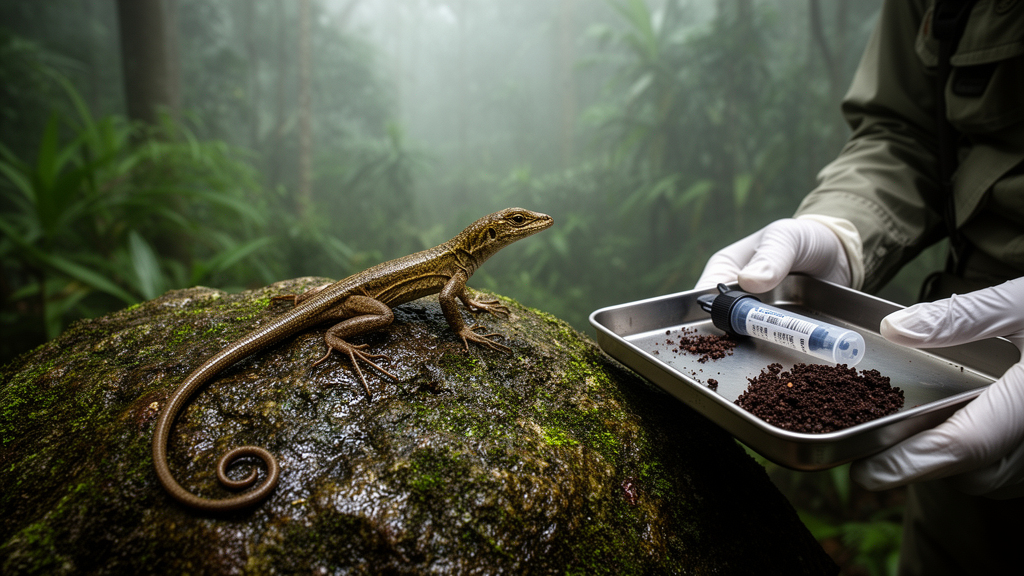
A new species of mountain horned dragon, Acanthosaura syrax, has been identified from high-elevation forest in Mae Wong National Park in western Thailand. A taxonomic study combining external morphology, measurements, scale counts and mitochondrial DNA analysis concluded that the small agamid lizard is distinct from its relatives, raising the number of recognized species in the genus to 23. The series consisted of an adult male holotype and seven adult paratypes collected in 2025 at Mae Wong District, Kamphaeng Phet Province. The holotype, THNHM31129, was collected at 1,340 metres above sea level; all eight specimens were deposited at the Natural History Museum, National Science Museum, Technopolis, Pathum Thani Province.
The animals were found during fieldwork in a part of the park previously reported to support Acanthosaura lepidogaster. Researchers did not encounter that species at the surveyed high-elevation site. Instead, the collected lizards formed a consistent morphotype distinguished by unusually small nuchal and dorsal crest spines, described as the smallest recorded in the genus. Photographs documented their coloration in life before the animals were euthanized by freezing at minus 10 degrees Celsius for one week, a procedure selected because the authors stated that the species can withstand several days at low temperatures. The specimens were fixed in 10% neutral buffered formalin for one week, rinsed and transferred to 70% ethanol. Liver samples were preserved separately in absolute ethanol for DNA extraction.
A. syrax is a small agamid with a narrow, moderately tall head, a somewhat compressed body and a distinctive arrangement of scales and spines. Its tympanum is small, rounded and scaleless, and the gular pouch is less developed than in many members of the genus. A tiny conical spine sits above the posterior margin of the eye, and a second small spine occurs on the occiput between the tympanum and nuchal crest. The nuchal crest has six or seven short, keeled, compressed and asymmetrical triangular spines. It is separated from the vertebral crest by a narrow diastema of five to eight scales. The dorsal crest itself consists of small, flat, saw-like triangular scales beginning around the shoulders and diminishing toward the base of the tail. The researchers assessed 51 morphometric and meristic characters, including body and limb dimensions, scale counts, spine lengths, tail proportions and the arrangement of head scales.
The type series displays conspicuous differences between males and females. Females reached a maximum snout–vent length of 101.2 millimetres, compared with 69.6 millimetres in males. Among the paratypes, female snout–vent lengths ranged from 75.5 to 101.2 millimetres, while males measured 62.5 to 69.6 millimetres. Female tails were 85.5–106.9 millimetres long and male tails were 72.4–77.6 millimetres long. In both sexes, tail length was relatively short, ranging from 1.06 to 1.16 times snout–vent length. Females lacked the transverse bar found across the dorsal head of the male holotype and had a pale yellowish-brown to orangish-brown body. The male’s body was dark brown with a marbled reticulum and pale greenish spots. Both sexes possessed pale whitish or whitish-yellow markings at the knees and elbows, as well as a black, diamond-shaped nuchal collar.
Other elements of the living coloration also helped distinguish the specimens. The head was dark brown and crossed by creamy-brown transverse bars, with the most prominent bar passing through the orbital region. Male lips and neck were yellowish-green, whereas those of females were whitish-brown. Neither sex had the black eye patch found in several Thai congeners. The underside was creamy, and the male tail was banded in pale brown and dirty yellowish-rusty tones, compared with a yellowish-creamy tail in females. The everted hemipenes of three males measured 5.3–7.2 millimetres in length. Each was symmetrical and spongy, with a budded-rosette shape and a tip width of 3.5–4.3 millimetres; in preserved ethanol, they were creamy yellow.
For the molecular analysis, the researchers extracted DNA from liver tissue and amplified a 698-base-pair fragment of the mitochondrial ND2 gene and a 600-base-pair fragment of COI. They compared the new sequences with sequences representing other Acanthosaura taxa and used Calotes emma as the outgroup for the ND2 analysis. Model selection identified the GTR+I+G substitution model for both datasets. Maximum-likelihood trees were reconstructed in IQ-TREE, with nodal support assessed through 1,000 ultrafast bootstrap replicates. Bayesian analyses in MrBayes used two independent runs, each with four chains, for one million generations; trees were sampled every 1,000 generations, and the first 25% were discarded as burn-in. The investigators defined significant clade support as an ultrafast bootstrap value of at least 95% and a Bayesian posterior probability of at least 0.95.
Both gene trees recovered the eight A. syrax specimens as a monophyletic lineage separated from the other sampled taxa, but the strength of support differed between markers. In the COI analysis, the lineage received 99% maximum-likelihood bootstrap support and a Bayesian posterior probability of 1.00, meeting the study’s thresholds for strong support. The ND2 analysis also produced a monophyletic group and separated it from A. lepidogaster, the closest sampled morphologically similar congener, but its reported support was lower: 76% bootstrap support and a posterior probability of 0.78. The results therefore provided concordant phylogenetic separation, with stronger statistical support from COI than from ND2. The study assessed mitochondrial markers and sampled taxa, rather than examining nuclear genes or every population potentially belonging to the species.
Genetic variation within the new species was minimal. Pairwise differences among the eight specimens ranged from 0 to 0.01% for ND2 and from 0 to 0.34% for COI. In the smaller ND2 comparison with seven other Thai congeners, distances from A. syrax were 0.14–0.21%. Its nearest ND2 comparison was with A. lepidogaster, at 0.14–0.16%. The COI dataset included 14 other congener species, many represented by samples from Vietnam, and showed distances of 14.96–28.13% from A. syrax. The nearest sampled COI comparison was with A. capra, at 14.96–15.44%, while A. lepidogaster differed by 16.64–17.53%. The unusually low divergence in ND2 means the formal recognition of A. syrax depended on the combined evidence of morphology and phylogenetic placement rather than on a single large genetic-distance threshold.
Field observations indicate that A. syrax occurs in a restricted high-elevation habitat within Mae Wong National Park. The researchers encountered it mainly in the upper mountain range above 1,300 metres and did not find individuals below 1,000 metres during their surveys. It was active from early to mid-day, basking on exposed rocks, fallen logs, small shrubs or cement structures. Toward the end of the afternoon, it retreated into the forest to rest beneath logs or rocks or in tree cavities. Its low daytime activity and relative immobility sometimes allowed the researchers to approach and capture specimens by hand without provoking an escape response. At dawn, some individuals were observed feeding on earthworms on the ground.
The species showed marked seasonal variation in activity. It was encountered most frequently, and at high intensity, from April to mid-June, covering the late dry season and transition into the early monsoon. Activity declined as the monsoon progressed and temperatures dropped, and was especially low in November and December, when minimum temperatures reached approximately 10 degrees Celsius. During the rainy season, sightings were concentrated around midday in direct sunlight, suggesting that solar radiation became a limiting factor for activity in wetter, cooler months. The authors interpret the small body size and unusually reduced crest spines as characteristics consistent with a high-altitude lineage, while emphasizing that the known distribution is based on field observations within one national park and has not yet been established across its full potential range.
The discovery shows that the diversity of mountain horned dragons in Thailand has been underestimated and that the highlands of Southeast Asia can retain unrecognized lineages. The authors proposed the English common name “Syrax mountain horned dragon” and the Thai name “King Ka Khaow Naam Lek Syrax.” The specific epithet refers to Syrax, the dragon associated with Queen Rhaenyra Targaryen in the fictional world of A Song of Ice and Fire, reflecting the lizard’s yellowish coloration, diminutive size and reported high clutch size. Because the documented population is associated with fragmented high-elevation forest in Mae Wong National Park, the authors recommend strengthening protection of the park’s primary evergreen forest. They also call for surveys in neighboring mountain ranges to establish the species’ full distribution and determine whether additional cryptic diversity remains undiscovered. The study provides no direct assessment of formal conservation status, but it identifies the known locality as a priority for further fieldwork and habitat protection.
Subject of Research: Morphological and mitochondrial DNA description of a new high-elevation mountain horned dragon from western Thailand
Article Title: Acanthosaura syrax sp. nov., a new species of mountain horned dragon from high-elevation habitats of western Thailand ( Squamata , Agamidae )
Article References: Trivalairat, P., Trivalairat, K., Moungkhaek, N., Caponov, S., & Lorsunyaluck, B. (2026). Acanthosaura syrax sp. nov., a new species of mountain horned dragon from high-elevation habitats of western Thailand (Squamata, Agamidae). ZooKeys, 1287, 47-76. https://doi.org/10.3897/zookeys.1287.186636
Image Credits: AI Generated
DOI: 10.3897/zookeys.1287.186636
Keywords: Acanthosaura syrax, new species, mountain horned dragon, Thailand, Mae Wong National Park, taxonomy, morphology, mitochondrial DNA, reptile biodiversity, high-elevation forests, cryptic species, Acanthosaura
Cite Scienmag News
Margaret Porter. (October 20, 2026). Morphology and DNA identify tiny highland dragon in western Thailand. Scienmag. https://scienmag.com/morphology-and-dna-identify-tiny-highland-dragon-in-western-thailand/
Margaret Porter. "Morphology and DNA identify tiny highland dragon in western Thailand." Scienmag, 20 October 2026, https://scienmag.com/morphology-and-dna-identify-tiny-highland-dragon-in-western-thailand/. Accessed 20 October 2026.
Margaret Porter. "Morphology and DNA identify tiny highland dragon in western Thailand." Scienmag. October 20, 2026. https://scienmag.com/morphology-and-dna-identify-tiny-highland-dragon-in-western-thailand/


