

Tuesday, October 20, 2026
Science
No Result
View All Result
  • Login
  • HOME
  • SCIENCE NEWS
  • CONTACT US
  • HOME
  • SCIENCE NEWS
  • CONTACT US
No Result
View All Result
Scienmag
No Result
View All Result
Home Science News Technology and Engineering

AI-guided symmetry speeds search for sound-absorbing woven designs

October 20, 2026
in Technology and Engineering
Denise Maddox
By Denise Maddox Scienmag Editorial Profile - Mechanical Engineering
Reading Time: 3 mins read
0
AI-guided symmetry speeds search for sound-absorbing woven designs

AI-guided symmetry speeds search for sound-absorbing woven designs

65
SHARES
587
VIEWS
Share on FacebookShare on Twitter
ADVERTISEMENT

A research team has combined artificial intelligence, symmetry analysis and physics-based simulation to identify woven textile patterns with potentially strong broadband sound absorption. After training, the method evaluated candidate designs and guided a computational search in less than a minute, while independent, detailed simulations showed that its acoustic-performance predictions agreed with the calculated results within 5%. The work remains a computational design study: the researchers have not yet manufactured and experimentally tested the proposed woven structures, so the results do not establish real-world acoustic performance.

The team, affiliated with the Laboratory of Tribology and Dynamics of Systems at École Centrale de Lyon and CNRS, Tohoku University’s Advanced Institute for Materials Research, and RIKEN iTHEMS, addressed a design problem that becomes increasingly difficult as the size of a textile pattern grows. Even a 10-by-10 weave has more possible yarn arrangements than could realistically be tested individually, and a detailed acoustic simulation can take more than an hour. The researchers sought a way to reduce the number of candidates that required expensive simulation while retaining patterns compatible with basic manufacturing and connectivity requirements.

They began by generating woven patterns that met those structural constraints, then grouped the patterns according to four types of repeating symmetry, including rotational and mirror symmetry. An AI system organized the patterns on a design map, placing structurally similar designs closer together. The researchers simulated a selected set of designs and used those results to train a prediction model.

Once trained, the model could evaluate candidate designs and direct a computer search in less than a minute. Independent, detailed simulations of selected designs were then used to check the predictions, which agreed with the simulation results within 5%. This agreement concerns modeled sound absorption, not measurements from physical acoustic tests.

The study also showed how symmetry can act as a physical design parameter rather than only a visual property. Woven patterns differ in how they distribute yarn crossings, and those crossings shape the microscopic gaps through which air moves. Some arrangements create more winding airflow paths, increasing opportunities for sound energy to be dissipated through friction and heat; others leave straighter and more open paths.

The size of the smallest repeating unit also affects the range of airflow and acoustic behaviors available. Lead author Thanasak Wanglomklang said the approach allows researchers to explore woven structures that would be impractical to examine through trial and error. He emphasized that the method “does not replace physics; it uses physics more strategically to identify promising, manufacturable designs.” Machine learning did not independently determine how sound would interact with a material.

Instead, physics-based simulation supplied training data, symmetry provided an organizing framework, and AI accelerated the identification of designs for closer physical evaluation. The study was published in Communications Materials on 27 August 2026 under the title “AI-assisted symmetry-informed topology optimization of woven materials for broadband sound absorption.” Experimental validation is the next stage.

The team plans to manufacture selected three-dimensional woven prototypes and test their sound absorption experimentally. It also plans to extend the method to multilayer woven materials, larger repeating structures and variations arising from manufacturing processes. Until those tests are completed, the supported result is a faster symmetry-informed route for prioritizing manufacturable candidates in a vast design space, together with close agreement between model predictions and detailed simulation.

The study does not yet demonstrate an improvement in experimentally measured sound absorption.

Subject of Research: Computational optimization of woven textile patterns for broadband sound absorption

Article Title: AI and symmetry accelerate the design of sound-absorbing woven materials

Article References: AI and symmetry accelerate the design of sound-absorbing woven materials. Original publication (Bibliographic details unavailable.)

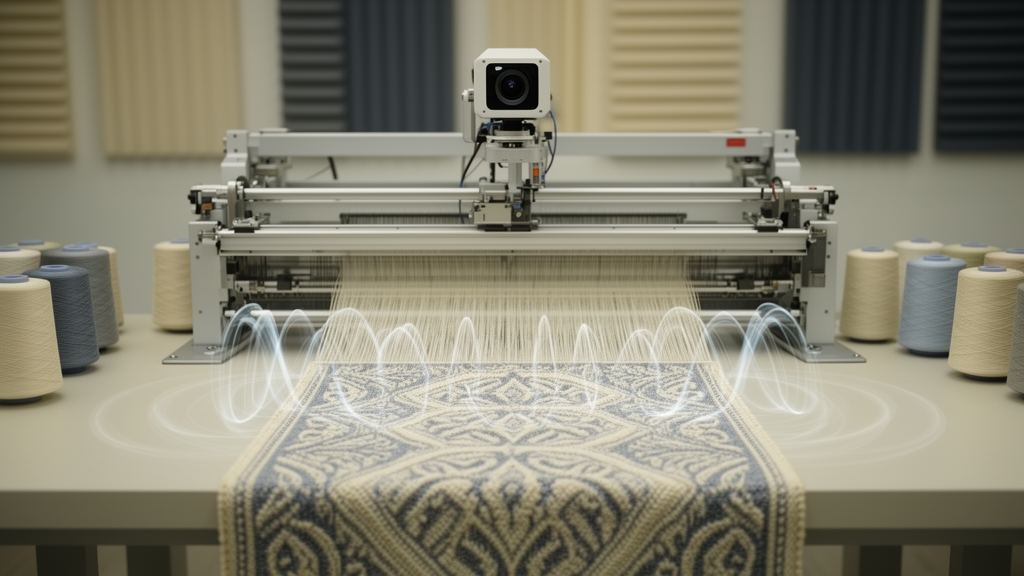
Image Credits: AI Generated

DOI: Not provided

Keywords: AI-assisted design, sound absorption, woven textiles, symmetry analysis, machine learning, acoustic simulation, materials optimization, topology optimization, multilayer materials, symmetry, accelerate, design

Cite Scienmag News

Denise Maddox. (October 20, 2026). AI-guided symmetry speeds search for sound-absorbing woven designs. Scienmag. https://scienmag.com/ai-guided-symmetry-speeds-search-for-sound-absorbing-woven-designs/

Denise Maddox. "AI-guided symmetry speeds search for sound-absorbing woven designs." Scienmag, 20 October 2026, https://scienmag.com/ai-guided-symmetry-speeds-search-for-sound-absorbing-woven-designs/. Accessed 20 October 2026.

Denise Maddox. "AI-guided symmetry speeds search for sound-absorbing woven designs." Scienmag. October 20, 2026. https://scienmag.com/ai-guided-symmetry-speeds-search-for-sound-absorbing-woven-designs/


Tags: ACCELERATEaccelerated computational modeling for acoustic textilesacoustic simulationAI-assisted designAI-assisted identification of effective woven sound absorbersAI-guided symmetry analysis for sound-absorbing woven textile designsbroadband acoustic performance prediction using physics-based simulationcomputational textile pattern search optimizationDesignMachine learningmachine learning in textile acousticsmanufacturing considerations in woven acoustic materialsmaterials optimizationmultilayer materialspattern grouping and classification for acoustic performancerapid evaluation of textile sound absorption propertiessimulation-driven design of woven soundproofing materialssound absorptionsymmetrysymmetry analysissymmetry-based design reduction in woven structurestextile pattern generation under structural constraintstopology optimizationwoven textiles
Share26Tweet16
Previous Post

Hybrid encryption protects federated updates in Medical-MNIST test

Next Post

Year-long youth cycling evaluation finds no group wellbeing improvement

Related Posts

Hybrid encryption protects federated updates in Medical-MNIST test
Technology and Engineering

Hybrid encryption protects federated updates in Medical-MNIST test

October 20, 2026
Light reveals competing pseudogap in doped cuprate superconductors
Technology and Engineering

Light reveals competing pseudogap in doped cuprate superconductors

October 20, 2026
Exemplar method aligns competing mammal taxonomies in under 30 seconds
Biology

Exemplar method aligns competing mammal taxonomies in under 30 seconds

October 20, 2026
Research report: Habitat‐Specific Design Strategies for Untethered Soft Robots
Technology and Engineering

Research report: Habitat‐Specific Design Strategies for Untethered Soft Robots

October 20, 2026
Research report: High-temperature molten salt electrophoretic deposition of TiB2 coatings on graphite: an experimental and first-principles study
Technology and Engineering

Research report: High-temperature molten salt electrophoretic deposition of TiB2 coatings on graphite: an experimental and first-principles study

October 20, 2026
Ultrasound-assisted solvent extraction boosts Houttuynia flavonoids
Technology and Engineering

Ultrasound-assisted solvent extraction boosts Houttuynia flavonoids

October 20, 2026
Next Post
Year-long youth cycling evaluation finds no group wellbeing improvement

Year-long youth cycling evaluation finds no group wellbeing improvement

  • Mothers who receive childcare support from maternal grandparents show more optimized

    Mothers who receive childcare support from maternal grandparents show more parental warmth, finds NTU Singapore study

    27656 shares
    Share 11059 Tweet 6912
  • University of Seville Breaks 120-Year-Old Mystery, Revises a Key Einstein Concept

    1061 shares
    Share 424 Tweet 265
  • Bee body mass, pathogens and local climate influence heat tolerance

    682 shares
    Share 273 Tweet 171
  • Researchers record first-ever images and data of a shark experiencing a boat strike

    546 shares
    Share 218 Tweet 137
  • Groundbreaking Clinical Trial Reveals Lubiprostone Enhances Kidney Function

    531 shares
    Share 212 Tweet 133
Science

Embark on a thrilling journey of discovery with Scienmag.com—your ultimate source for cutting-edge breakthroughs. Immerse yourself in a world where curiosity knows no limits and tomorrow’s possibilities become today’s reality!

RECENT NEWS

  • Pathogen seasonality and genetics in dairy cattle at an Inner Mongolia farm
  • Year-long youth cycling evaluation finds no group wellbeing improvement
  • AI-guided symmetry speeds search for sound-absorbing woven designs
  • Hybrid encryption protects federated updates in Medical-MNIST test

Categories

  • Agriculture
  • Anthropology
  • Archaeology
  • Athmospheric
  • Biology
  • Biotechnology
  • Blog
  • Bussines
  • Cancer
  • Chemistry
  • Climate
  • Earth Science
  • Editorial Policy
  • Marine
  • Mathematics
  • Medicine
  • Pediatry
  • Policy
  • Psychology & Psychiatry
  • Science Education
  • Science News
  • Social Science
  • Space
  • Technology and Engineering

Subscribe to Blog via Email

Enter your email address to subscribe to this blog and receive notifications of new posts by email.

Join 5,150 other subscribers

© 2025 Scienmag - Science Magazine

Welcome Back!

Login to your account below

Forgotten Password?

Retrieve your password

Please enter your username or email address to reset your password.

Log In
No Result
View All Result
  • HOME
  • SCIENCE NEWS
  • CONTACT US

© 2025 Scienmag - Science Magazine

Discover more from Science

Subscribe now to keep reading and get access to the full archive.

Continue reading