


A study of publicly available international wildlife seizure records found that Türkiye served mainly as a transit point in illegal wildlife trade between 2011 and 2022, appearing in documented cases involving 34 countries. The researchers compiled 55 seizure records from three sources and identified routes connecting Africa, Europe and Asia. Animal products accounted for 61.8% of the cases, live animals for 36.4% and medicinal products for 1.8%.
Air travel featured in 50 records, while five involved land transport. The findings describe patterns in recorded seizures, not the full scale of trafficking, because the authors could not access several major law-enforcement databases and noted substantial gaps in incident details. The analysis combined records from the Environmental Investigation Agency’s Global Environmental Crime Tracker, the Reducing Opportunities for Unlawful Transport of Endangered Species Partnership dashboard and nine grey-literature documents located through advanced Google searches.
The researchers also searched the Web of Science for peer-reviewed studies specifically examining illegal international wildlife trade involving Türkiye but found no article devoted to that subject. Four artificial-intelligence platforms were used to identify organizations that might hold relevant data, after which each organization’s website was checked manually. The resulting dataset covered seizures in which Türkiye was designated as an origin, transit or destination country; the seizures themselves did not necessarily take place in Türkiye.
Among the 51 records for which route roles could be classified without ambiguity, Türkiye was a transit country in 31 cases, or 61%; a destination in seven cases, or 14%; and an origin in 13, or 26%. Four records were excluded from that analysis because the origin was missing or multiple origins were named. Türkiye itself had the largest number of seizure records, with 15, followed by Vietnam with seven and China with five.
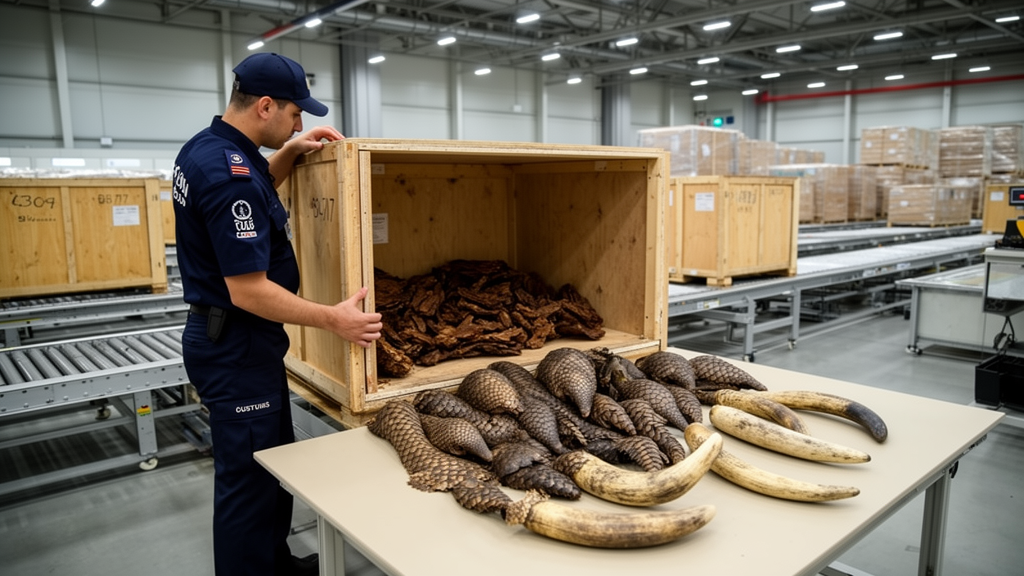
These counts are associated with recorded seizure locations and documented routes rather than estimates of national involvement in the underlying illicit trade. The wider network nevertheless positioned Türkiye between African source areas and Asian markets, while also connecting those markets with Europe. Seized wildlife products included an estimated 3,156 kg of elephant ivory in 226 pieces, 6,566 kg of pangolin scales, 176 kg of rhino horn in 34 horns, 74 kg of bobcat skins and 990 tortoises.
Other records listed 503 emperor scorpions, 19 corals, 10 African grey parrots, 3,740 northern medicinal leeches, 90–135 kg of European eels, and packages or tubes containing king cobras. Mammals represented 63.6% of the 55 cases, reptiles 20%, birds 7.3%, leeches 3.6%, and fish, corals and arachnids 1.8% each. These were totals that could be estimated from the available reports; some records identified only broad groups such as mammals or reptiles and did not state exact numbers of animals.
The documented routes connected the three continental regions in several patterns. Pangolin-scale shipments originated in the Democratic Republic of the Congo, Nigeria and Ghana, transited through Türkiye and were intended for Vietnam, China, Laos, Hong Kong or Romania; seizures occurred in Vietnam, Nepal, Thailand, Hong Kong and Türkiye. Turkish authorities intercepted six attempted rhino-horn shipments involving routes from South Africa and Mozambique toward Vietnam and China, while another seizure occurred at the Greece–Türkiye border.
African elephant ivory routes included links from the Democratic Republic of the Congo to Germany and Türkiye, and from Egypt and Türkiye through the United Arab Emirates and Lebanon to Germany. Other ivory consignments were listed as passing from Türkiye toward Vietnam, Malaysia, China and Singapore. Only 22% of the 55 records provided enough information to identify how the wildlife was detected.
Nine percent were found through risk assessments, seven through routine checks, four through random checks and two through x-ray scanning or a sniffer dog. Transport methods were also frequently unspecified. Among cases with that information, 29% involved checked luggage, 24% air cargo and 7% items carried on the person.
The high proportion of air-related cases is consistent with Türkiye’s role in international aviation, but the authors caution that the small number of land-border records may reflect lower detection rather than less trafficking across terrestrial routes. Annual seizure counts varied substantially from 2011 through 2022, with a standard deviation of 3.65 across the records. Monthly counts showed moderate variability, with a standard deviation of 2.07.
August had the highest monthly count, nine records, and October the lowest, one. The dataset is too limited to establish a seasonal trafficking pattern. Counts can reflect passenger and cargo volumes, enforcement staffing, detection technology, international operations, media attention, changes in reporting, altered trafficker routes and the timing of shipments.
The findings therefore do not show that illegal trade rises in summer or falls in autumn, and they cannot separate changes in underlying activity from changes in the likelihood that violations are detected and reported. One exceptional case fell outside the main 2011–2022 compilation: Turkish authorities seized an infant gorilla at Istanbul Airport on 22 December 2024, following a reported journey from Nigeria to Bangkok. A United Nations Environment Programme assessment cited by the study estimated that only about 14 infant gorillas enter the live trade annually, with a global retail value ranging from US$560,000 to US$2.1 million.
The interception attracted widespread attention on social media and prompted the Turkish Ministry of Agriculture and Forestry to conduct a public naming survey, after which the animal was called Zeytin, meaning “olive” in English. The case was separated from the main dataset rather than included in the 2011–2022 statistical analysis. The study also draws on earlier research to describe consequences for Türkiye’s own biodiversity.
Illegal and legal exports for the pet trade affected Mediterranean tortoises, with Türkiye supplying 19% of the global legal Testudo trade until 2004. Excessive collection was identified as a contributing factor to low genetic diversity in Hermann’s tortoises in Türkiye, while trade involving the Wagner viper and Caucasus viper was described as an existential threat. These background findings are not direct measurements of the 55 seizure cases, and the dataset does not establish how much illegal trade contributes to particular population declines.
The central limitation is incomplete and uneven data. Major systems operated by the Convention on International Trade in Endangered Species, the World Customs Organization and TRAFFIC’s TWIX platform were unavailable to the public, while some open dashboards provided aggregated weights rather than incident-level information. Species identification and exact quantities were frequently absent, and records from different sources overlapped.
Seizure data capture detected events, which may partly reflect enforcement intensity, and cannot reveal the volume that escaped detection. The authors consequently characterize Türkiye as a predominant transit point in the analyzed records, not as an estimate of all illegal wildlife trade involving the country. They call for more transparent records, consistent incident reporting, improved detection at air and land crossings, and international cooperation among source, transit and destination countries.
Subject of Research: Analysis of public international wildlife seizure records involving Türkiye from 2011 to 2022
Article Title: Where there’s smoke there is fire: Türkiye and the international illegal wildlife trade
Article References: Can, O. E. (2025). Where there’s smoke there is fire: Türkiye and the international illegal wildlife trade. Nature Conservation, 59, 1-20. https://doi.org/10.3897/natureconservation.59.149288
Image Credits: AI Generated
DOI: 10.3897/natureconservation.59.149288
Keywords: wildlife trafficking, Türkiye, illegal wildlife trade, seizure records, transit routes, elephant ivory, pangolin scales, rhino horn, air transport, biodiversity, there, smoke
Cite Scienmag News
Margaret Porter. (October 20, 2026). Türkiye Predominantly Served as a Wildlife Trade Transit Point. Scienmag. https://scienmag.com/turkiye-predominantly-served-as-a-wildlife-trade-transit-point/
Margaret Porter. "Türkiye Predominantly Served as a Wildlife Trade Transit Point." Scienmag, 20 October 2026, https://scienmag.com/turkiye-predominantly-served-as-a-wildlife-trade-transit-point/. Accessed 20 October 2026.
Margaret Porter. "Türkiye Predominantly Served as a Wildlife Trade Transit Point." Scienmag. October 20, 2026. https://scienmag.com/turkiye-predominantly-served-as-a-wildlife-trade-transit-point/


