


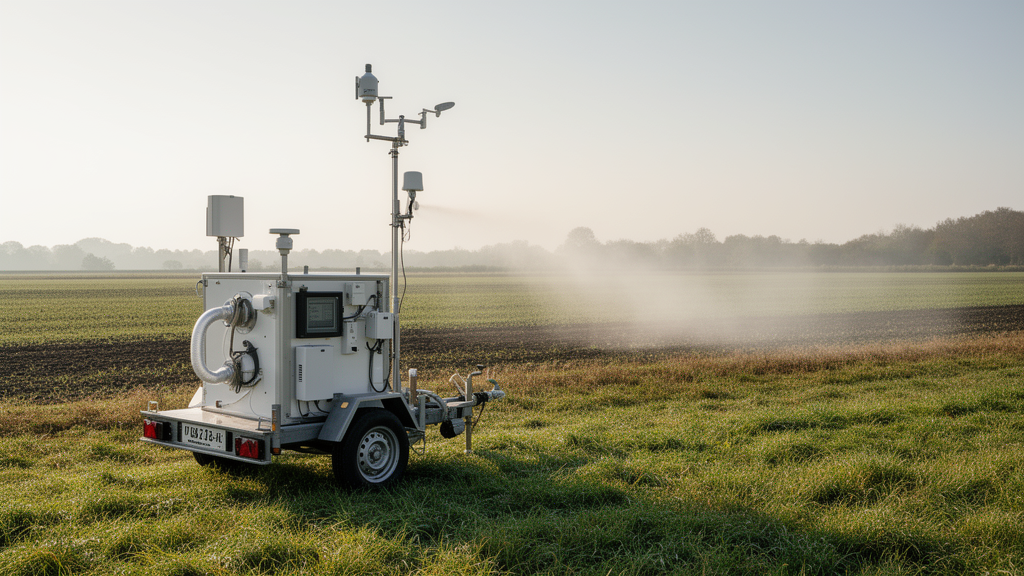
A joint inversion using simultaneous methane and radon measurements from 17 European sites produced methane emission estimates that differed by a few percent from estimates based on methane observations alone. The regional study, covering mainly central Europe during 2021, found that the two gases shared errors in simulated atmospheric transport, particularly vertical mixing. By incorporating that relationship into the inversion, researchers represented transport uncertainty more realistically than a conventional methane-only analysis could.
The resulting methane totals were generally slightly lower in countries well covered by the monitoring network, while uncertainty reduction was modestly greater. The method does not directly repair the transport model; instead, it uses radon to diagnose how transport errors affect methane observations and prevents those errors from being mistaken entirely for emission biases. Atmospheric inversions infer surface emissions by comparing measured concentrations with concentrations simulated by a transport model.
The differences, known as model-data mismatches, are conventionally attributed through Bayesian optimization to errors in the assumed fluxes, observational uncertainty and transport-model uncertainty. This can become problematic when the transport model systematically misrepresents atmospheric mixing. If a simulation disperses a tracer too rapidly through the planetary boundary layer, it may predict concentrations that differ from observations for reasons unrelated to the underlying emissions.
An inversion that does not recognize such errors can compensate by adjusting fluxes in the wrong direction. The new analysis targets that problem with radon-222, a radioactive gas produced in soils and released to the atmosphere. Radon has an e-folding lifetime of about 5.5 days, similar to the timescale for ventilating the planetary boundary layer, and it is chemically inert apart from radioactive decay.
Those properties allow radon concentrations to accumulate when the lower atmosphere is stably stratified but prevent long-lived accumulation aloft. The investigators used hourly methane and radon observations from continental towers, coastal stations, mountain sites and one urban site in the British Isles, northern France, the Netherlands, Germany and Switzerland. Afternoon observations were selected for most sites to favor well-mixed conditions; nighttime data were used at two mountain sites to avoid thermally generated slope winds.
Simulations were generated with the Stochastic Time-Inverted Lagrangian Transport model, or STILT, driven by meteorological fields from the European Centre for Medium-Range Weather Forecasts. For each site and hour, 100 numerical particles were released and traced backward for up to 10 days to map the surface areas influencing the observations. Methane priors combined anthropogenic emissions from agriculture and waste management, fossil-fuel use, natural terrestrial sources and ocean sources.
Daily process-based radon fluxes were calculated using high-resolution German soil-moisture data and coarser data elsewhere. The two gases were inverted jointly with a non-diagonal covariance matrix that allowed their model-data mismatches to vary together. The standard analysis used a correlation coefficient of 0.6, the median value measured across the 17 sites.
Transport-model performance varied sharply with atmospheric stability. At Karlsruhe, for example, the standard deviation of the methane mismatch when the modeled boundary-layer height was below 500 metres was 134 percent larger than under higher mixing heights; for radon, it was 144 percent larger. Across all sites, one-third of afternoon observations occurred under stable conditions, with mismatch variability 105 percent greater for methane and 128 percent greater for radon than in well-mixed conditions.
The two tracers tended to diverge from their simulations in the same direction, consistent with shared errors in vertical mixing. At Karlsruhe, the correlation between their mismatches was 0.82 for afternoon data and 0.75 for other hours. The median across all sites was about 0.6, although the weakest association occurred at a site strongly affected by local methane emissions that the coarse transport model could not resolve.
Several tests supported the interpretation that common transport errors, rather than correlated flux errors, drove much of the relationship. Anthropogenic sources accounted for roughly 80 percent of methane emissions across the relevant central European domain, whereas radon comes mainly from soil, so their source errors were expected to be largely independent. Moreover, replacing the STILT radon simulations with simulations from FLEXPART or NAME weakened the methane-radon association: the afternoon coefficient of determination fell from 0.67 with STILT to 0.44 and 0.34, respectively.
The investigators also considered peatlands, where wet soil can suppress radon release while promoting methane production. Such opposing effects would tend to anti-correlate the two flux errors, and peatlands contributed less than 2 percent of methane emissions in the study domain. With realistic uncertainty assumptions, the dual-tracer analysis changed country-total methane estimates by only a few percent.
Germany’s annual mean was nearly identical to the methane-only result because lower estimates in southern Germany offset higher values in northern Germany. In the Netherlands, Belgium, the United Kingdom and Ireland, annual mean methane totals were 1 to 3 percent lower than in the methane-only inversion, while corresponding radon totals were 0 to 8 percent lower. The inversion also reduced model-data mismatch bias by a median of 69 percent for methane and 58 percent for radon.
For Germany, the methane-only result increased the annual prior total by 75 percent and reduced its statistical uncertainty by 85 percent; the radon-only result increased the prior radon total by 45 percent and reduced uncertainty by 88 percent. The dual-tracer method achieved slightly greater methane uncertainty reduction, indicating that radon supplied information not available from methane alone. The importance of radon’s prior flux uncertainty became clearer in sensitivity experiments.
The standard inversion assigned 30 percent uncertainty to the annual total radon flux over the European model domain, corresponding to roughly 60 percent uncertainty for Germany. In an intentionally unrealistic sensitivity scenario, the uncertainty for Germany’s annual radon total was set to 5 percent. Under that condition, the dual- and methane-only methane estimates for Germany diverged by 8 percent.
Tighter constraints made the system less willing to alter radon fluxes to erase its mismatch, effectively turning radon into a stricter diagnostic of transport performance. That diagnostic reduced methane adjustments during periods when the model performed poorly and concentrated them around conditions the model represented more accurately. Differences reached roughly 10 percent only under the unrealistically tight 5 percent scenario.
The method also has boundaries that the results make explicit. It requires colocated methane and radon measurements, a monitoring network far denser than currently exists in many regions, and reliable maps of soil radon emissions. It is expected to work best where transport errors mainly reflect deficient vertical mixing rather than strong local sources that a regional model cannot resolve.
In peatland-dominated areas, methane and radon prior-flux errors may need to be represented explicitly rather than assumed to be independent. An evaluation at two German sites excluded from the inversion showed the trade-off clearly: the methane-only analysis reduced their mean mismatch by 67 percent, whereas the dual-tracer inversion accepted a 3 to 7 percent higher mismatch because it interpreted part of that discrepancy as a shared transport bias. Radon therefore did not make every observation fit better; it changed the attribution of the mismatch.
The study suggests that better radon flux maps and expanded monitoring networks could make methane inversions more reliable, while broader tests with other trace gases would determine how widely the approach can be applied.
Subject of Research: Use of radon observations to represent transport-model error in European methane emission inversions
Article Title: Can radon help to improve methane emission estimates? Results from a dual-tracer inversion
Article References: Maier, F., Rödenbeck, C., Karstens, U., Koch, F.-T., Gachkivskyi, M., Smerald, A., & Gerbig, C. (2026). Can radon help to improve methane emission estimates? Results from a dual-tracer inversion. Atmospheric Chemistry and Physics, 26(20), 14699-14723. https://doi.org/10.5194/acp-26-14699-2026
Image Credits: AI Generated
DOI: 10.5194/acp-26-14699-2026
Keywords: methane emissions, radon-222, atmospheric inversion, vertical mixing, transport models, central Europe, model-data mismatch, Bayesian analysis, greenhouse gases, radon monitoring, radon, help
Cite Scienmag News
Russell Cooper. (October 20, 2026). Can radon help to improve methane emission estimates? Results from a dual-tracer inversion. Scienmag. https://scienmag.com/can-radon-help-to-improve-methane-emission-estimates-results-from-a-dual-tracer-inversion/
Russell Cooper. "Can radon help to improve methane emission estimates? Results from a dual-tracer inversion." Scienmag, 20 October 2026, https://scienmag.com/can-radon-help-to-improve-methane-emission-estimates-results-from-a-dual-tracer-inversion/. Accessed 20 October 2026.
Russell Cooper. "Can radon help to improve methane emission estimates? Results from a dual-tracer inversion." Scienmag. October 20, 2026. https://scienmag.com/can-radon-help-to-improve-methane-emission-estimates-results-from-a-dual-tracer-inversion/


