


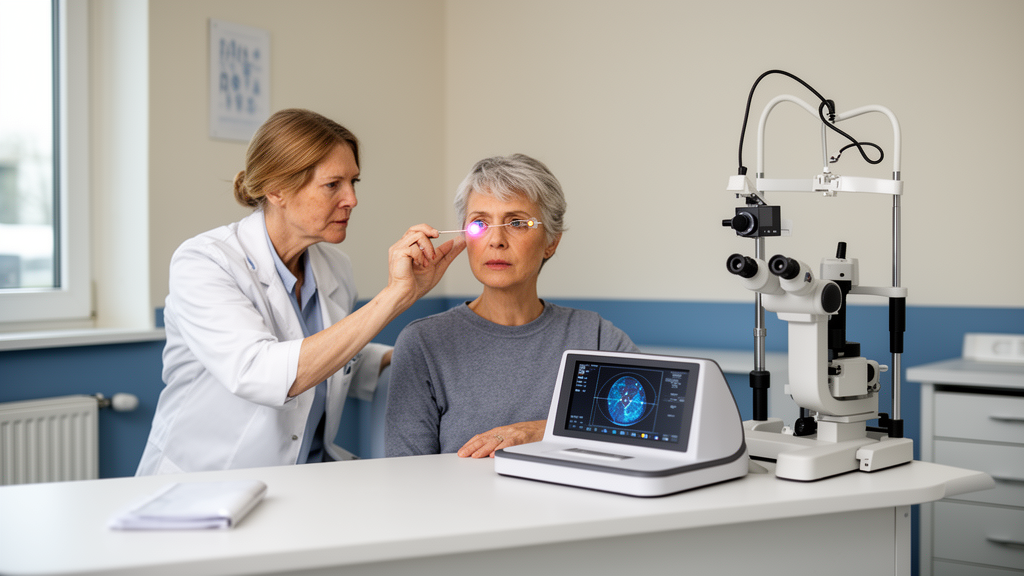
A seven-study research collection presented in Frontiers in Neuroscience examines visual and oculomotor assessment and rehabilitation after mild traumatic brain injury, commonly called concussion. The editorial describes evidence ranging from eye-movement tracking and symptom surveys to functional brain imaging and targeted vision therapy. Across the collection, the reported findings concern altered pursuit and saccadic control, accommodative and convergence problems, light sensitivity, patient-reported visual symptoms, and changes in brain activity following rehabilitation.
The studies do not establish one universal program for concussion, but together they illustrate how visual function can be measured in people whose standard brain imaging may show no gross structural lesions. The editorial notes that mild traumatic brain injury has traditionally been categorized as “mild” partly because conventional neuroimaging does not reveal obvious structural damage. Nevertheless, symptoms can persist and be profoundly disabling.
The authors associate this burden with diffuse axonal injury and subtle disruptions of neural networks, although the collection does not quantify how frequently either mechanism accounts for a particular symptom. Visual and oculomotor dysfunction can affect pursuit and rapid eye movements, fixation, convergence, accommodation, and the integration of vestibular and visual information. The editorial therefore argues that each patient’s oculomotor and visual sensory systems warrant an independent clinical evaluation rather than assessment through a general symptom score alone.
One study, led by Shani and colleagues, assessed oculomotor markers during simple and predictive visual tracking tasks after traumatic brain injury. The researchers quantified eye-tracking errors, oculomotor latency, pupil responses, and vergence stability, finding subtle alterations in smooth pursuit, saccadic control, and predictive target tracking. These measures are intended to characterize functional impairments associated with traumatic brain injury and to provide objective information that can be used when monitoring recovery or tailoring visual rehabilitation.
The editorial does not report a diagnostic threshold validated for every population, nor does it claim that these measurements alone identify concussion. Instead, it presents eye tracking as a complementary way to document behavior that may be difficult to capture through symptom reporting alone. Patient-reported measures provide a second perspective on visual injury.
Almutairi and colleagues carried out a cross-cultural adaptation and validation of the Brain Injury Vision Symptom Survey, or BIVSS, into Arabic. They then used the validated Arabic survey in a case-control evaluation of visual symptom burden after traumatic brain injury. The findings described accommodative dysfunction, light sensitivity, and binocular vision disorders as pervasive influences on activities of daily living and functioning.
Validating the survey for Arabic-speaking participants allows visual experiences to be assessed across a different linguistic and cultural setting. The editorial presents such instruments as important for documenting the full burden of visual symptoms, while the case-control design does not demonstrate that use of a survey improves clinical outcomes. A complementary study by Ghosh and colleagues examined post-concussion symptom profiles in a pediatric and adolescent cohort using the Convergence Insufficiency Symptom Survey, or CISS.
The analysis identified differences in symptom-reporting trends associated with convergence insufficiency, supporting age-specific diagnostic thresholds rather than applying the same thresholds indiscriminately across age groups. The relevance of this work is that visual symptoms and convergence difficulties can be relevant to younger people’s functioning at school and during developmental activities. The study characterizes how symptoms are reported in its cohort; it does not establish the prevalence of convergence insufficiency in all young people with concussion, and the editorial presents timely, age-aware assessment as a concern rather than as a proven means of preventing specific long-term outcomes.
Functional magnetic resonance imaging offered a neurological view of one rehabilitation approach in the collection. Sangoi and colleagues reported findings from the CONCUSS clinical trial, which investigated changes in neural activity following vergence and accommodative therapy in patients with post-concussion convergence insufficiency. After rehabilitation, the researchers found significant alterations in cortical and subcortical activation within the oculomotor network.
The result was interpreted as neurofunctional evidence of activity-dependent neuroplasticity associated with targeted vision therapy. Because the measurement concerns brain activation in this trial population and setting, it does not show that every symptom improves, that activation alone represents full clinical recovery, or that the same therapy is effective for all forms of concussion. Another study focused on spectral filters and dynamic accommodation in people with mild traumatic brain injury.
Almutairi and colleagues examined colored lenses and neutral-density filters, reporting that these filters could modulate gain in the visual pathway, provide immediate relief for photophobia, and support accommodative stability during visual tasks. The result addresses a symptom that can substantially interfere with visual activity after injury. The findings concern the effects of the tested filters during the study’s tasks; they do not show that colored lenses correct the underlying neurological injury or establish one filter as appropriate for every patient.
The editorial consequently presents spectral filtering as one component of visual rehabilitation rather than as a stand-alone treatment. Taken together, the seven studies support a shift from reactive management of post-concussion visual problems toward an approach built around objective and patient-reported assessment. Eye tracking can characterize pursuit, saccades, prediction, pupil response, and vergence, while validated surveys can record the burden of visual symptoms in daily life.
The fMRI trial adds evidence about activity-dependent changes in the oculomotor network after targeted therapy, and the filter study addresses accommodation and photophobia during visual tasks. The collection does not supply a single treatment sequence, compare all of these methods in one trial, or show that they work equally well for every patient. Its scope is instead to bring complementary forms of assessment and rehabilitation together within an interdisciplinary research framework.
The editorial calls for collaboration among optometrists, ophthalmologists, vision scientists, neurologists, sports-medicine specialists, physiotherapists, and neuroscientists. It identifies the broader goal as improving functional outcomes and quality of life for people recovering from mild traumatic brain injury or concussion. Emerging eye-tracking technologies are highlighted as a potential route to making objective oculomotor assessment more accessible, allowing baseline deficits to be quantified and treatment outcomes monitored.
Its findings point toward more objective and evidence-based visual rehabilitation while leaving open which combinations of assessment tools and interventions are most effective in particular clinical groups.
Subject of Research: Visual and oculomotor assessment and targeted rehabilitation after mild traumatic brain injury or concussion
Article Title: Editorial: Visual rehabilitation of mild traumatic brain injuries or concussion
Article References: Yap, T. P., Gowrisankaran, S., & Yaramothu, C. (2026). Editorial: Visual rehabilitation of mild traumatic brain injuries or concussion. Frontiers in Neuroscience, 20, Article 2021547. https://doi.org/10.3389/fnins.2026.2021547
Image Credits: AI Generated
DOI: 10.3389/fnins.2026.2021547
Keywords: mild traumatic brain injury, concussion, visual rehabilitation, oculomotor dysfunction, eye tracking, vision therapy, convergence insufficiency, accommodation dysfunction, functional MRI, post-concussion symptoms, Editorial, Visual
Cite Scienmag News
Cassandra Pierce. (October 20, 2026). Editorial: Visual rehabilitation of mild traumatic brain injuries or concussion. Scienmag. https://scienmag.com/editorial-visual-rehabilitation-of-mild-traumatic-brain-injuries-or-concussion/
Cassandra Pierce. "Editorial: Visual rehabilitation of mild traumatic brain injuries or concussion." Scienmag, 20 October 2026, https://scienmag.com/editorial-visual-rehabilitation-of-mild-traumatic-brain-injuries-or-concussion/. Accessed 20 October 2026.
Cassandra Pierce. "Editorial: Visual rehabilitation of mild traumatic brain injuries or concussion." Scienmag. October 20, 2026. https://scienmag.com/editorial-visual-rehabilitation-of-mild-traumatic-brain-injuries-or-concussion/


