

Tuesday, October 20, 2026
Science
No Result
View All Result
  • Login
  • HOME
  • SCIENCE NEWS
  • CONTACT US
  • HOME
  • SCIENCE NEWS
  • CONTACT US
No Result
View All Result
Scienmag
No Result
View All Result
Home Science News Medicine

ACSS1 links nutrient stress to impaired bone formation in mouse models

October 20, 2026
in Medicine
Ophelia Keating
By Ophelia Keating Scienmag Editorial Profile - Health Services Research
Reading Time: 2 mins read
0
ACSS1 links nutrient stress to impaired bone formation in mouse models

ACSS1 links nutrient stress to impaired bone formation in mouse models

65
SHARES
587
VIEWS
Share on FacebookShare on Twitter
ADVERTISEMENT

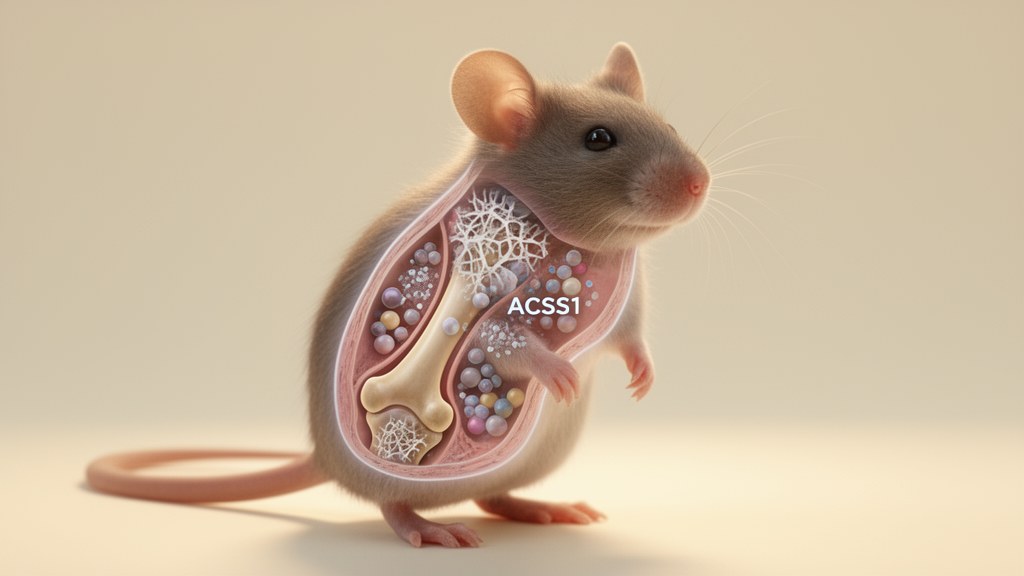
In mouse experiments, nutrient excess caused acetyl-CoA synthetase 1 (ACSS1) to accumulate in bone marrow skeletal stem cells, where it disrupted metabolic flexibility, mitochondrial function and osteogenesis. The study links excess glucose, alcohol or acetate to a stress pathway that reduced bone formation through increased acetyl-CoA production and abnormal protein acetylation. These findings concern mouse models and bone-forming precursor cells, not a demonstrated treatment for human disease.

The researchers found that excess glucose, alcohol or acetate activated a mitochondrial reactive oxygen species signaling pathway, which engaged the integrated stress response and the transcription factor CEBPB. This signaling increased ACSS1, a protein involved in converting acetate into acetyl-CoA. Once accumulated, ACSS1 raised acetyl-CoA production from supplied acetate or from acetate generated internally from glucose or ethanol.

The metabolic rewiring promoted excessive protein acetylation and specifically inactivated malate enzyme 2 (ME2) through acetylation at lysine 94. ME2 inactivation disturbed the malate-aspartate shuttle and, according to the study, created a self-perpetuating cycle of redox imbalance and oxidative stress. That cycle intensified mitochondrial dysfunction and impaired the osteogenic capacity of the affected cells.

The mechanism therefore connected several elements of the stress response: acetate metabolism, acetyl-CoA abundance, protein acetylation, mitochondrial communication and the differentiation of cells that form bone. ACSS1 was identified as a key stress responder that mediated this mitonuclear communication in bone marrow skeletal stem cells. Genetic deletion of Acss1 in male mouse models of type 2 diabetes and chronic alcohol consumption restored mitochondrial resilience, osteogenic capacity and bone formation.

The researchers also used an adeno-associated virus to deliver a non-acetylatable ME2 mutant to osteoprogenitor cells; this approach produced protective effects in the models tested. Deletion of Acss1 protected against osteoporosis or osteonecrosis, while delivery of the ME2 mutant similarly counteracted the bone-forming defects associated with the experimental metabolic stresses. Because the reported experiments were conducted in mice and bone-forming cells, the results establish a mechanism in those systems rather than a clinical benefit in people.

The central finding is that nutrient stress can drive ACSS1-dependent metabolic rewiring, mitochondrial damage and impaired bone formation through a pathway involving ME2 acetylation.

Subject of Research: ACSS1-mediated metabolic stress and impaired bone formation in mouse models

Article Title: Nutrient stress-driven ACSS1 controls metabolic flexibility and bone formation

Article References: Gao, L., Yuan, Z., Huang, T., Li, P., Zhong, Y., Gao, J., Luo, Y., Li, B., Pan, H., Ye, K., & Guan, M. (2026). Nutrient stress-driven ACSS1 controls metabolic flexibility and bone formation. Nature Communications. https://doi.org/10.1038/s41467-026-77684-w

Image Credits: AI Generated

DOI: 10.1038/s41467-026-77684-w

Keywords: ACSS1, nutrient stress, bone formation, bone marrow stem cells, mitochondrial dysfunction, osteogenesis, protein acetylation, ME2, type 2 diabetes, osteoporosis, Nutrient, stress-driven

Cite Scienmag News

Ophelia Keating. (October 20, 2026). ACSS1 links nutrient stress to impaired bone formation in mouse models. Scienmag. https://scienmag.com/acss1-links-nutrient-stress-to-impaired-bone-formation-in-mouse-models/

Ophelia Keating. "ACSS1 links nutrient stress to impaired bone formation in mouse models." Scienmag, 20 October 2026, https://scienmag.com/acss1-links-nutrient-stress-to-impaired-bone-formation-in-mouse-models/. Accessed 20 October 2026.

Ophelia Keating. "ACSS1 links nutrient stress to impaired bone formation in mouse models." Scienmag. October 20, 2026. https://scienmag.com/acss1-links-nutrient-stress-to-impaired-bone-formation-in-mouse-models/


Tags: acetateacetyl-CoA synthetase 1 in nutrient excessACSS1ACSS1 role in skeletal stem cell metabolismbone formationbone marrow stem cellsimpact of glucose and alcohol on bone healthmalate enzyme 2 inhibition and redox imbalanceME2metabolic rewiring affecting bone cell differentiationmitochondrial dysfunctionmitochondrial dysfunction and oxidative stress in bone cellsmitochondrial reactive oxygen species signaling in bone metabolismnutrientnutrient stressNutrient stress and bone formation impairment in miceosteogenesisosteoporosisprotein acetylationprotein acetylation and enzyme inactivation in bone cellsstress signaling pathways in osteogenesisstress-drivenType 2 diabetes
Share26Tweet16
Previous Post

Structured maintenance linked to 99.91% rolling-door availability in Lima

Next Post

Brazilian MMPI-2-RF shows promising correspondence but uneven reliability

Related Posts

Fire extinguishers leave most forensic DNA profiles intact in mock tests
Medicine

Fire extinguishers leave most forensic DNA profiles intact in mock tests

October 20, 2026
Nomogram predicts vascular crisis after free flap surgery
Medicine

Nomogram predicts vascular crisis after free flap surgery

October 20, 2026
Rehmannioside A protects dopaminergic neurons in rotenone Parkinson’s models
Medicine

Rehmannioside A protects dopaminergic neurons in rotenone Parkinson’s models

October 20, 2026
Childhood Vasculitis Improved on Tocilizumab but Arteries Remain Damaged
Medicine

Childhood Vasculitis Improved on Tocilizumab but Arteries Remain Damaged

October 20, 2026
Dusty mining jobs linked to higher pneumoconiosis prevalence in US miners
Medicine

Dusty mining jobs linked to higher pneumoconiosis prevalence in US miners

October 20, 2026
Nursing Student’s Knowledge of and Attitudes Towards Pain Management: A Cross-Sectional Study
Medicine

Nursing Student’s Knowledge of and Attitudes Towards Pain Management: A Cross-Sectional Study

October 20, 2026
Next Post
Brazilian MMPI-2-RF shows promising correspondence but uneven reliability

Brazilian MMPI-2-RF shows promising correspondence but uneven reliability

  • Mothers who receive childcare support from maternal grandparents show more optimized

    Mothers who receive childcare support from maternal grandparents show more parental warmth, finds NTU Singapore study

    27656 shares
    Share 11059 Tweet 6912
  • University of Seville Breaks 120-Year-Old Mystery, Revises a Key Einstein Concept

    1061 shares
    Share 424 Tweet 265
  • Bee body mass, pathogens and local climate influence heat tolerance

    682 shares
    Share 273 Tweet 171
  • Researchers record first-ever images and data of a shark experiencing a boat strike

    546 shares
    Share 218 Tweet 137
  • Groundbreaking Clinical Trial Reveals Lubiprostone Enhances Kidney Function

    531 shares
    Share 212 Tweet 133
Science

Embark on a thrilling journey of discovery with Scienmag.com—your ultimate source for cutting-edge breakthroughs. Immerse yourself in a world where curiosity knows no limits and tomorrow’s possibilities become today’s reality!

RECENT NEWS

  • Fire extinguishers leave most forensic DNA profiles intact in mock tests
  • Research report: Editorial: Multiscale analysis of ultrasound-assisted and electro-physical methods for modifying structure–property relationships in plant-based foods
  • Evidence map finds EFT’s comparative advantage in PTSD treatment remains uncertain
  • Brazilian MMPI-2-RF shows promising correspondence but uneven reliability

Categories

  • Agriculture
  • Anthropology
  • Archaeology
  • Athmospheric
  • Biology
  • Biotechnology
  • Blog
  • Bussines
  • Cancer
  • Chemistry
  • Climate
  • Earth Science
  • Editorial Policy
  • Marine
  • Mathematics
  • Medicine
  • Pediatry
  • Policy
  • Psychology & Psychiatry
  • Science Education
  • Science News
  • Social Science
  • Space
  • Technology and Engineering

Subscribe to Blog via Email

Enter your email address to subscribe to this blog and receive notifications of new posts by email.

Join 5,150 other subscribers

© 2025 Scienmag - Science Magazine

Welcome Back!

Login to your account below

Forgotten Password?

Retrieve your password

Please enter your username or email address to reset your password.

Log In
No Result
View All Result
  • HOME
  • SCIENCE NEWS
  • CONTACT US

© 2025 Scienmag - Science Magazine

Discover more from Science

Subscribe now to keep reading and get access to the full archive.

Continue reading