


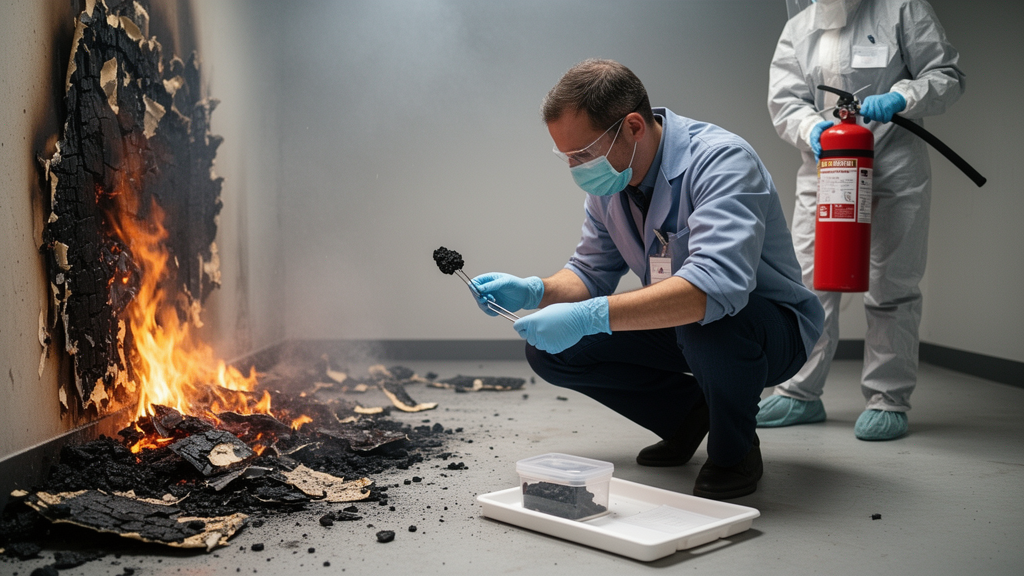
Fire extinguishers generally did not prevent investigators from recovering usable DNA profiles from artificial blood, saliva and touch traces in a mock forensic study. Researchers created 620 samples on laboratory and vehicle surfaces, sprayed them with powder, foam or carbon dioxide extinguishers, and found no general reduction in DNA concentration after one hour. Short tandem repeat analysis, or STR profiling, also remained possible across the cohorts.
The clearest deterioration occurred after foam had remained on epithelial-cell traces for 25 hours, while complete blood and saliva profiles remained obtainable even after longer exposure. Because the experiment did not reproduce an actual fire, it did not test the effects of intense heat, smoke or soot on burned surfaces. The investigation addressed a recurring problem in forensic genetics: biological traces may be recovered from a vehicle or crime scene after an extinguisher has been used, yet genetic analysis can fail to identify the person who deposited the material.
Vehicles involved in theft, hit-and-run collisions or other criminal activity may be burned, and extinguishers are also sometimes applied without a fire in an attempt to conceal evidence. DNA from occupants can help identify a driver or passenger, making the reliability of post-extinguisher analysis important for investigations. The study was published as a short communication in the International Journal of Legal Medicine on 20 October 2026.
For the experiment, the team prepared blood, saliva and epithelial-cell samples and deposited them on a laboratory bench, steering wheel, car door, seat-belt buckle and glove-compartment cover. Blood and saliva were applied in different volumes, while epithelial touch traces were created by rubbing fingers and hands onto the surfaces, either as single-donor deposits or mixtures from two people. The overall sample collection involved three female employees aged 26 to 59 whose DNA profiles were known.
For the touch-trace procedures, one woman classified as a “good shedder” was selected alongside another classified as a “bad shedder,” so the experiments represented both stronger and weaker cell transfer. All surfaces were cleaned before use, and negative controls produced no profiles. Each trace was allowed to dry for 24 hours.
Some samples were then sprayed on all sides until one of three commercial extinguishers was empty: 6 liters from the powder or foam extinguisher and 2 liters of carbon dioxide. Samples were collected one hour later, with additional 25-hour cohorts prepared for the powder and foam agents. Untreated samples served as controls.
The carbon dioxide group was sampled only after one hour because the gas dissipates rapidly and leaves no residue, meaning that prolonged exposure was not considered relevant in the experimental setup. The powder and foam cohorts included 196 samples each, comprising 72 blood traces, 72 saliva traces and 52 epithelial-cell traces; the carbon dioxide cohort contained 98 samples, while 130 untreated samples formed the reference group. The powder was an ABC formulation intended for fires involving solids, liquids or gases.
Its main components included ammonium dihydrogen phosphate, ammonium sulfate, barium sulfate and silica gel. The foam, recommended for solid and liquid fires, contained alkyl polyglucosides, 2-(2-butoxyethoxy)ethanol, ethanol and a perfluorinated amphoteric surfactant. The carbon dioxide extinguisher displaced oxygen without leaving a chemical residue.
This difference in composition and persistence was central to the results: powder and foam remained on the sampled surfaces, whereas carbon dioxide rapidly escaped. The investigators also noted that the agents did not cause extensive mechanical removal of traces, such as the washing or blowing away expected if powerful water flow had been applied. DNA was extracted with forensic casework kits and quantified by real-time PCR.
Two microliters of each extract were analyzed in duplicate and amplified with the PowerPlex ESX17fast multiplex kit. Fragment results were examined on an ABI 3500 genetic analyzer. A full profile contained every allele attributable to the known donor at all tested STR loci.
A partial profile lacked one to four donor alleles, while a “no evidence” profile lacked more than four and could not identify the donor. The quantification system had a reproducible detection threshold of at least 25 picograms of DNA. Previous validation work cited by the researchers found that complete ESX17fast profiles remained possible with inputs of approximately 62.5 to 64 picograms, and that partial profiles commonly occurred at still lower template amounts.
After one hour, none of the three extinguishers caused a general decrease in DNA concentration compared with controls. The measured concentrations covered a broad range because the samples differed greatly in biological content: control blood on the laboratory bench reached 10.2 nanograms per microliter, while epithelial deposits from two people measured below 0.001 nanogram per microliter. Among treated samples, the highest concentration was 10.7 nanograms per microliter in a 20-microliter blood sample on artificial leather one hour after foam treatment.
Foam reduced average measured DNA by about 40% after 25 hours, with exceptions for 25-microliter saliva samples and epithelial traces from two people. The untreated controls showed no corresponding decline. The investigators attributed the foam-associated reduction cautiously to its perfluorinated surfactant and cited prior evidence that such compounds can increase reactive oxygen species and promote DNA damage.
Apparent increases in some later measurements were more plausibly related to variation in the starting material than to an extinguishing agent. Contact pressure, the duration of contact, the random number of cells transferred, time since eating or drinking, and an individual’s shedding status can all affect initial DNA yield. This variability also produced large standard deviations in some control measurements, including plus or minus 3.2 nanograms per microliter for 20-microliter blood samples.
The authors therefore emphasized the broader pattern across cohorts rather than isolated differences in mean concentrations. Their results indicate that the agents did not uniformly destroy or remove quantifiable DNA during the tested exposure periods. STR results showed that the chemical agents did not generally make profiling impossible.
All untreated blood samples produced full profiles. At 25 hours, the rates remained 100% for powder and 95% for foam. Saliva showed a similar pattern: after one hour, full profiles ranged from 94% with foam to 98% with carbon dioxide, and after 25 hours they ranged from 95% with foam to 100% with powder.
Even when foam lowered measured DNA concentration, enough material remained for successful amplification. The researchers linked this outcome to the comparatively generous input available for amplification and to validation results showing that complete profiles can be obtained with relatively small DNA quantities. Touch DNA produced more variable outcomes, reflecting the inherently low DNA content of epithelial-cell deposits.
Untreated samples yielded complete profiles in 28% of cases after one hour and 67% after 25 hours; at one hour, 39% were partial and 33% contained insufficient donor information. Following treatment, complete profile rates were 31% for powder, 18% for foam and 46% for carbon dioxide after one hour. At 25 hours, 25% of powder samples and 3% of foam samples produced complete profiles, while 17% and 15%, respectively, were partial.
Compared with the respective one-hour results, the proportion of full profiles fell by 6 percentage points for powder and 15 points for foam, while no-evidence results rose by 17 and 13 points. Epithelial traces are difficult because keratinized cells contain little intact nuclear DNA, so their baseline limitations were often greater than the added effect of the extinguishers. The results support a narrow conclusion: extinguishing-agent residue alone is unlikely to defeat forensic DNA analysis, especially when investigators recover blood or saliva from surfaces that were not directly burned.
The authors noted that heat in a real fire causes DNA fragmentation and makes amplification more difficult, while smoke and soot may also affect trace quality. They described the experiment as a mock scenario rather than a model of a fire scene and noted that successful identification from heavily burned surfaces would be unlikely regardless of whether an extinguisher had been used. Real cases may also remain in the laboratory for much longer before sampling.
The researchers called for future work to incorporate actual fire exposure, longer incubation with extinguishing agents and the delays encountered during real forensic processing.
Subject of Research: Effects of powder, foam and carbon dioxide fire extinguishers on forensic DNA quantity and STR-profile integrity
Article Title: Impact of fire extinguishing agents on DNA quantity and integrity
Article References: Konrad, H., Fertyk, S., Firl, K., Hartung, B., & Poetsch, M. (2026). Impact of fire extinguishing agents on DNA quantity and integrity. International Journal of Legal Medicine. https://doi.org/10.1007/s00414-026-04042-2
Image Credits: AI Generated
DOI: 10.1007/s00414-026-04042-2
Keywords: forensic DNA, fire extinguishers, STR profiling, touch DNA, blood evidence, saliva evidence, ABC powder, firefighting foam, PFAS, crime scenes, Impact, fire
Cite Scienmag News
Ophelia Keating. (October 20, 2026). Fire extinguishers leave most forensic DNA profiles intact in mock tests. Scienmag. https://scienmag.com/fire-extinguishers-leave-most-forensic-dna-profiles-intact-in-mock-tests/
Ophelia Keating. "Fire extinguishers leave most forensic DNA profiles intact in mock tests." Scienmag, 20 October 2026, https://scienmag.com/fire-extinguishers-leave-most-forensic-dna-profiles-intact-in-mock-tests/. Accessed 20 October 2026.
Ophelia Keating. "Fire extinguishers leave most forensic DNA profiles intact in mock tests." Scienmag. October 20, 2026. https://scienmag.com/fire-extinguishers-leave-most-forensic-dna-profiles-intact-in-mock-tests/


