


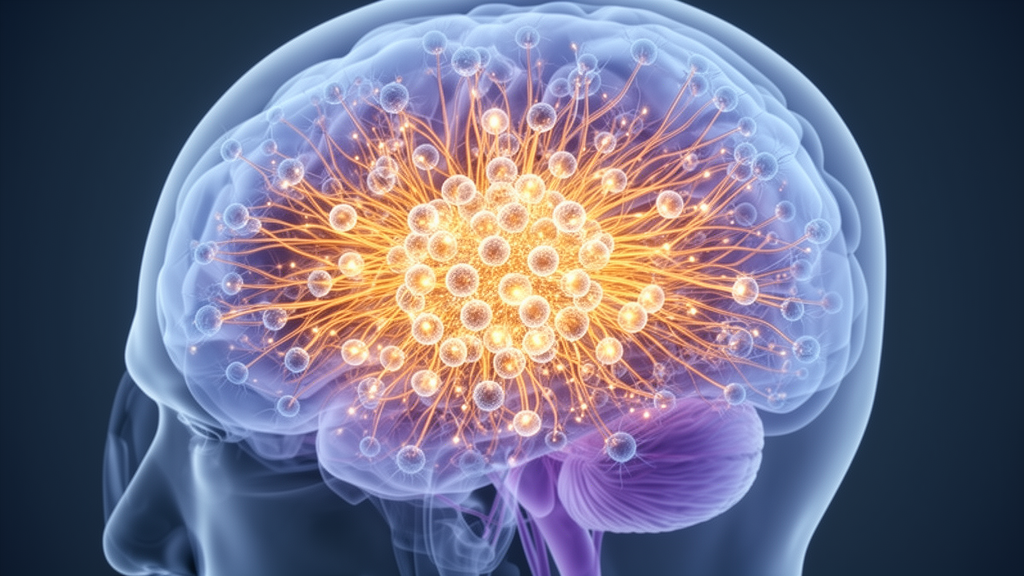
A simulation study of 25 independently generated cortical-inspired networks found that embedding a strongly recurrent excitatory core within surrounding excitatory and inhibitory populations increased the mutual information between successive core states. The modeled embedding did not optimize information flux in the strict sense: simpler, optimized static biases produced higher values than the complete surrounding network. Instead, the results support a narrower interpretation in which the embedding circuit acts as a distributed regulator that prevents a strongly recurrent core from becoming trapped in a highly active, low-diversity state. The finding comes from a simplified model rather than a direct recording from biological tissue.
The researchers built an “Embedded Core Model,” a 125-neuron abstraction of selected features of cortical layer 5 microcircuits. It contained 10 excitatory core neurons, 90 excitatory peripheral neurons and 25 inhibitory interneurons. Core neurons were densely and strongly interconnected, with 30 directed core-to-core connections among the 90 possible off-diagonal pairs. The peripheral neurons formed a more weakly connected background, while interneurons projected with negative weights to both excitatory groups but did not connect to one another. Excitatory connectivity density was set at 11.6%, and excitatory weights were drawn from a lognormal distribution, with the largest sampled weights assigned to the designated core connections. The model was not intended to reconstruct a particular cortical column, and its binary, synchronously updated neurons omitted spikes, conduction delays, synaptic dynamics, plasticity, cell-type diversity and ongoing sensory input.
Information flux was defined as the mutual information between successive global states of the core. For most comparisons, the researchers compressed this quantity into a triplet-based indicator, averaging mutual information within three fixed groups of three core neurons and across six ordered pairs of groups. The indicator was designed for paired comparisons between conditions, not as a numerical substitute for the complete 10-neuron information rate. It was later checked against a semianalytical calculation of full-state mutual information for the autonomous isolated core, where the complete 1,024-by-1,024 transition matrix could be constructed directly.
Embedding produced a large and consistent difference across the ensemble. In the reference regime, the mean intra-triplet contribution was 0.052 bit, with a 95% confidence interval of 0.043–0.061 bit, while the inter-triplet contribution was 0.064 bit, with an interval of 0.058–0.072 bit. The combined indicator was approximately 116. When the peripheral and interneuron populations were removed, the corresponding contributions fell to 0.014 bit and 0.017 bit, and the indicator dropped to 30.9. The isolated core was not merely less predictable; it occupied a restricted part of its state space. Its mean on-probability was 0.881, compared with 0.548 in the embedded condition. Because successive states carried less diversity, their mutual information remained low even though the restricted dynamics were relatively predictable.
Directional interventions indicated that the benefit did not require a closed feedback loop in which core output continuously shaped the surrounding circuit. Removing projections from the core to the periphery or interneurons had essentially no effect on the ensemble mean, and removing both pathways together was similarly ineffective. In contrast, deleting inhibitory projections from interneurons to the core reduced the intra-triplet measure by a mean of 44.1 × 10−3 bit, with a 95% confidence interval of 36.0–52.6 × 10−3 bit, and reduced the inter-triplet measure by 55.0 × 10−3 bit, with an interval of 47.9–63.0 × 10−3 bit. Both decreases occurred in all 25 networks. Direct excitatory projections from peripheral neurons to the core were not consistently required, whereas interactions among peripheral and interneuron populations helped establish the operating conditions under which inhibition acted on the core.
Signal-replacement experiments separated the main properties of the embedding input. Replaying the complete recorded embedding sequence into an isolated core reproduced the full embedded result, showing that ongoing feedback from the core was unnecessary once the input sequence had been generated. Replacing each fluctuating input with its own temporal mean produced an even higher indicator of 129.5, exceeding full embedding in 23 of the 25 paired networks. Across the ensemble, 228 of 250 neuron–network combinations had negative mean embedding inputs; the average mean was −6.37 and the average standard deviation was 4.01. The surrounding circuit therefore supplied heterogeneous negative biases that shifted core neurons away from saturation, rather than relying on complex moment-to-moment signals.
Fluctuations did not provide a clear advantage beyond the mean input. Temporally white, independent Gaussian signals matched to each neuron’s empirical mean and standard deviation reduced the indicator to 110.9, below the embedded value in every network. A more demanding multivariate control matched the full empirical mean vector and instantaneous spatial covariance matrix. It restored the indicator to 116.1, essentially identical to full embedding, with paired differences of +0.37 × 10−3 bit for the intra-triplet measure and −0.25 × 10−3 bit for the inter-triplet measure; both confidence intervals included zero. The study therefore found no evidence that non-Gaussian marginal distributions contributed a unique benefit under the tested conditions. Matching spatial covariance was sufficient for Gaussian signals to reproduce the embedded result, although the control did not reproduce temporal autocorrelation or higher-order dependencies.
Simple static biases performed better than the modeled embedding architecture. A network-specific sweep of one common negative bias yielded a held-out indicator of 191.6, with a 95% confidence interval of 173.3–211.3, compared with 116.1 under full embedding. The optimized uniform condition exceeded full embedding in every network. An evolutionary search for ten neuron-specific biases produced a held-out indicator of 208.8, with an interval of 188.2–230.8, and also exceeded full embedding in all 25 networks. In the illustrated network, selected biases ranged from −14.08 to −0.41, consistent with the different recurrent inputs received by individual neurons. These were the best solutions found under a finite search budget rather than guaranteed global optima, but the held-out results show that the core could be moved to higher-flux regimes without changing its recurrent weights.
A local adaptive rule produced the strongest result in the isolated-core comparison. Each neuron adjusted its own bias according to whether its recent activation frequency was above or below one half. Starting from zero, the biases became negative and stabilized at different levels. Across the ensemble, final mean activities for the ten neuron identities ranged from 0.4997 to 0.5001. When adaptation stopped and the learned biases were held constant during independent evaluations, the mean indicator reached 213.8, with a 95% confidence interval of 192.3–236.3. It exceeded full embedding in every network and was slightly higher than the numerically optimized neuron-specific condition in 24 of 25 cases, by 5.0 indicator units on average. A target activity of one half maximizes the marginal output entropy of a binary neuron, but it does not mathematically guarantee maximal network mutual information because conditional entropy also matters.
Entropy decomposition clarified the mechanism. Mutual information is the entropy of successor states minus the conditional entropy that remains after the preceding state is known. Isolation reduced successor-state entropy by 1.164 bit; a nearly offsetting reduction in conditional entropy meant that transitions became more predictable, but not predictably enough to compensate for the loss of state diversity. Matched means reduced both quantities more modestly, with the reduction in conditional entropy slightly larger, producing a net information-flux increase. Optimized and adaptive biases increased both successor-state entropy and transition uncertainty, but the entropy gain was larger. Independent Gaussian fluctuations created a slightly unfavorable balance, whereas the component changes under spatially matched Gaussian input nearly canceled. These results show why the issue cannot be reduced to a simple opposition between bias and noise.
The reduced indicator was strongly validated against the complete-core measure. Across five cores and 36 uniform-bias conditions per network, Spearman correlations with semianalytical full-state mutual information ranged from 0.9907 to 0.9997, averaging 0.9959. The two measures changed in the same direction over an average of 97.71% of successive bias intervals, and the bias maximizing the reduced indicator differed from the full-state optimum by an average of only 0.24 units. Thirty alternative triplet partitions produced a median correlation of 0.9977, with a minimum of 0.9673. Separate controls showed that randomly assigning strong core weights erased the embedding advantage, while independently tuning inhibition to the core and periphery improved the common-weight reference. These findings support the conclusion that embedding regulates a problem created by strong recurrence, rather than delivering the maximum information flux available to the tested architectures.
For biological neuroscience, the simulation suggests one possible functional role for core–periphery organization: maintaining a usable dynamic range in a strongly recurrent subnetwork. It does not show that evolution produced cortical circuits to maximize mutual information, or that a surrounding circuit is the only means of accomplishing this. For artificial recurrent systems, the results point toward local excitability regulation as an alternative to exclusively global parameter tuning, including approaches resembling reservoir computing. The limits are substantial: the model is binary and synchronous, its synaptic weights are fixed, and its information measure describes statistical dependence rather than causal transfer between particular neurons. High successive-state mutual information also does not guarantee useful memory, prediction or task performance. Testing whether this operating-point principle survives in asynchronous, spiking and data-constrained circuits, and whether it predicts computational performance, will require models closer to biological tissue.
Subject of Research: Simulation study of information-flux regulation in cortical-inspired core–periphery neural networks.
Article Title: Are cortical microcircuits optimized for information flux?—A simulation-based reverse engineering study
Article References: Metzner, C., Ghebleh, A., Prebeck, K., Schilling, A., Maier, A., Kinfe, T., & Krauss, P. (2026). Are cortical microcircuits optimized for information flux?—A simulation-based reverse engineering study. Frontiers in Computational Neuroscience, 20, Article 1886601. https://doi.org/10.3389/fncom.2026.1886601
Image Credits: AI Generated
DOI: 10.3389/fncom.2026.1886601
Keywords: cortical microcircuits, recurrent neural networks, information flux, mutual information, core–periphery organization, neuronal inhibition, adaptive bias, Boltzmann neurons, reservoir computing, simulation study, cortical, microcircuits
Cite Scienmag News
Denise Maddox. (October 20, 2026). Modeled cortical core–periphery networks enhance information flux by regulating saturation. Scienmag. https://scienmag.com/modeled-cortical-core-periphery-networks-enhance-information-flux-by-regulating-saturation/
Denise Maddox. "Modeled cortical core–periphery networks enhance information flux by regulating saturation." Scienmag, 20 October 2026, https://scienmag.com/modeled-cortical-core-periphery-networks-enhance-information-flux-by-regulating-saturation/. Accessed 20 October 2026.
Denise Maddox. "Modeled cortical core–periphery networks enhance information flux by regulating saturation." Scienmag. October 20, 2026. https://scienmag.com/modeled-cortical-core-periphery-networks-enhance-information-flux-by-regulating-saturation/


