


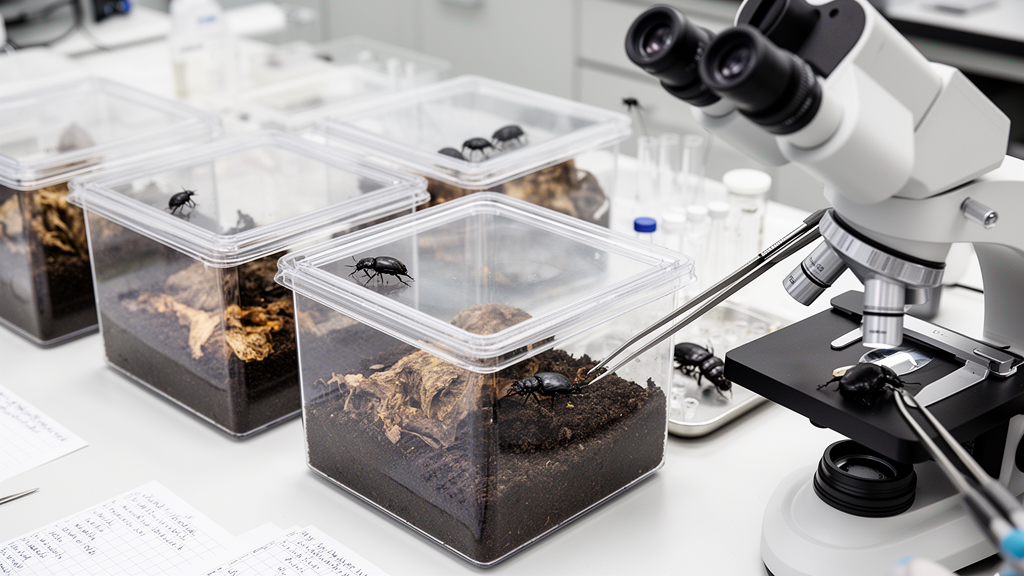
A controlled laboratory experiment involving two tunnelling dung beetle species found that manipulating beetle density and sex ratio together was associated with more dung burial, changes in the number of broods produced, and changes in the size and dry weight of individual broods. Onthophagus binodis and Digitonthophagus gazella were tested in identical conditions with 10 independent replicates per treatment. The results describe a reproductive trade-off under the tested conditions, but they do not establish which of the two manipulated variables produced each response or identify competition, mating or individual feeding as the underlying mechanism.
The researchers selected the two species because they are established in cattle pastures in northern New South Wales, Australia, and both bury vertebrate dung beneath the soil to construct brood chambers. They are paracoprid, or tunnelling, beetles in which males and females cooperate during dung relocation and brood construction, with females primarily responsible for constructing and provisioning broods. Such activity can connect reproductive behaviour with ecological processes including dung removal, soil aeration, nutrient cycling, secondary seed dispersal and fly control.
The experiment focused on two functions in the laboratory: dung burial as a measure of ecosystem activity, and several reproductive outcomes that reflected how the beetles allocated resources among broods. To reduce variation associated with the age and reproductive status of field-collected adults, the researchers mass-reared first-generation, or F1, beetles. Females were sexually mature at approximately 15 days old, a status confirmed through dissection of representative individuals and microscopic examination of ovarian and oocyte development.
Only relatively large beetles were used, while only major males were included for O. binodis because minor males have reduced or rudimentary pronotal horns. The two species were reared separately but tested concurrently at approximately 25°C and 40% relative humidity under a 12-hour light-and-dark cycle. Nesting substrate contained sand and vermiculite at a ratio of 1:2 and was maintained at approximately 10% moisture.
Each species experienced six breeding configurations: one female, one male–female pair, one pair plus one female, two pairs, two pairs plus one female, and three pairs. Because abundance and composition changed across this series, the experiment could evaluate the combined effect of density and sex ratio but could not isolate their individual effects. A randomised block design supplied 10 independent replicates for every treatment and species.
Each container received 100 grams of cattle dung twice weekly for 14 days, so total food provision remained constant while the number of beetles increased. The dung came from one pasture, was homogenised and frozen before use, and was given to both species. This design standardised the resource and made per-capita availability lower in containers holding more beetles.
Brood production varied significantly with the combined density-and-sex-ratio treatment in both species. The O. binodis trials yielded 804 broods in total, whereas D. gazella yielded 453. For O. binodis, brood numbers were highest with one pair plus one female and with two pairs plus one female; for D. gazella, the highest numbers occurred with two pairs and with two pairs plus one female.
A solitary female produced the fewest broods in both species. When results were averaged across treatments, O. binodis produced more broods than D. gazella, with the species difference reported as highly significant. The beetles were not matched for body size: experimental O. binodis averaged 111 ± 29.8 mg and D. gazella 80 ± 20.1 mg, so the contrast cannot be attributed to species alone.
Brood size and dry weight followed a different pattern from brood number. The combined treatment significantly affected ellipsoid volume and dry weight in both species, and the three-pair treatment produced the smallest broods. O. binodis produced larger broods in the solitary-female, one-pair, one-pair-plus-one-female and two-pair treatments than in the two-pairs-plus-one-female and three-pair treatments.
Its heaviest broods occurred with one or two pairs. D. gazella produced larger and heavier broods with one pair or one pair plus one female than with two or three pairs. Averaged across treatments, D. gazella produced significantly larger and heavier individual broods than O. binodis despite producing fewer broods in total.
These measurements describe differences in brood allocation; they do not by themselves demonstrate differences in offspring quality, survival or fitness. Brood volume was strongly associated with brood dry weight in both species, supporting their use as complementary measures of material investment per brood. For O. binodis, the fitted regression was ellipsoid volume = 395.84 + 1,589.6 × brood dry weight, with marginal R² = 0.766 and p < 0.001.
For D. gazella, it was ellipsoid volume = 227.04 + 1,565.6 × brood dry weight, with marginal R² = 0.792 and p < 0.001. The relationship between brood number and volume was much weaker. O. binodis showed a statistically significant but slight negative association, with marginal R² = 0.057 and p < 0.001, whereas D. gazella showed no significant association, with marginal R² = 0.005 and p = 0.213.
Brood quantity therefore did not reliably predict brood size across the dataset. Dung burial showed the opposite overall pattern to individual brood mass. The combined density-and-sex-ratio treatment significantly affected burial in both species, with higher-beetle treatments generally burying more dung than the solitary-female control.
For O. binodis, the two-pairs-plus-one-female and three-pair treatments buried 91.5 g/kg dry matter more organic matter than a solitary female, with p = 0.003. For D. gazella, treatments with two pairs or more buried 124 g/kg dry matter more than a solitary female, with p < 0.001. Across treatments, D. gazella buried significantly more dung than O. binodis.
Neither feeding period nor its interaction with treatment significantly changed the burial response. The study did not directly measure the relationships among dung burial, individual resource intake, mating success or aggression. Several limitations constrain interpretation of these patterns.
Density and sex ratio were manipulated together rather than independently, and equal dung provisioning meant that per-capita resource availability changed as the number of beetles rose. It also covered a conservative range of no more than three breeding pairs per container. In addition, the dung was frozen and thawed, which may alter some characteristics, although all containers received dung subjected to the same treatment.
Across treatments, the beetles consumed only about 50% to 55% of the dung’s organic matter. These results therefore characterize reproductive allocation and dung burial under standardised laboratory conditions rather than demonstrating field-scale responses in natural populations. Overall, the experiment shows that joint variation in beetle abundance and sex composition coincided with a shift from larger, heavier broods at several lower-density treatments to smaller broods at the highest density, while dung burial generally increased.
Maximum brood production occurred at intermediate treatment combinations rather than at the largest group in either species. The authors interpret the pattern as a trade-off between the number of broods and investment per brood, but the design cannot determine whether altered resource availability, male–female interactions or other mechanisms produced that pattern. The findings nevertheless establish a measurable link between the experimental composition of breeding groups, reproductive allocation and an ecosystem-relevant process in two common Australian pasture tunnellers.
Subject of Research: Joint effects of beetle density and sex ratio on dung burial and reproductive allocation in two tunnelling dung beetle species
Article Title: Combined Effects of Beetle Density and Sex Ratio on Reproductive Trade‐Offs and Dung Burial in Tunnelling Dung Beetles
Article References: Chowdhury, Z. J., Hemmings, Z., Arriaga‐Jimenez, A., Vernes, K., Schaerf, T. M., & Andrew, N. R. (2026). Combined Effects of Beetle Density and Sex Ratio on Reproductive Trade‐Offs and Dung Burial in Tunnelling Dung Beetles. Ecology and Evolution, 16(10), Article e74499. https://doi.org/10.1002/ece3.74499
Image Credits: AI Generated
DOI: 10.1002/ece3.74499
Keywords: dung beetles, Onthophagus binodis, Digitonthophagus gazella, brood production, dung burial, sex ratio, reproductive allocation, ecosystem engineering, laboratory experiment, Australian pastures, Combined, Effects
Cite Scienmag News
Drew Townsend. (October 20, 2026). Lab Study Links Combined Beetle Density and Sex Ratio to Burial and Brood Traits. Scienmag. https://scienmag.com/lab-study-links-combined-beetle-density-and-sex-ratio-to-burial-and-brood-traits/
Drew Townsend. "Lab Study Links Combined Beetle Density and Sex Ratio to Burial and Brood Traits." Scienmag, 20 October 2026, https://scienmag.com/lab-study-links-combined-beetle-density-and-sex-ratio-to-burial-and-brood-traits/. Accessed 20 October 2026.
Drew Townsend. "Lab Study Links Combined Beetle Density and Sex Ratio to Burial and Brood Traits." Scienmag. October 20, 2026. https://scienmag.com/lab-study-links-combined-beetle-density-and-sex-ratio-to-burial-and-brood-traits/


