


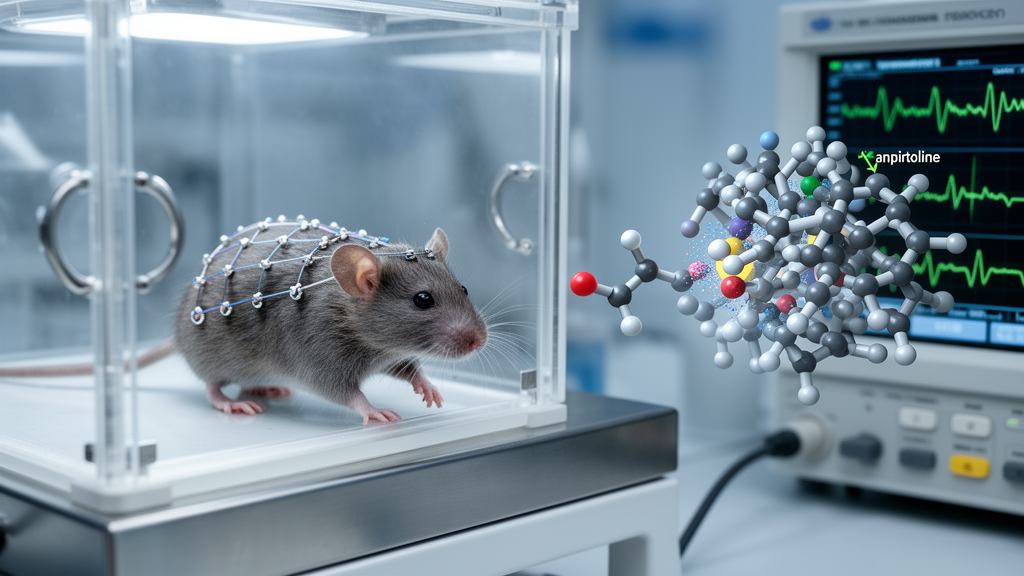
Intranasal exposure to cerium dioxide nanorods produced neurological abnormalities in male mice, including altered exploration, increased seizure susceptibility and abnormal epileptiform activity in electroencephalography, according to a controlled laboratory study. The particles accumulated in the hippocampus and striatum, where researchers also observed reduced expression of the serotonin 1B receptor, or 5-HT1B. Treatment with the selective 5-HT1B receptor agonist anpirtoline partially reversed several behavioral, electrophysiological and molecular changes. The findings implicate disrupted serotonergic signaling as an important contributor to the observed neurotoxicity, but the mouse experiments do not establish human risk or demonstrate that anpirtoline can treat nanoparticle poisoning in people.
The researchers used commercially available rod-shaped cerium dioxide particles, designated CeO2 NRs, with most of the measured size distribution between 6.5 and 11.7 nanometres. Cerium dioxide has redox properties associated with the reversible conversion of Ce3+ and Ce4+, allowing it to participate in reactions involving reactive oxygen species. This dualistic behavior has supported interest in possible antioxidant biomedical uses while also making biological effects dependent on factors such as concentration, exposure duration, morphology and route of administration. Earlier studies have reported both antioxidant activity and harmful effects involving oxidative stress, inflammation and cellular damage. The current experiments were designed to examine neurological function and signaling rather than to establish the material’s general safety or toxicity.
Eight-week-old male C57BL/6J mice received 10.5 milligrams per kilogram of CeO2 NRs by intranasal instillation once daily for three consecutive days. Control animals received the same volume of saline. After the last exposure, the researchers conducted behavioral tests, seizure-susceptibility tests and EEG recordings before collecting brain tissue for histological staining, transcriptome sequencing and proteomics. A separate experiment included controls, particle-exposed mice, mice given anpirtoline alone and exposed mice treated with anpirtoline. The agonist was administered intraperitoneally at 0.5 milligrams per kilogram, 30 minutes after each particle exposure. The selected particle dose was lower than the 40 milligrams per kilogram used in some earlier mouse studies that focused heavily on oxidative brain injury and cell death.
Analysis of brain tissue by inductively coupled plasma optical emission spectrometry showed significantly greater cerium accumulation in the hippocampus and striatum than in the other examined regions, with reported differences of p less than 0.0001. Biological transmission electron microscopy then revealed rod-shaped or particulate cerium dioxide structures inside hippocampal neurons, including material enclosed in lysosomes and particles observed in nuclei. In a separate lysosome-mimicking experiment, artificial lysosomal fluid altered the particles’ surface structure, reduced their crystallinity and broadened selected diffraction peaks, consistent with partial transformation under lysosome-like conditions. Primary cortical neurons took up the particles after one hour of exposure to fluorescently labeled CeO2 NRs at 100 micrograms per millilitre. After three days, 100 micrograms per millilitre reduced measured apoptosis, whereas 500 and 1,000 micrograms per millilitre significantly increased apoptosis and neuronal death. The tested concentrations exceeded those directly measured in vivo, however, and the authors cautioned that the cellular results could not be directly extrapolated to physiological exposure.
Behavioral testing showed a consistent shift toward unusually intensive exploration. In the open-field test, exposed mice spent more time in the central zone and entered it more frequently than controls. In the novel-object recognition test, they spent longer and made more frequent approaches toward the novel object. Particle-exposed animals also spent a greater proportion of their time in the open arms of the elevated plus maze, a pattern the authors associated with increased risk-taking. Their forced-swim immobility was approximately 20%, compared with roughly 60% in controls, while social-preference and social-novelty indices were also elevated. The investigators interpreted the combined pattern as increased novelty seeking and weaker behavioral inhibition. These assays measured behavioral differences in mice and did not diagnose a human psychiatric disorder or establish the motivation underlying the altered behavior.
Seizure testing indicated that the particles also changed responses to an epileptogenic challenge. Under cumulative pentylenetetrazol administration, exposed mice developed more severe seizure-like responses after the first and second injections than controls, although the groups no longer differed significantly after the third and fourth injections. EEG recordings provided a separate measure of network excitability. Mice exposed to CeO2 NRs displayed burst-like discharges, occasional epileptiform spikes and localized increases in time-frequency power despite not exhibiting overt seizures. When a larger pentylenetetrazol challenge was administered, particle-exposed animals produced more frequent and prolonged epileptiform activity than animals receiving pentylenetetrazol alone. The measured outcomes therefore associate intranasal particle exposure with increased abnormal electrical activity and reduced resistance to seizure-inducing stimulation, while the absence of spontaneous overt seizures in the exposed mice remains an important boundary on the findings.
Integrated transcriptomic and quantitative proteomic analyses pointed toward changes in neurotransmitter regulation, oxidative metabolism, inflammation and neuronal stability. Under the study’s differential-expression criteria, 33 genes were upregulated and 39 were downregulated in exposed mice compared with controls. Htr1b, the gene encoding the 5-HT1B receptor, was among the reduced transcripts, while expression of Glul, which encodes glutamine synthetase, also fell. Pathway analysis implicated oxidative phosphorylation, arachidonic-acid-related inflammatory pathways, chemokine signaling and mitogen-activated protein kinase signaling. Quantitative proteomics identified 6,733 proteins across 20 samples, including decreases in Kcnt2 and Slc24a3, which are involved in maintaining neuronal electrical stability. RNA and protein integration revealed several concordant changes associated with oxidative stress, but the effects were modest and may have been weakened by inter-individual variability because the transcriptomic and proteomic measurements did not use matched animals.
Immunofluorescence measurements in the hippocampus and striatum showed increased serotonin fluorescence together with reduced 5-HT1B receptor expression. The abundance of tryptophan hydroxylase 2, described in the study as a rate-limiting enzyme of central serotonin synthesis, did not change significantly. The researchers therefore inferred that the higher local serotonin signal was more consistent with altered utilization, secretion or feedback regulation than with increased synthesis. The 5-HT1B receptor acts as an inhibitory presynaptic autoreceptor and heteroreceptor that restrains the release of serotonin and other neurotransmitters. Its downregulation was accompanied by increased hippocampal c-Fos, used as a marker of neuronal activation, and elevated intracellular calcium in exposed primary neurons. Stronger inducible nitric oxide synthase and weaker arginase-1 signals indicated a shift toward a more pro-inflammatory and less repair-oriented cellular environment. BV2 microglial cells exposed to CeO2 NRs also showed increased inducible nitric oxide synthase expression, supporting a direct effect on the cell model under the tested conditions.
The anpirtoline experiment provided functional evidence that impaired 5-HT1B signaling contributed to at least some of the measured abnormalities. The agonist reduced central-zone activity to control levels in the open-field test, shortened novel-object exploration, reduced open-arm time and brought social-preference measures closer to control values. It partially restored forced-swim immobility. During the cumulative seizure challenge, treated exposed mice had lower early Racine seizure scores than exposed animals without anpirtoline and resembled controls after the first injection. Anpirtoline also reduced abnormal EEG discharges and high-power regions during the pentylenetetrazol challenge, while it did not significantly alter baseline EEG activity in unexposed mice. Molecular analyses showed partial restoration of 5-HT1B receptor protein, lower serotonin and c-Fos signals, and increased arginase-1 expression in the hippocampus and striatum. These results support a functional role for the receptor, but the intervention was partial and does not exclude contributions from inflammation, oxidative stress, glutamate signaling and gamma-aminobutyric acid release.
Overall, the experiments connect short-term intranasal CeO2 NR exposure with brain accumulation, altered exploration, increased seizure susceptibility, abnormal EEG activity, serotonergic dysregulation, neuroinflammation and neuronal hyperactivation in male mice. The rescue experiments indicate that loss of 5-HT1B signaling is an important mechanism rather than the only possible mechanism. Important limitations remain: the work involved short exposure in one mouse strain and sex, the in vitro concentrations exceeded directly measured in vivo levels, and species differences in nasal anatomy and olfactory deposition prevent direct translation of the dose into a human exposure. The anpirtoline findings therefore provide a mechanistic lead for nanomaterial safety research and future testing, not evidence of a clinical treatment or a quantified human neurological hazard.
Subject of Research: Neurobehavioral effects of intranasally administered cerium dioxide nanorods in male mice
Article Title: High-dose cerium dioxide nanorods induce behavioral and electroencephalographic abnormalities through 5-HT1B receptor signaling disruption with an evaluation of anpirtoline's therapeutic potential
Article References: Liu, M., Li, Y., Shen, C., Huang, H., Liu, Q., Fu, B., Wu, B., Wu, X., Luo, Y., Shan, Y., Niu, X., & Zhao, G. (2026). High-dose cerium dioxide nanorods induce behavioral and electroencephalographic abnormalities through 5-HT1B receptor signaling disruption with an evaluation of anpirtoline's therapeutic potential. Materials Today Bio, 41, Article 103749. https://doi.org/10.1016/j.mtbio.2026.103749
Image Credits: AI Generated
DOI: 10.1016/j.mtbio.2026.103749
Keywords: cerium dioxide nanorods, intranasal exposure, mouse neurotoxicity, serotonin 1B receptor, anpirtoline, electroencephalography, seizure susceptibility, neuroinflammation, brain accumulation, multi-omics, High-dose, cerium
Cite Scienmag News
Drew Townsend. (October 20, 2026). High-dose cerium dioxide nanorods induce behavioral and electroencephalographic abnormalities through 5-HT1B receptor signaling disruption with an evaluation of anpirtoline’s therapeutic potential. Scienmag. https://scienmag.com/high-dose-cerium-dioxide-nanorods-induce-behavioral-and-electroencephalographic-abnormalities-through-5-ht1b-receptor-signaling-disruption-with-an-evaluation-of-anpirtolines-therapeutic-potential/
Drew Townsend. "High-dose cerium dioxide nanorods induce behavioral and electroencephalographic abnormalities through 5-HT1B receptor signaling disruption with an evaluation of anpirtoline’s therapeutic potential." Scienmag, 20 October 2026, https://scienmag.com/high-dose-cerium-dioxide-nanorods-induce-behavioral-and-electroencephalographic-abnormalities-through-5-ht1b-receptor-signaling-disruption-with-an-evaluation-of-anpirtolines-therapeutic-potential/. Accessed 20 October 2026.
Drew Townsend. "High-dose cerium dioxide nanorods induce behavioral and electroencephalographic abnormalities through 5-HT1B receptor signaling disruption with an evaluation of anpirtoline’s therapeutic potential." Scienmag. October 20, 2026. https://scienmag.com/high-dose-cerium-dioxide-nanorods-induce-behavioral-and-electroencephalographic-abnormalities-through-5-ht1b-receptor-signaling-disruption-with-an-evaluation-of-anpirtolines-therapeutic-potential/


