


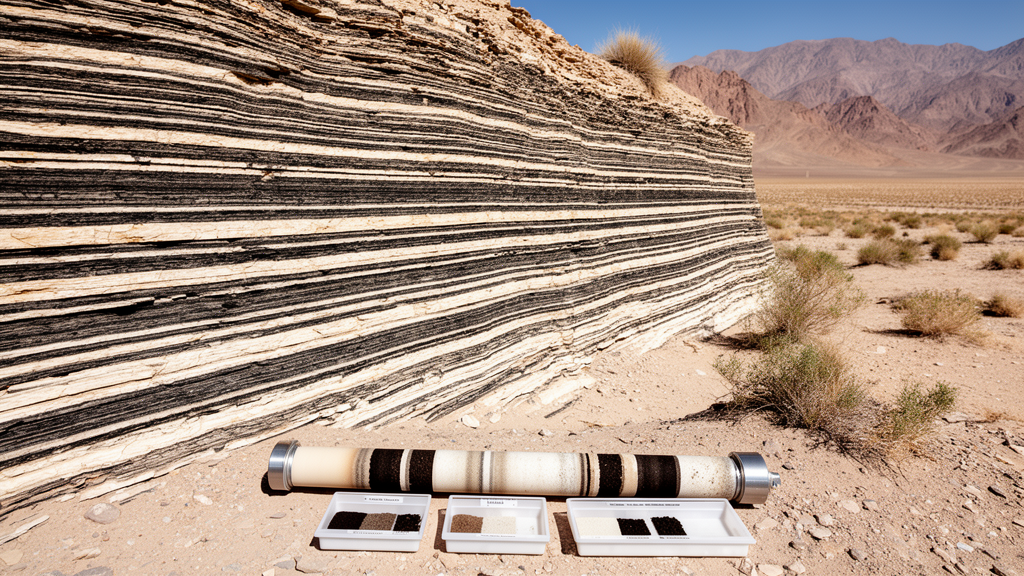
A high-resolution study of Carboniferous strata in southwestern China’s Tarim Basin has identified astronomical signals in the Karawuyi Formation and used them to establish a framework for locating organic-rich intervals. Researchers combined natural gamma-ray logs from four wells and one measured outcrop section with total organic carbon measurements and elemental geochemical data from Well QQ2. The analysis identified 13 fourth-order sequences and 50 fifth-order sequences in the reference well, showing that organic-matter enrichment was consistently associated with particular phases of an approximately 405,000-year orbital cycle.
The Karawuyi Formation is a roughly 300–600-metre-thick interval of interbedded mudstone, sandstone and limestone in the southwestern Tarim Basin. During the Carboniferous, the basin formed a broad epicontinental sea with shallow marine, lagoon-bay, tidal-flat and delta environments. Individual beds in the formation are thin, while lithofacies change rapidly both vertically and laterally.
Those conditions make sequence boundaries difficult to identify from rock descriptions alone and complicate the correlation of organic-rich beds between wells. The study therefore used gamma-ray records as its principal cyclostratigraphic proxy because they provide continuous, finely sampled measurements that respond to changes in clay content, organic-matter abundance and radioactive-element enrichment. For the detailed analysis of Well QQ2, the researchers removed isolated anomalies and missing records, checked sampling intervals, interpolated where necessary and resampled the gamma-ray data at 0.05-metre intervals.
Long-term trends were removed with locally weighted scatterplot smoothing, using a smoothing span of 60%. Multi-taper spectral analysis then identified the principal periodic components, while evolutive harmonic analysis tracked their vertical persistence. A correlation-coefficient analysis estimated an average sedimentation rate of approximately 6.99 centimetres per thousand years.
At that rate, six observed cyclic thicknesses closely matched astronomical periods proposed for about 300 million years ago: 27.17 metres for the 405-thousand-year long-eccentricity cycle, 6.62 metres for the 95-thousand-year short-eccentricity cycle, 2.88 and 2.26 metres for obliquity cycles, and 1.43 and 1.25 metres for precession cycles. The relative deviations between the observed and theoretical thicknesses ranged from 0.31% to 5.74%. The spectral analysis produced 11 peaks above the 99% confidence level of a red-noise background model.
Evolutive harmonic analysis indicated that the 27.17- and 6.62-metre signals remained relatively continuous through most of the studied interval, whereas the obliquity and precession signals were expressed more intermittently. The 14.45-metre peak was interpreted as a possible harmonic response rather than an independent orbital component because its thickness is close to half the theoretical thickness of the long-eccentricity cycle. No distinct peak occurred at the expected 8.60-metre thickness for the 123-thousand-year short-eccentricity component.
The researchers suggested that rapid lithofacies changes, variable sedimentation and local depositional hiatuses may have weakened or prevented its expression, meaning the absence of the peak does not by itself demonstrate an absence of the corresponding orbital influence. Gaussian band-pass filtering isolated the two most persistent eccentricity signals and supplied a reference for dividing the succession. The long-eccentricity curve marked 13 fourth-order sequences, while the short-eccentricity curve resolved 50 fifth-order sequences.
Each fourth-order interval generally contained three to five fifth-order sequences. Boundaries were placed near long-eccentricity minima and checked against sedimentary evidence, including increased sandy deposits, abrupt lithological changes and inflection points in gamma-ray logs. During base-level rise, muddy or argillaceous carbonate deposits generally increased toward a maximum-flooding interval; during base-level fall, sandy and carbonate-rich beds became more common.
Well QQ2 served as the reference for correlation with the ATG outcrop section and Wells YB8, MT1 and MB1 along a southwest–northeast transect. That regional correlation showed that differential preservation accounts for much of the apparent lateral variation in the sequence record. The ATG section, Well QQ2 and Well MB1 each contained 13 fourth-order sequences, whereas Wells YB8 and MT1 contained 10.
The authors linked the reduced records in YB8 and MT1 to their positions on relative structural highs, where erosion may have removed part of the succession. At a larger scale, the formation was divided into two third-order sequences: the upper mudstone and lower sand-mud stone members formed the first, while the upper sand-mud stone and limestone-bearing members formed the second. Fifth-order sequences were especially densely developed in the sand-mud stone member, where sandstone and mudstone repeatedly interbed.
Total organic carbon in the sand-mud stone member of Well QQ2 ranged from 0.02% to 6.24%, with an average of 1.87%. To evaluate the association between organic matter and orbital phase, the researchers selected six complete long-eccentricity cycles and divided each into high- and low-value intervals using the midpoint between the filtered curve’s local maximum and minimum. Mean TOC was 2.24% in the high-value intervals and 1.56% in the low-value intervals.
The high-value interval had the greater mean TOC in all six cycles, a paired difference that was statistically significant in a two-sided Wilcoxon signed-rank test with p = 0.031. High TOC generally coincided with dark mudstone and silty mudstone near long-eccentricity maxima and maximum flooding, whereas lower values were associated with intervals containing more sand or carbonate. Elemental proxies indicated that the orbital pattern coincided with a broader environmental cycle.
Near long-eccentricity maxima, the molybdenum enrichment factor and uranium enrichment factor generally increased while the thorium-to-uranium ratio decreased, a combination consistent with more reducing bottom-water conditions. At the same times, the C-value and chemical index of alteration typically rose while the strontium-to-copper ratio fell, indicating relatively warm and humid conditions, stronger chemical weathering, greater runoff and stronger terrigenous input. Near eccentricity minima, the proxies commonly shifted toward weaker reducing conditions, reduced freshwater supply and enhanced carbonate deposition.
Strontium-to-barium ratios suggested that salinity also varied, although their imperfect correspondence with the orbital curve indicated additional influences from lithology, water-mass connectivity and relative sea level. The authors interpret the environmental contrast through a pair of depositional models. During long-eccentricity maxima, they propose that greater orbital eccentricity strengthened seasonal contrasts and supported a warm, humid phase with increased precipitation and runoff.
Nutrients and terrestrial sediment entered the epicontinental sea, while relative sea-level rise produced deeper water and greater accommodation. In their model, increased nutrient delivery could have supported primary productivity, whereas reducing conditions could have enhanced organic-matter preservation. During long-eccentricity minima, weaker freshwater input, lower nutrient supply, falling relative sea level, greater oxygenation and carbonate dilution corresponded with generally lower TOC.
These are paleoenvironmental interpretations of the measured associations rather than direct experimental demonstrations of causation. Thin coal seams represent a separate, locally observed mode of organic-matter accumulation. They occur above some maximum-flooding intervals during base-level fall, when the authors propose that marginal swamp conditions may have favoured plant-matter accumulation.
This differs from organic-rich mudstone deposited around maximum flooding under relatively deeper-water conditions. Because the seams occur only in several wells and sections, the study does not treat them as a general feature of all fourth-order sequences. Thirteen long-eccentricity cycles imply an astrochronological duration of about 5.3 million years for the Karawuyi Formation, broadly compatible with an independent biostratigraphic estimate, although the available fossil constraints do not precisely date the formation boundaries.
Organic-rich intervals were relatively thick near the Kunlun Mountains and the Bachu Uplift but thinned markedly around the Maigaiti Slope, broadly tracking differences in sequence preservation. The framework thus links preferred stratigraphic position with subsequent structural and erosional control on lateral continuity, without directly measuring present-day oil reserves or drilling productivity.
Subject of Research: Astronomically calibrated sequence stratigraphy and organic-matter enrichment in the Carboniferous Karawuyi Formation
Article Title: High-frequency sequence stratigraphy and organic matter enrichment patterns of the Carboniferous Karawuyi Formation, Southwestern Tarim Basin
Article References: Li, H., Lei, X., Zhang, L., Chen, C., Huang, Q., Chen, X., & Lin, C. (2026). High-frequency sequence stratigraphy and organic matter enrichment patterns of the Carboniferous Karawuyi Formation, Southwestern Tarim Basin. Frontiers in Earth Science, 14, Article 1956103. https://doi.org/10.3389/feart.2026.1956103
Image Credits: AI Generated
DOI: 10.3389/feart.2026.1956103
Keywords: Karawuyi Formation, Tarim Basin, Carboniferous stratigraphy, cyclostratigraphy, Milankovitch cycles, organic matter enrichment, total organic carbon, paleoenvironment, sequence stratigraphy, hydrocarbon source rocks, High-frequency, sequence
Cite Scienmag News
Violet Maxwell. (October 20, 2026). Research report: High-frequency sequence stratigraphy and organic matter enrichment patterns of the Carboniferous Karawuyi Formation, Southwestern Tarim Basin. Scienmag. https://scienmag.com/research-report-high-frequency-sequence-stratigraphy-and-organic-matter-enrichment-patterns-of-the-carboniferous-karawuyi-formation-southwestern-tarim-basin/
Violet Maxwell. "Research report: High-frequency sequence stratigraphy and organic matter enrichment patterns of the Carboniferous Karawuyi Formation, Southwestern Tarim Basin." Scienmag, 20 October 2026, https://scienmag.com/research-report-high-frequency-sequence-stratigraphy-and-organic-matter-enrichment-patterns-of-the-carboniferous-karawuyi-formation-southwestern-tarim-basin/. Accessed 20 October 2026.
Violet Maxwell. "Research report: High-frequency sequence stratigraphy and organic matter enrichment patterns of the Carboniferous Karawuyi Formation, Southwestern Tarim Basin." Scienmag. October 20, 2026. https://scienmag.com/research-report-high-frequency-sequence-stratigraphy-and-organic-matter-enrichment-patterns-of-the-carboniferous-karawuyi-formation-southwestern-tarim-basin/


