


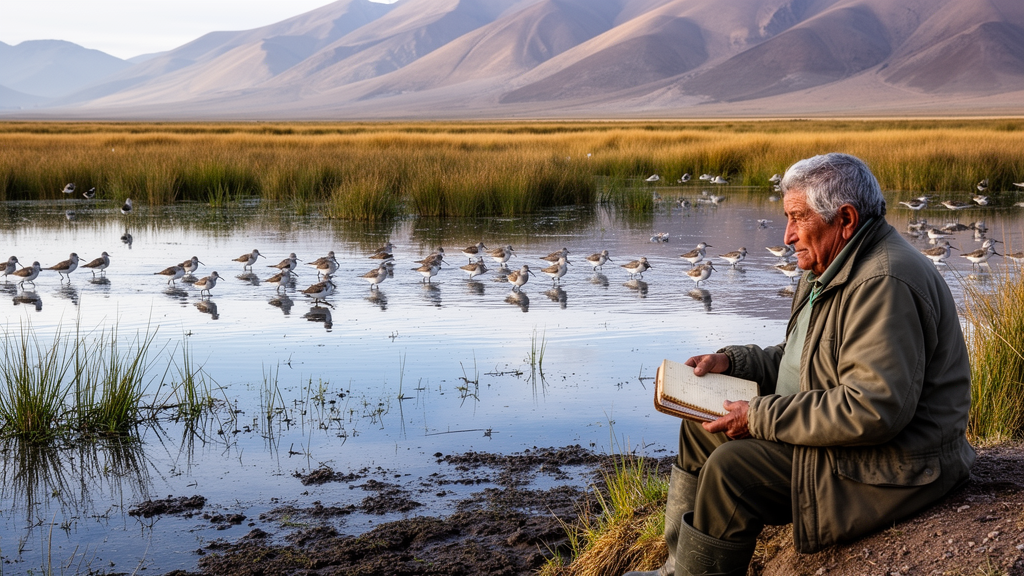
Bird observations in Chile’s Río Cruces Wetland helped residents identify environmental change, recalling pollution, the decline of river navigation, earthquakes and other transformations across the surrounding territory. An observational study led by researchers at the Institute of Ecology and Biodiversity (IEB) found that community participants recognized 87 bird species and helped identify 27 sites of biocultural significance. The study also found that 93% of those sites were outside the wetland sanctuary’s formal boundaries, showing that the communities’ memory of biodiversity extended beyond the protected area.
The project focused on the Río Cruces Wetland in Chile’s Los Ríos Region, a Nature Sanctuary covering more than 6,000 hectares and recognized as the country’s first Ramsar Site. Black-necked swans, spot-flanked gallinules, Southern lapwings, Austral thrushes and dozens of other species are associated with the wetland, which is visited by both resident birds and species that migrate during the year. The landscape has changed substantially over time.
The 1960 earthquake, pollution of the Cruces River, the decline of river navigation and urban expansion are among the events that altered both the ecosystem and the relationship between surrounding communities and their territory. Researchers from IEB, the University of Concepción and other organizations worked with residents of ten rural communities between 2019 and 2023. The project was an observational study and a knowledge co-production process in which local residents helped generate, interpret and share information.
Six residents from different communities were trained as biocultural monitors and took shared responsibility for coordinating activities with families, schools and other local residents. The change from a conventional researcher-led approach was prompted partly by the COVID-19 pandemic, but the research team said the participatory structure became a methodological strength. The central question was which birds could serve as indicators of biocultural memory and landscape transformation, while also documenting places and events that formed part of the wetland’s collective memory.
Participants recognized 87 species, or 73% of the bird species recorded by the Nature Sanctuary. The research team interpreted this result as evidence of substantial local knowledge about biodiversity. Community members also used birds to identify less visible changes, including species that had disappeared from particular areas and others that had become more frequent in specific parts of the sanctuary.
The findings were based on local observations and memory within this community setting, rather than on a controlled comparison between different monitoring systems. One especially clear spatial result was the location of the 27 sites identified as having particular biocultural significance. Ninety-three percent were outside the sanctuary’s boundaries.
These places were associated with experiences through which local knowledge, biodiversity and everyday life intersected. The project recovered memories of traditional navigation along the Cruces River, which had been important for decades as a route for moving people and goods to local markets and Valdivia’s River Market. Boats also created opportunities to gather, exchange goods and knowledge, and socialize.
As roads and bridges were constructed, river travel gradually became less prominent, transforming relationships between communities and the territory. Other memories associated with the mapped sites included gathering mushrooms and medicinal plants, making handicrafts and preparing beverages. To recover place-based accounts, researchers and participants traveled by boat and walked through locations selected during the mapping process.
In describing the significance of birds, Cristóbal Pizarro, an IEB researcher and director of the Laboratory for Anthropocene Studies, said that birds allow people to recall events of profound significance. He pointed to the environmental disaster caused by pollution of the Cruces River, noting that the migration and mass die-off of black-necked swans had a deep impact on communities surrounding the area. The study also documented those who sustain local knowledge of the wetland.
Around 54 people and families participated, and researchers identified 19 individuals with particularly extensive knowledge of biodiversity and transformations in the territory. Those participants ranged in age from 20 to 85, and most were women. Their participation was closely connected to their role in caring for the territory and preserving knowledge that forms part of community memory.
Pizarro described the relationship between experienced knowledge holders and younger residents returning to the territory as part of a broader effort to strengthen intergenerational connections and recover knowledge that may otherwise be lost. Returning the information to participants was an important part of the process. The team created the documentary Voices of a Territory, which features participants’ testimonies and experiences, and presented it at the Gran Diálogo de la Memoria, or Great Memory Dialogue.
The gathering brought together residents from different communities, researchers, authorities and other stakeholders connected to the wetland, allowing recovered stories to circulate among the people whose experiences they documented. The project also produced the Manifesto for Dialogue on the Biocultural Memory of the Río Cruces Wetland Nature Sanctuary. Its seven principles address conserving and restoring the wetland and its biocultural heritage, strengthening local communities and passing knowledge to future generations.
Other initiatives also emerged from the work, including an annual Bird Festival that has drawn strong participation from local communities. The findings offer a case study of how a participatory observational method can connect biodiversity observations with community histories in a landscape affected by crisis. The results are specific to Río Cruces, where the project depended on sustained engagement, locally trained monitors and relationships with ten surrounding communities; they should not be treated as a general estimate for other wetlands.
Nevertheless, the authors say the approach could be adapted to other territories, including places affected by floods, droughts or situations where access is difficult. By documenting how residents used birds to identify ecological change while recording memories of navigation, pollution, cultural practices and daily encounters with nature, the study demonstrates how knowledge co-production can inform community monitoring and landscape conservation beyond a protected area’s legal perimeter.
Subject of Research: Biocultural memory, wetland birds and community conservation in Chile’s Río Cruces Wetland
Article Title: Research explores the valuable connection between birds, memory, and territory in Chile
Article References: Research explores the valuable connection between birds, memory, and territory in Chile. Original publication (Bibliographic details unavailable.)
Image Credits: AI Generated
DOI: Not provided
Keywords: Río Cruces Wetland, Chile, wetland birds, biocultural memory, community monitoring, knowledge co-production, participatory research, environmental history, wetland conservation, Ecology and Society, Research, explores
Cite Scienmag News
Margaret Porter. (October 20, 2026). Chile wetland study links birds with community memory of ecological change. Scienmag. https://scienmag.com/chile-wetland-study-links-birds-with-community-memory-of-ecological-change/
Margaret Porter. "Chile wetland study links birds with community memory of ecological change." Scienmag, 20 October 2026, https://scienmag.com/chile-wetland-study-links-birds-with-community-memory-of-ecological-change/. Accessed 20 October 2026.
Margaret Porter. "Chile wetland study links birds with community memory of ecological change." Scienmag. October 20, 2026. https://scienmag.com/chile-wetland-study-links-birds-with-community-memory-of-ecological-change/


