


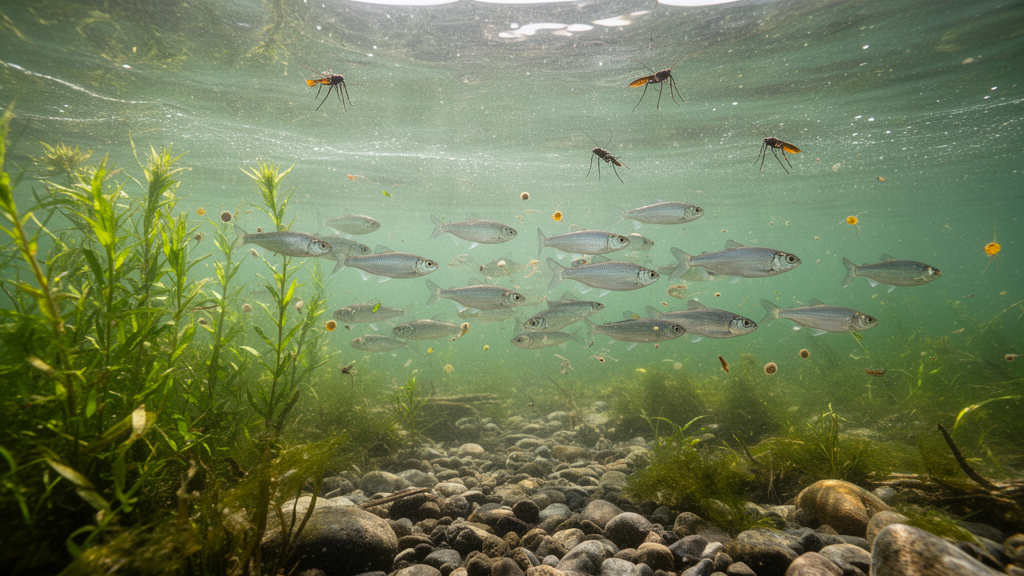
A global synthesis of 78 freshwater datasets spanning more than 30,000 sites found that productivity–biodiversity relationships are predominantly unimodal, with taxonomic and functional diversity tending to peak at intermediate productivity rather than rising continuously across the full productivity gradient. The study used phosphorus as an indicator of productivity and found that the relationship was slightly less curved for functional diversity than for taxonomic diversity.
The analysis compared how productivity–biodiversity relationships varied across diversity dimensions, trophic groups and freshwater ecosystem types. Unimodal relationships were more pronounced among producers than among consumers, indicating that the association differed between groups occupying different roles in aquatic communities. The pattern was also stronger in lakes than in rivers. These contrasts show that productivity was associated with different biodiversity responses across ecological settings, although the observational synthesis does not establish that productivity changes directly caused the patterns.
Functional diversity provided a complementary view of how communities changed along the phosphorus gradient. The clearest functional reorganization was a contraction in resource-related trait space, together with marked shifts in the functional centroids of communities. The study therefore examined functional traits alongside taxonomic measures rather than treating the two dimensions as interchangeable. Its findings support considering both dimensions when evaluating biodiversity responses to productivity, without implying that functional measures replace taxonomic diversity.
Climatic, geographic and human land-use gradients also modified the shape of productivity–biodiversity relationships. The results indicate that a given productivity level may be associated with different biodiversity patterns under different environmental conditions. Taken together, the study suggests that predictions of freshwater biodiversity responses to productivity can benefit from accounting for functional diversity, trophic group, ecosystem type and broad-scale environmental context. The research was published as an open-access article in Communications Earth & Environment. The supplied version is an early peer-reviewed article that the publisher states may be replaced automatically by the final version of record after further edits.
Subject of Research: Global analysis of productivity–biodiversity relationships across freshwater taxonomic and functional diversity.
Article Title: Functional diversity complements taxonomical diversity in productivity-biodiversity relationships in freshwaters
Article References: Liu, G., Graco-Roza, C., Liao, W., Martín-Devasa, R., Castañeda-Gómez, L., Teittinen, A., Qi, X., Li, Y., Qu, X., Kokociński, M., Wu, N., & Soininen, J. (2026). Functional diversity complements taxonomical diversity in productivity-biodiversity relationships in freshwaters. Communications Earth & Environment. https://doi.org/10.1038/s43247-026-04169-5
Image Credits: AI Generated
DOI: 10.1038/s43247-026-04169-5
Keywords: freshwater biodiversity, productivity gradients, functional diversity, taxonomic diversity, phosphorus, lakes, rivers, global synthesis, trophic groups, ecosystem ecology, Functional, diversity
Cite Scienmag News
Margaret Porter. (October 20, 2026). Freshwater biodiversity peaks at intermediate productivity in global synthesis. Scienmag. https://scienmag.com/freshwater-biodiversity-peaks-at-intermediate-productivity-in-global-synthesis/
Margaret Porter. "Freshwater biodiversity peaks at intermediate productivity in global synthesis." Scienmag, 20 October 2026, https://scienmag.com/freshwater-biodiversity-peaks-at-intermediate-productivity-in-global-synthesis/. Accessed 20 October 2026.
Margaret Porter. "Freshwater biodiversity peaks at intermediate productivity in global synthesis." Scienmag. October 20, 2026. https://scienmag.com/freshwater-biodiversity-peaks-at-intermediate-productivity-in-global-synthesis/


