


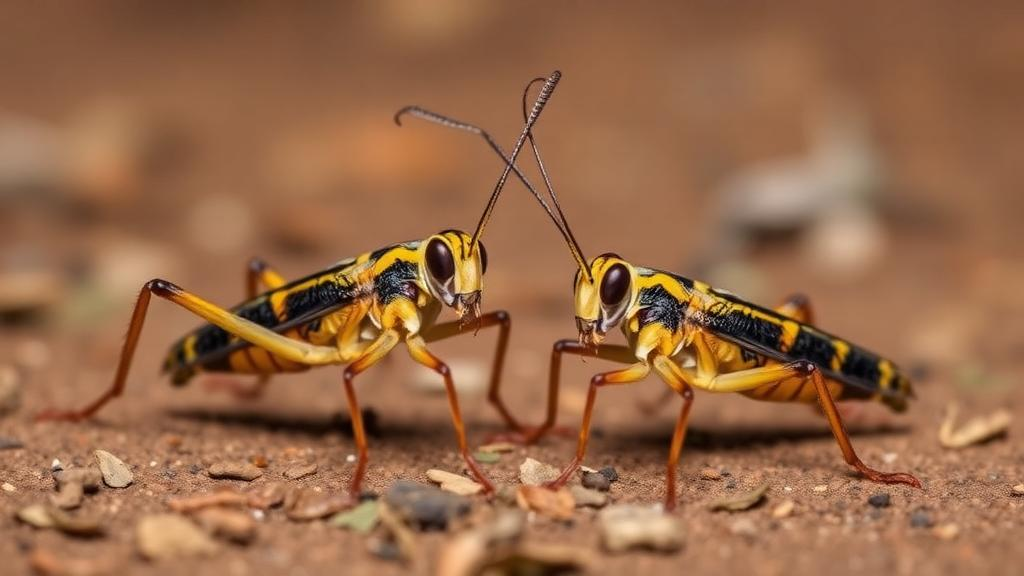
A continent-scale comparison of two hybridizing North American field crickets found that body size, wing-cover color and female ovipositor length can distinguish the species in some regions but vary substantially elsewhere. The study combined morphological records, genetic ancestry estimates and environmental data for 4,221 Gryllus pennsylvanicus and Gryllus firmus collected at 337 localities in the United States and Canada over four decades. Its results show that regional variation can complicate species-level comparisons, while also revealing genetically distinct-looking patterns among southern populations currently grouped as G. firmus.
The more northern and broadly distributed G. pennsylvanicus occurs throughout much of the United States, whereas G. firmus is concentrated along the eastern coast and extends into Texas. The species, whose common ancestry dates to roughly 200,000 years ago, meet along the eastern front of the Appalachian Mountains and form a hybrid zone. They differ in several respects: G. firmus is often associated with sandy habitats, tends to be lighter in color, has longer ovipositors and is generally larger.
G. firmus females mated to G. pennsylvanicus males lay few eggs that do not hatch, an asymmetry consistent with the direction in which mitochondrial DNA moves between the species. These differences had previously been characterized in only a handful of locations, particularly Connecticut. That focus left open whether the same traits consistently identified the species across their full ranges.
The distinction matters because body size can vary with climate and growing-season length, while ovipositor length may be associated with local soil conditions. A trait that appears diagnostic in one hybrid zone could therefore reflect adaptation or population history rather than a stable species difference. To address that problem, the researchers assembled published and unpublished measurements collected with consistent methods, supplemented them with molecular markers for a subset of crickets and compared patterns across broad geographic regions and within the Connecticut hybrid zone.
Among allopatric populations, the two species differed significantly in male and female body size, absolute ovipositor length and ovipositor length relative to body size. The distributions nevertheless overlapped. Ovipositor length provided the clearest separation and remained informative after being scaled relative to pronotum width.
In a small subset of males for which wing-cover color was measured by spectrophotometry, color alone misclassified 3% of individuals as the wrong species: one of 24 G. pennsylvanicus males and none of seven G. firmus males. Body size alone misclassified 23% of 358 males, with 56 of 268 G. pennsylvanicus and 27 of 90 G. firmus assigned incorrectly. For females, body size and relative ovipositor length together produced a 12% misclassification rate, with 15 of 189 G. pennsylvanicus and 17 of 90 G. firmus misclassified.
These results identify useful diagnostic combinations, but they do not show that any one trait cleanly separates every individual. Crickets from or near the hybrid zone overlapped extensively with the allopatric samples, yet the sympatric group was intermediate for several female traits. Its females differed from both allopatric species in body size, absolute ovipositor length and relative ovipositor length.
Male body size in sympatric populations was not significantly different from that of allopatric G. firmus, although it was greater than in G. pennsylvanicus. The findings indicate that populations in contact do not simply reproduce the morphology of either pure species. They also show why a broad geographic survey is necessary: measurements from a single focal area may capture a regional form rather than the full extent of species divergence.
Variation within each species was substantial. G. pennsylvanicus from the southern, southwestern and central United States were larger than populations in the northwest and west-north-central regions. G. firmus from the south were also generally larger than those from the Northeast, although the southern samples were not significantly different from either northeastern or southeastern populations.
Ovipositor length varied geographically within both species. Eastern G. pennsylvanicus had the shortest ovipositors and central populations had the longest, though the central sample was limited. Within G. firmus, relative ovipositor length was shortest in the south, intermediate in the Southeast and longest in the Northeast.
Southeastern females had nearly the same absolute ovipositor length as northeastern females but were larger, showing why absolute and body-size-adjusted measurements can tell different geographic stories. Southern G. firmus populations also differed sharply from one another. Florida animals were much larger than northeastern G. firmus but had only slightly longer ovipositors, producing shorter ovipositors relative to body size.
Texas G. firmus did not differ from northeastern G. firmus in overall size but had still shorter relative ovipositors. The magnitude of these differences was similar to that separating G. firmus from the closely related, recently described G. thinos. Earlier genetic analyses had also placed Texas and Florida G. firmus-like populations in distinct evolutionary clusters.
The combined morphological and genetic evidence supports the proposition that Texas G. firmus may be an undescribed cryptic species, but the study notes that a phylogeny including northeastern, Texas and Florida populations, along with tests of reproductive compatibility, is still needed to resolve their relationships. Genetic data from the hybrid zone connected morphology to ancestry. Among crickets with a mixture of nuclear DNA from the two species, highly admixed individuals generally had intermediate phenotypes.
The nuclear hybrid index, which estimates the proportion of alleles inherited from G. firmus, explained 47% of the variation in relative ovipositor length. Its association was also strong with female body size, male tegmina color and male body size, explaining 28%, 31% and 19% of their respective variation, respectively. The analysis also detected asymmetric mitochondrial introgression: crickets with predominantly G. firmus nuclear ancestry frequently carried G. pennsylvanicus mitochondrial DNA.
Environmental models identified associations but did not reveal a single mechanism accounting for morphology across the entire distribution. Across the species’ ranges, the best-supported model for ovipositor length included latitude, elevation, average soil clay content and minimum and maximum temperatures; the selected model for pronotum width included latitude, longitude, soil sand content and minimum temperature. Higher clay content and higher minimum and maximum temperatures were associated with longer ovipositors, while higher minimum temperatures were associated with larger body size.
Within Connecticut, minimum and maximum temperatures and soil organic matter were retained in the best-supported model for ovipositor length. However, the expected simple relationship between sandy soil and long ovipositors did not hold. Both species use their ovipositors to place eggs in soil, but ovipositor length does not necessarily dictate laying depth, and established soil preferences and egg-viability patterns are geographically localized.
The authors therefore emphasize that habitat associations are variable and require further investigation. Body size also varied in ways compatible with climatic and developmental constraints. Northern populations tended to be smaller, matching the pattern expected where a shorter growing season leaves less time for growth.
G. firmus additionally shows regional variation in seasonal emergence: in Virginia it emerges earlier than G. pennsylvanicus, creating temporal isolation, whereas the two species emerge simultaneously in Connecticut. Florida G. firmus may produce multiple generations annually yet are considerably larger than northern populations, leaving open whether its life cycle differs discontinuously from that of other G. firmus. The geographic study therefore establishes a need to test species boundaries across many populations and environments, but it does not demonstrate that one model of body-size evolution, habitat association or hybrid-zone structure can explain every population.
Its clearest conclusion is more limited and more useful: traits that distinguish two species in one region may shift elsewhere, so apparent divergence must be assessed with range-wide sampling, genetic evidence and explicit consideration of local conditions.
Subject of Research: Geographic variation in morphology, ancestry, and environmental associations in two hybridizing field cricket species
Article Title: Geographic variation in phenotypic divergence between two hybridizing field cricket species
Article References: Byerly, A. R., Jenck, C., Goetz, A. R. B., Weissman, D. B., Gray, D. A., Ross, C. L., Maroja, L. S., & Larson, E. L. (2023). Geographic variation in phenotypic divergence between two hybridizing field cricket species. Journal of Orthoptera Research, 32(2), 189-200. https://doi.org/10.3897/jor.32.90713
Image Credits: AI Generated
DOI: 10.3897/jor.32.90713
Keywords: field crickets, Gryllus firmus, Gryllus pennsylvanicus, phenotypic divergence, hybrid zones, speciation, cryptic species, local adaptation, ovipositor length, mitochondrial introgression, Geographic, variation
Cite Scienmag News
Gavin Prescott. (October 20, 2026). Research report: Geographic variation in phenotypic divergence between two hybridizing field cricket species. Scienmag. https://scienmag.com/research-report-geographic-variation-in-phenotypic-divergence-between-two-hybridizing-field-cricket-species/
Gavin Prescott. "Research report: Geographic variation in phenotypic divergence between two hybridizing field cricket species." Scienmag, 20 October 2026, https://scienmag.com/research-report-geographic-variation-in-phenotypic-divergence-between-two-hybridizing-field-cricket-species/. Accessed 20 October 2026.
Gavin Prescott. "Research report: Geographic variation in phenotypic divergence between two hybridizing field cricket species." Scienmag. October 20, 2026. https://scienmag.com/research-report-geographic-variation-in-phenotypic-divergence-between-two-hybridizing-field-cricket-species/


