


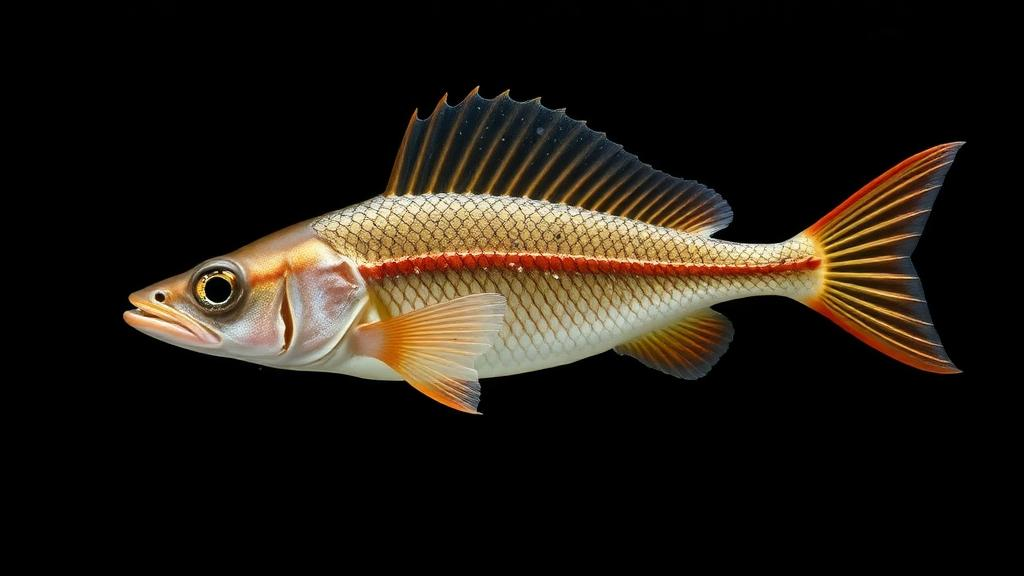
A cache of fossil fish from a 244-million-year-old quarry near Berlin may have reset the clock on one of evolution’s great success stories. Researchers have identified three previously unknown kinds of stem teleosts—early members of the lineage that ultimately produced today’s vast majority of ray-finned fishes—from the middle Anisian of the Germanic Basin. The discovery pushes the oldest accepted fossil evidence for Teleosteomorpha several million years into the past and demonstrates that the earliest phase of the radiation was geographically broader and more varied than the fossil record previously indicated.
The fishes come from the Muschelkalk quarry at Rüdersdorf, 25 km east of central Berlin, a historic source of limestone and cement that has yielded marine reptiles, sharks, actinopterygians and countless invertebrates. The new material comes from a thin interval known as the Fischmergel near the base of the lower Wechsellagerung in the middle Muschelkalk. Its age places it in the middle Anisian, about 244 million years ago. Although the locality is famous, most teleosteomorph remains had previously appeared only as isolated skull-roof plates; the new collection includes those plates alongside nearly complete specimens that reveal bodies, fins, scales and jaws.
One fossil was named Pseudopholidoctenus germanicus, a new genus and species assigned to Pholidophoridae. It is a diminutive fish about 36 millimetres in standard length, with a body that was probably oblong rather than strongly streamlined. Its head carried a triangular skull roof, an almost five-times-deeper opercle than subopercle, small conical teeth and a series of conspicuous square-shaped scutes before the upper lobe of the tail. The tail was hemiheterocercal, with an abbreviated dorsal lobe and no evident hypaxial procurrent rays. Its ganoid scales had smooth surfaces interrupted by small serrations along their rear margins.
A second fossil lineage, represented by Barschichthys ruedersdorfensis, is unusual enough to receive its own family, Barschichthyidae. The fish reached about 80 millimetres in total length and possessed a broad, conspicuously lobed front edge to the skull roof—a feature unlike the triangular nasal region seen in most Triassic teleosteomorphs. Its long lower jaw extended behind the orbit, while the maxillary blade broadened toward the rear. Small conical teeth were present in the upper jaw, and the anterior body was armored with thick, ganoid scales. Differences in skull proportions between specimens may reflect sexual dimorphism, although that possibility will remain untested until more material becomes available.
The third species, Ruedersdorfia berlinensis, is known mainly from three skull roofs. Its orbital and postorbital regions are almost equal in length, producing proportions unlike those of the other Rüdersdorf fishes. A very short nasal region, distinctive surface ornamentation and an exceptionally short middle pitline support its recognition as a distinct taxon. Because its phylogenetic position cannot yet be resolved securely, the authors place it within Teleosteomorpha as family incertae sedis. Together, the three taxa demonstrate that stem teleosts were not a single line of nearly identical fishes evolving in isolation, but a small but anatomically varied radiation.
Size may have been central to that early experiment. Most Triassic teleosteomorphs were only about 50 millimetres in standard length, and some were smaller. Pseudopholidoctenus, Prohalecites porroi, Marcopoloichthys ani and Seinstedtia parva fall near or below 40 millimetres in standard length, making them candidates for miniaturization. Yet the fossil evidence does not show the paedomorphic traits often associated with extreme miniaturization in living fishes. The earliest ray-finned fish therefore combined very small adult sizes with ancestral features rather than the truncated development commonly seen in modern miniature species.
Their jaws also reveal several feeding strategies within the same primitive radiation. The long, tooth-bearing jaws of Prohalecites suggest a carnivorous diet, while Pholidorhynchodon malzannii was equipped with small conical teeth and much larger teeth on its snout, making it the clearest candidate for predatory stem teleost. Marcopoloichthys had no teeth and is interpreted as a suction feeder capable of drawing in plankton or very small prey. Most pholidophorids had minute teeth and protractile lower jaws, indicating a broadly similar suction-based feeding mechanism, although their exact targets remain unknown. These differences show that ecological specialization appeared early, before teleosts became the dominant fishes in many Jurassic and Cretaceous marine ecosystems.
The Rüdersdorf material also changes the geographic narrative. The oldest accepted stem teleosts had appeared in the marine Tethys Ocean, with pholidophorids and marcopoloichthyids appearing in Europe and Asia at nearly the same time. By the late Ladinian, three lineages—Prohalecitidae, Pholidophoridae and Marcopoloichthyidae—were established, and about 20 species occupied the Tethys. The new Rüdersdorf fishes came from a restricted marine basin in the Germanic Basin, outside the open Tethys, and they are approximately 244 million years old. Their presence supports Europe as an early center of teleosteomorph diversification, challenging the suggestion that China alone hosted the lineage’s origin, although additional discoveries could yet revise that conclusion.
After a roughly two-million-year interval with no reported teleosteomorphs, the Hettangian, the story accelerates. In the Early Jurassic Sinemurian, two major groups appeared in European seas: the non-monophyletic “pholidophoriforms” and proleptolepids and leptolepids. Their average standard length was about 100 millimetres, roughly double that of typical Triassic forms, and their bodies were more oblong or fusiform. Small suction-feeding proleptolepids soon appeared in Chile, about 199 to 190 million years ago, demonstrating a rapid spread from the Tethys to the Paleo-Pacific through connections such as the Spanish Corridor. The Triassic forms were a prelude not merely to larger fish, but to an extraordinary expansion of body size, ecological specialization and global distribution.
The new fossils do not mean that molecular estimates of an even older teleosteomorph origin are resolved; several molecular studies have placed crown teleosts in the Paleozoic, far before any known fossil record. What they show is that recognizable stem teleosts were already ecologically diverse by the middle Anisian. Tiny suction feeders and possible predators coexisted in European and Asian marine basins, displaying variations in skull construction, scales, jaws, body proportions and fin architecture. In that sense, the Rüdersdorf discovery is more than a three-species inventory: it captures a pivotal moment when a modest lineage of small fishes began testing the forms and lifestyles that would later define modern ray-finned fishes.
Subject of Research: Triassic diversification and early evolutionary history of stem teleost ray-finned fishes
Article Title: The oldest teleosts ( Teleosteomorpha ): their early taxonomic, phenotypic, and ecological diversification during the Triassic
Article References: Arratia, G., & Schultze, H.-P. (2024). The oldest teleosts (Teleosteomorpha): their early taxonomic, phenotypic, and ecological diversification during the Triassic. Fossil Record, 27(1), 29-53. https://doi.org/10.3897/fr.27.115970
Image Credits: AI Generated
DOI: 10.3897/fr.27.115970
Keywords: stem teleosts, Teleosteomorpha, Triassic fishes, fossil record, Rüdersdorf, pholidophorids, ray-finned fishes, early Jurassic, fish evolution, paleontology, oldest, teleosts
Cite Scienmag News
Gavin Prescott. (October 19, 2026). Tiny Triassic Fish Rewrite the Origin of Modern Ray-Finned Fishes. Scienmag. https://scienmag.com/tiny-triassic-fish-rewrite-the-origin-of-modern-ray-finned-fishes/
Gavin Prescott. "Tiny Triassic Fish Rewrite the Origin of Modern Ray-Finned Fishes." Scienmag, 19 October 2026, https://scienmag.com/tiny-triassic-fish-rewrite-the-origin-of-modern-ray-finned-fishes/. Accessed 19 October 2026.
Gavin Prescott. "Tiny Triassic Fish Rewrite the Origin of Modern Ray-Finned Fishes." Scienmag. October 19, 2026. https://scienmag.com/tiny-triassic-fish-rewrite-the-origin-of-modern-ray-finned-fishes/


