


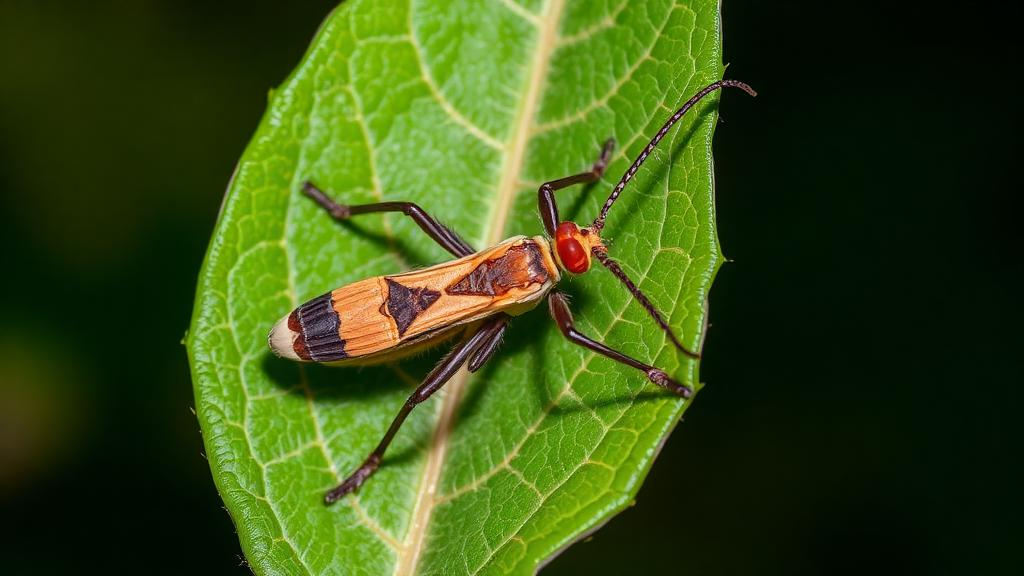
A tiny moth that lives inside the leaves of common bistort has been documented for the first time in France, Belgium and Switzerland, substantially extending its known European range. The species, Antispilina ludwigi, was originally described in 1941 from material collected near Waldaubach in Hesse, Germany, but remained one of Europe’s least understood leaf-mining moths. Researchers found it during targeted searches of its host plant across mountain bogs, wet meadows and heathlands in the Massif Central, the Jura, the Ardennes and the Alps. The new records, supported by adult specimens, larvae, leaf mines, detailed anatomical studies and DNA barcoding, show that the moth is rare but frequently overlooked. Its apparent scarcity may reflect an absence of systematic searching rather than a genuinely restricted distribution.
Antispilina ludwigi belongs to Heliozelidae, a small family of moths whose larvae feed within leaves and construct portable protective cases from pieces of mined tissue. It is the only known member of the genus Antispilina that feeds on an herbaceous plant. Its sole confirmed host is common bistort, Bistorta officinalis, a perennial in the buckwheat family Polygonaceae that occurs across Europe and extends into Siberia. The moth is also the only known species to make a blotch mine on this plant, providing a conspicuous field sign that can be used without capturing the adult insect. In French samples, 87% of mines began close to the leaf’s midrib, and the larvae frequently created paired mines on opposite sides of it.
Focused fieldwork transformed the moth’s known distribution. A search on Mont Mézenc in the Massif Central in 2009 produced numerous mines and several larvae. A more intensive survey in Auvergne in 2017 led the researchers to encourage colleagues in Belgium and Switzerland to inspect common bistort for the same signs. Those searches succeeded, yielding the first formally published records for all three countries. French populations were found in the Massif Central, including Ardèche and Puy-de-Dôme, as well as the Jura; Belgian records came from the Ardennes area of Liège; and Swiss populations were documented in the Jura and northern Alps. Many of the new sites were at middle elevations, generally between about 450 and 1,650 metres, although previous Polish records demonstrated that the moth can also occur in lowland meadows.
The study provides the first comprehensive redescription of the species, including characters of the adult moth, larva and genitalia. Adults are minute, with a wingspan of approximately 4.2 to 5.0 millimetres. The forewings are almost black, sometimes reflecting bronze, and bear a narrow silver-white fascia near one-fifth to one-quarter of their length. Two contrasting silver-white spots occur farther toward the tip, one on the dorsal edge and one on the costa. The head, thorax and legs are dark, and the fringe is grey rather than the conspicuous white seen in some superficially similar moths. A key feature is the absence of a tibial epiphysis, a projection on the foreleg present in the related vine leaf miner Holocacista rivillei. Antispilina also has two-segmented labial palps, whereas the larger Antispila species have a distinct pale line along the wing fringe.
Male genitalia provide further diagnostic characters. The species has a long, strongly sclerotized vinculum, a bilobed tegumen and subtriangular valves bearing stalked combs of blunt sensory structures. Its phallus is cylindrical, lacks cornuti and contains a spinose phallocrypt. The female’s ovipositor tip is flattened and equipped with five cusps, while the eighth abdominal segment includes a pair of sclerotized rods in the vestibulum. These structures distinguish the moth from related taxa whose external appearance can be similar. The identification was also tested with DNA barcoding. Nine specimens from Poland, France and Belgium fell into the Barcode of Life cluster BOLD:AAW5935, with an average pairwise distance of 0.36% and a maximum of 0.81%.
The immature stages reveal a distinctive mining strategy. A newly hatched larva makes a small, nearly circular blotch near a major vein, gluing frass between the upper and lower epidermis and producing a reddish-brown mark visible on both sides of the leaf. The mine then expands into an elongated translucent blotch, usually between lateral veins, with darker frass scattered through its interior and irregularly eaten margins. In the final feeding instar, the caterpillar cuts a flat, reinforced case about three millimetres long from both epidermal layers. It carries this shield away from the mine, shelters, and moults into a non-feeding fifth instar before pupating inside the case. Several larvae may feed together where mines merge, while heavily mined leaves can be conspicuous from considerable distances.
Its life cycle appears to include one generation each year, with an extended period of larval activity from June into September. Feeding is most concentrated in July in the mountains, and the flight period varies with elevation, generally extending from April to June. Reared adults emerged the following spring after overwintering at low temperatures; one adult was also collected by sweeping common bistort in Switzerland in May 2020. The moth is difficult to survey as an adult because it is extremely small and inconspicuous, but the mines remain visible after larvae have departed. The researchers therefore recommend that observers inspect host plants and photograph the evidence, which can be done even in poor weather and does not require collecting the moth.
Although the new discoveries show that Antispilina ludwigi is more widespread than historical records implied, the authors warn that it may still be declining. Its habitat consists of nutrient-poor wet meadows, mountain bogs, moorland, wet grassland and montane heath, often with scattered shrubs or trees. These habitats are being lost through drainage, agricultural intensification, abandonment, encroachment by scrub and natural reforestation. The host plant itself becomes less abundant under intensive management because it benefits from low-intensity grazing. The moth has not been recorded in Germany in recent years, and other insect specialists using common bistort are also in retreat, making it difficult to determine whether changes reflect genuine population loss or incomplete monitoring.
Conservation of the moth may nevertheless be strengthened through efforts aimed at more conspicuous butterflies. Lycaena helle, the scarce copper butterfly, and Boloria eunomia, the marsh fritillary, feed on the same host and are among Europe’s most threatened butterflies. The moth was found at every visited site of Lycaena helle in the Swiss Jura and alongside it in Belgian sites and parts of the Massif Central. Other locally restricted insects also depend on common bistort, including Boloria titania and the micromoths Coleophora pratella and Phiaris astrana. A monitoring program for Lycaena helle, whose habitat in Wallonia has been protected since 2001, has encouraged the recovery of host-rich wetlands in the Belgian Ardennes. Such restoration can simultaneously preserve the conditions required by the leaf miner and a wider specialist community.
Researchers therefore recommend low-intensity, rotational management that prevents natural woodland regeneration without disturbing adults, eggs or larvae during sensitive periods from April through July. At higher elevations, they suggest extending the no-intervention period into the first half of August, when larvae may still be present in their mines. Searches should focus on large common bistort plants in suitable wet, nutrient-poor habitats, especially places already known from the butterfly species. Given the moth’s wide European host-plant distribution and the relative ease of recognizing its mines, the authors expect further populations in German mountains, Austria, northern Italy, Slovenia, Romania, Belarus, Ukraine and European Russia. The study demonstrates that focused inspection of host plants can uncover overlooked species, while coordinated monitoring offers a practical route to conserving this obscure moth before its remaining populations become more fragmented.
Subject of Research: Distribution, biology, identification and conservation of the common-bistort leaf-mining moth Antispilina ludwigi
Article Title: Antispilina ludwigi Hering, 1941 ( Lepidoptera , Heliozelidae ) a rare but overlooked European leaf miner of Bistorta officinalis ( Polygonaceae ): new records, redescription, biology and conservation
Article References: van Nieukerken, E. J., Wullaert, S., Lee, B.-W., & Bryner, R. (2021). Antispilina ludwigi Hering, 1941 (Lepidoptera, Heliozelidae) a rare but overlooked European leaf miner of Bistorta officinalis (Polygonaceae): new records, redescription, biology and conservation. Nota Lepidopterologica, 44, 99-121. https://doi.org/10.3897/nl.44.63848
Image Credits: AI Generated
DOI: 10.3897/nl.44.63848
Keywords: Antispilina ludwigi, leaf mining, common bistort, Heliozelidae, moth distribution, DNA barcoding, insect conservation, wet meadows, European biodiversity, range expansion, Antispilina, ludwigi
Cite Scienmag News
Margaret Porter. (October 19, 2026). Rare European leaf miner discovered across three countries. Scienmag. https://scienmag.com/rare-european-leaf-miner-discovered-across-three-countries/
Margaret Porter. "Rare European leaf miner discovered across three countries." Scienmag, 19 October 2026, https://scienmag.com/rare-european-leaf-miner-discovered-across-three-countries/. Accessed 19 October 2026.
Margaret Porter. "Rare European leaf miner discovered across three countries." Scienmag. October 19, 2026. https://scienmag.com/rare-european-leaf-miner-discovered-across-three-countries/


