


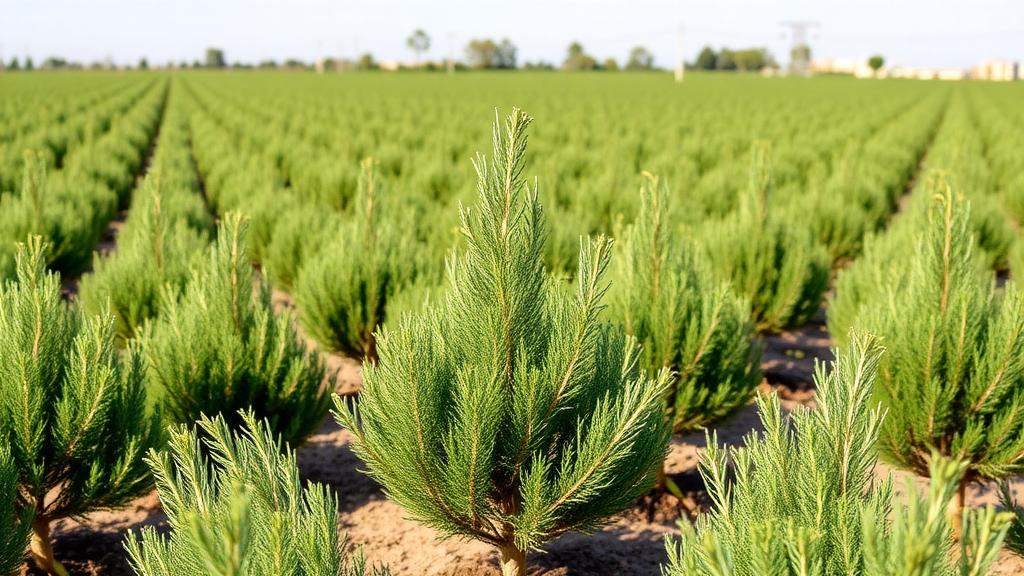
Italy’s plan to plant about 6.6 million trees across 14 metropolitan cities has created an unexpected test of the country’s forest nurseries. The National Recovery and Resilience Plan seeks to expand urban and peri-urban forests, improve air quality, protect biodiversity, reduce land consumption and deliver environmental benefits in heavily populated areas. A survey of two representative nurseries in Sicily and Apulia suggests that the nation has a foundation of locally adapted trees, but not nearly enough plant material to deliver the scheme at the scale envisioned. The findings point to a bottleneck that is biological as well as administrative: suitable seedlings must exist, be raised in sufficient numbers and be ready when planting projects begin.
The two facilities examined—the Filici nursery at Cammarata in Agrigento province and the Gargano Mountain Reclamation Consortium nursery at San Marco in Lamis in Foggia province—were selected because of their production scale, organization and regional importance. Together, they illustrate both the potential and the fragility of southern Italy’s nursery network. Filici was established in the early 1950s to support reforestation on the slopes of Mount Cammarata, while the Gargano facility opened in 2011 and combines tree propagation with the conservation of local plant diversity. Both use root-ball cultivation as their main method, although bare-root production also occurs at a much smaller scale.
Filici occupies 2 hectares, of which about 1.5 hectares are used for production. Its sloped ground is arranged in stepped plots retained by walls built with local limestone, and plants are watered manually or by automated sprinklers. The nursery collects seed from forests in neighboring areas that are included in Sicily’s designated seed-wood network, a practice intended to preserve local genetic characteristics. Its technical and seasonal workforce is small: one forestry technician, one team leader and three fixed-term workers, with the seasonal staff having previously reached 10. Reduced funding has had a clear effect, with annual production falling from a historical peak of about 400,000 seedlings to no more than 50,000, while average mortality is estimated at 10%.
The Gargano nursery presents a different operational profile. It covers 1.1 hectares, including 0.5 hectares for production, and employs two full-time and two part-time workers. Irrigation is supplied manually from the municipal aqueduct, while rainwater-harvesting tanks are under construction. The site contains seed-processing and direct-seeding laboratories, storage rooms, a greenhouse for seedlings sensitive to low temperatures, offices, teaching facilities and a small botanical garden of rare or endangered Gargano plants. Its average annual output is about 150,000 seedlings, compared with average mortality of roughly 20%. Much of its material is intended for Apulian restoration projects, and its production is guided by phytosanitary, genetic and morphological criteria designed to reduce risks such as those associated with the pathogen Xylella fastidiosa.
A census conducted from spring 2021 through autumn 2022 found 22,360 seedlings at Filici, representing 55 species, 26 genera and 26 families. Of these taxa, 43, or 78.2%, were classified as native, while 12, or 21.8%, were exotic. The largest stocks included 5,000 Quercus ilex, 5,000 Q. pubescens, 2,000 Mediterranean cypress, 2,000 wild olive and 1,000 each of Greek fir and Pyrus spinosa. The presence of only 10 Abies nebrodensis seedlings highlighted the facility’s role in conserving the endangered Sicilian fir. At the same time, the 1,000 Greek fir seedlings raised at Filici were considered potentially problematic because the species could hybridize with the endemic Sicilian fir.
Gargano held far more material: 190,876 seedlings encompassing 80 species, 59 genera and 32 families. Native taxa made up 68 species, or 85%, and exotic taxa 12, or 15%. Quercus ilex was the most numerous species with 28,654 seedlings, followed by Quercus cerris with 25,968, Fraxinus ornus with 18,292 and Q. pubescens with 17,780. Other substantial stocks included 13,031 Spartium junceum, 6,611 Salix alba, 5,544 Acer campestre, 4,690 Pinus halepensis, 4,501 Castanea sativa and 3,779 Fagus sylvatica. Plants in both nurseries were between one and five years old, and their overall phytosanitary condition was described as good.
Native species clearly dominated both collections, a result with direct implications for the success of metropolitan planting. Trees raised from local seed are more likely to carry genetic traits suited to the soils, climate and ecological conditions of their planting sites. Using such material can also protect distinctive populations, maintain genetic diversity, reduce the risk of genetic pollution and improve the establishment of forests under conditions expected to include climate change. The survey’s authors considered the species represented in the two nurseries qualitatively suitable for the plan, but the quantities available were too low for the accelerating demand generated by Italy’s green-oriented policy. Seedlings cannot simply be ordered at short notice: each stock represents years of collection, propagation, cultivation and nursery management.
The exotic plants require a more selective response. Some have long histories of traditional use, including Citrus × aurantium, Diospyros kaki, Morus alba, Punica granatum and Ziziphus jujuba, and were not regarded as invasive. Yet the production of Acer negundo, Ligustrum lucidum and Robinia pseudoacacia was considered a priority for withdrawal because these species can become invasive when planted in natural environments. This distinction matters because a large planting campaign could unintentionally amplify ecological problems. The study therefore emphasized that suitability cannot be measured only by whether a tree is attractive, hardy or inexpensive; origin, genetic compatibility, ecological effects and phytosanitary condition also determine whether large-scale propagation is responsible.
Italy’s urban-tree ambitions are colliding with a nursery sector that has experienced repeated contraction. Large areas were reforested from the 1930s onward to address widespread hydrogeological instability, and public nurseries initially supplied planting material under legal requirements that often made it free. As the scale of mountain reforestation declined in the 1970s, many nurseries closed or reduced their activity. More recently, urban heat, flooding, erosion, air pollution and pressure on soils have renewed interest in trees and green infrastructure, but regional funding and specialist staffing have not consistently followed. A census of regional nurseries in Apulia identified 20 facilities—seven managed publicly and 13 privately—while Sicily’s Regional Nursery Center included 16, each specialized in different production. These networks offer a base, yet the two studied nurseries reveal how production can be constrained even where a substantial standing stock exists.
For the National Recovery and Resilience Plan, the immediate challenge is therefore to translate a national planting target into a dependable regional supply chain. The researchers called for inventories of nursery stocks, expanded production of useful native species and restoration of qualified personnel. Local seed collection, careful genetic tracking and coordinated scheduling are equally important: the correct species must reach the correct site at the correct size and season. Urban planners must also identify viable locations for new forests amid competing demands for land and political constraints. The survey concludes that the two southern nurseries contain plant material broadly aligned with the plan’s ecological aims, but their numerical shortfall prevents them from meeting the expected surge in demand. Six and a half million trees can transform metropolitan landscapes; whether they can also strengthen regional biodiversity will depend on nurseries being rebuilt before the shovels reach the soil.
Subject of Research: The capacity of forest nurseries in Sicily and Apulia to supply native trees for Italy’s urban reforestation program
Article Title: Forest nurseries and the National Recovery and Resilience Plan: the case of Sicily and Apulia (Italy)
Article References: Pardi, R., Venturella, G., Domina, G., Di Gristina, E., Cirlincione, F., & Gargano, M. L. (2023). Forest nurseries and the National Recovery and Resilience Plan: the case of Sicily and Apulia (Italy). Italian Botanist, 15, 49-63. https://doi.org/10.3897/italianbotanist.15.102133
Image Credits: AI Generated
DOI: 10.3897/italianbotanist.15.102133
Keywords: forest nurseries, urban forestry, Italy, Sicily, Apulia, native trees, reforestation, biodiversity, National Recovery and Resilience Plan, planting 6.6 million trees, Forest, nurseries
Cite Scienmag News
Margaret Porter. (October 19, 2026). Southern Italy’s Nurseries Test the Promise of 6.6 Million New Trees. Scienmag. https://scienmag.com/southern-italys-nurseries-test-the-promise-of-6-6-million-new-trees/
Margaret Porter. "Southern Italy’s Nurseries Test the Promise of 6.6 Million New Trees." Scienmag, 19 October 2026, https://scienmag.com/southern-italys-nurseries-test-the-promise-of-6-6-million-new-trees/. Accessed 19 October 2026.
Margaret Porter. "Southern Italy’s Nurseries Test the Promise of 6.6 Million New Trees." Scienmag. October 19, 2026. https://scienmag.com/southern-italys-nurseries-test-the-promise-of-6-6-million-new-trees/


