


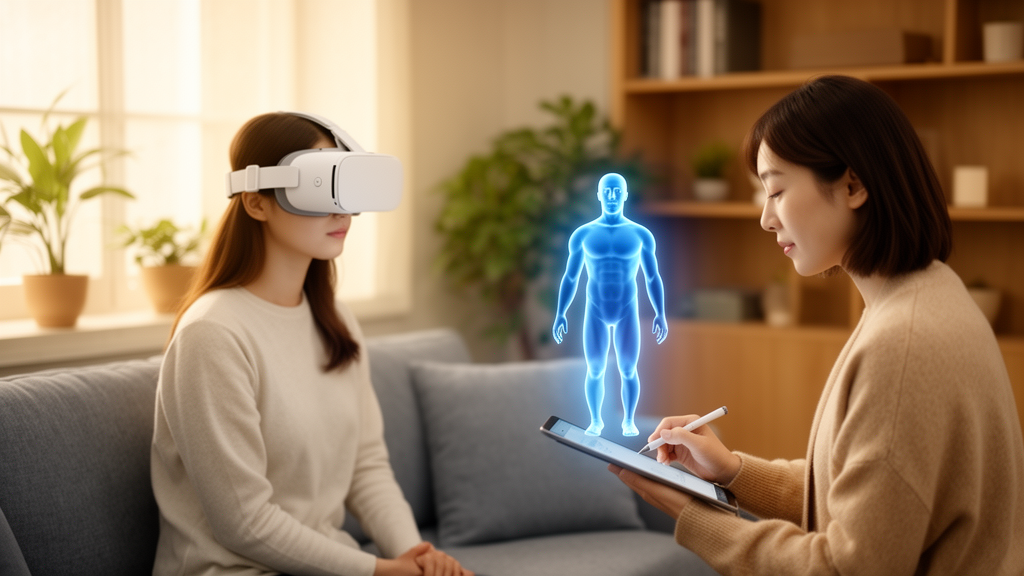
South Korea has one of the most acute mental health crises in the developed world, and one of the most advanced digital infrastructures on the planet. A new systematic review published in Discover Education brings those two realities together, mapping how researchers in the country have spent the past several years testing whether psychological counseling can work inside the metaverse. The answer, according to the analysis of 43 studies, is a cautious but striking yes, with avatar-based therapy showing real promise in specific clinical domains while leaving deeper questions about mechanisms and ethics unresolved.
The stakes are high. Recent health indicators show South Korea’s suicide rate standing at 23 per 100,000 people, the highest among OECD member nations, and suicide accounts for 52.7 percent of deaths among people in their twenties. Depression prevalence among that age group remains at 18.2 percent even after the pandemic’s acute phase ended, a pattern the researchers describe as structural persistence rather than residual distress. Traditional counseling, they argue, struggles to deliver the seamless emotional connection and spatial accessibility that modern clients demand, creating an opening for radically new delivery models.
The metaverse, in this context, is not simply a video call with fancier graphics. The review defines it broadly, encompassing both high-immersion virtual reality environments using head-mounted displays and low-immersion, two-dimensional web-based platforms such as ZEP and Metaforest, where users interact through avatars in persistent virtual spaces. This inclusive definition treats the level of immersion as a contextual feature rather than a defining boundary, reflecting how Korean practitioners actually deploy the technology: cheaply, scalably, and on devices clients already own.
To capture the field’s trajectory, the research team from Kyung Hee University followed the PRISMA guidelines for systematic reviews, searching South Korea’s central academic database, RISS, from its inception to March 2025. An initial haul of 439 records was whittled down through successive screening rounds to 43 studies, 27 peer-reviewed journal articles and 16 dissertations, all focused on therapeutic interventions rather than incidental uses of virtual worlds. The team then applied a five-stage content analysis framework, coding each study’s methodology, platform, target population and thematic focus, with inter-coder reliability reaching a kappa of 0.82 for interpretive categories and a perfect 1.00 for descriptive variables.
The temporal pattern is telling. Almost nothing was published before 2022, when research on theoretical direction-setting and early effectiveness validation emerged simultaneously. By 2024, as platforms matured, effectiveness studies surged to become the dominant theme, joined by growing bodies of work on empirical experience analysis and counselor education. The field, the authors conclude, has moved from exploration toward practical application and professional standard-setting, a shift compressed into roughly three years.
What the effectiveness studies reveal is nuanced. Metaverse-based group counseling consistently improved interpersonal outcomes: a cognitive-behavioral group program significantly boosted college students’ interpersonal trust, satisfaction and openness, a nonviolent communication program enhanced empathy and emotional regulation in early adolescents while reducing conflicts with peers and siblings, and class-based programs strengthened elementary school students’ cohesion and empathy. Interventions targeting behavior also performed well, with a solution-focused program reducing delinquency among juvenile offenders more than a face-to-face comparison, and a metaverse platform aiding early-stage delinquency prevention through enhanced self-awareness and goal setting.
Emotional and psychological outcomes showed more variability. A positive psychology coaching program outperformed both a Zoom-based group and a control group on well-being and life satisfaction among young adults, and an acceptance and commitment therapy program reduced public speaking anxiety more effectively than face-to-face delivery, including physiological markers. But a burnout intervention for teachers, while trending in the right direction, did not reach statistical significance, and findings on identity formation were mixed, consistent with the view that deep personality-level change resists short-term interventions regardless of medium.
The most consistent therapeutic mechanism identified across the literature is protected anonymity. Across usability evaluations and experience studies, clients repeatedly reported that avatar-mediated invisibility lowered the psychological burden of seeking help, reduced resistance to counseling, promoted self-disclosure and fostered unbiased communication. Counselors noticed it too: novice therapists felt less professional anxiety, clients disclosed main concerns without the usual rapport-building period, and in one striking inversion of the traditional clinical hierarchy, clients often adapted to the technology faster than their counselors and led the sessions. Virtual spaces added their own affordances, allowing therapists to recreate healing environments, from nurturing counseling rooms for abuse survivors to stress-inducing scenes for controlled exposure work.
The review is equally clear about the gaps. None of the 43 studies directly tested the mechanism by which metaverse-specific affordances, such as avatar anonymity or symbolic space, produce therapeutic change, even though every applied study measured an outcome. Person-centered therapy, which depends on empathy and unconditional positive regard, was never explicitly operationalized, though related findings on anonymity and rapid disclosure offer theory-adjacent hints. Ethical infrastructure lags badly: platforms may record and store sessions under provider control, anonymity can be misused, and guidelines for crisis intervention, data privacy and AI counselor reliability remain underdeveloped. The authors call for standardized counselor training that treats digital competencies as core clinical skills, robust legal frameworks, and targeted deployment to geographically isolated populations.
There are caveats to the review itself. It drew only on Korean-language sources in a single database, included dissertations alongside peer-reviewed work without formal quality appraisal, and relied heavily on locally developed platforms, so the findings are best read as a context-bound evidence map rather than a global verdict. Yet that context is precisely what makes South Korea informative. With world-leading display technology, near-universal connectivity and acute demand, the country functions as a testbed for what digitally mediated mental health care could look like at scale, and its empirical experience may offer transferable lessons as other nations confront their own crises in access to psychological support.
Subject of Research: Metaverse-based psychological counseling research trends in South Korea
Article Title: A comprehensive analysis of metaverse counseling research trends in Korean literature
Article References: Nam, J. K., Kim, A., Yoon, S., Kim, H., & Kim, K. (2026). A comprehensive analysis of metaverse counseling research trends in Korean literature. Discover Education, 5(1), Article 961. https://doi.org/10.1007/s44217-026-02146-w
Image Credits: AI Generated
DOI: 10.1007/s44217-026-02146-w
Keywords: metaverse, counseling, avatars, mental health, South Korea, systematic review, virtual reality, teletherapy, anonymity, digital therapy, cyberpsychology, counselor education
Cite Scienmag News
Courtney Benton. (October 19, 2026). Avatars on the Couch: South Korea Charts the Rise of Metaverse Therapy. Scienmag. https://scienmag.com/avatars-on-the-couch-south-korea-charts-the-rise-of-metaverse-therapy/
Courtney Benton. "Avatars on the Couch: South Korea Charts the Rise of Metaverse Therapy." Scienmag, 19 October 2026, https://scienmag.com/avatars-on-the-couch-south-korea-charts-the-rise-of-metaverse-therapy/. Accessed 19 October 2026.
Courtney Benton. "Avatars on the Couch: South Korea Charts the Rise of Metaverse Therapy." Scienmag. October 19, 2026. https://scienmag.com/avatars-on-the-couch-south-korea-charts-the-rise-of-metaverse-therapy/


