


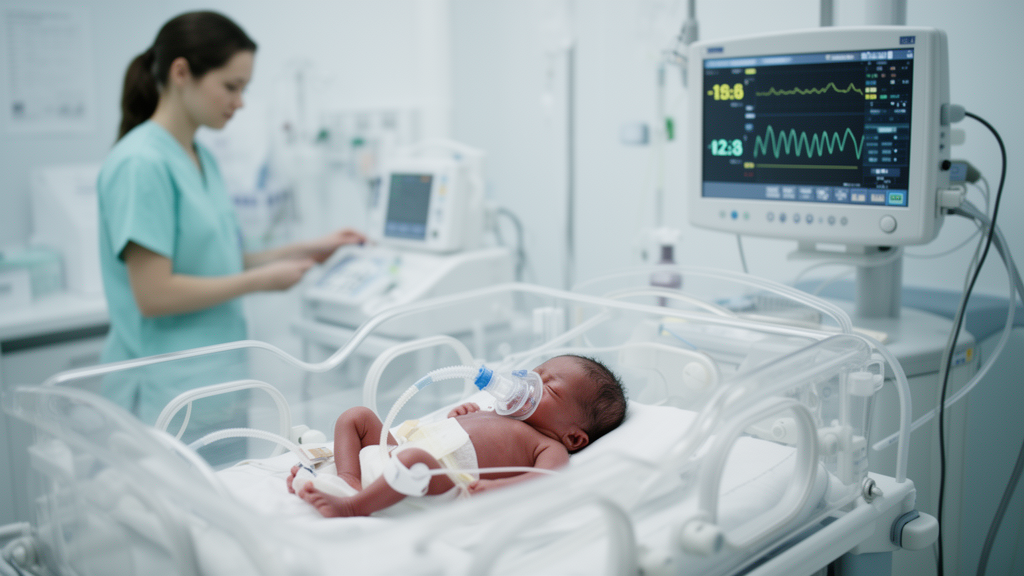
For the smallest and sickest premature babies, few decisions weigh as heavily on families and physicians as whether to place a tracheostomy. The surgery, which creates a surgical opening in the windpipe to connect a baby to long-term mechanical ventilation, can be lifesaving for infants whose lungs never matured properly after an early birth. Yet it also commits a child to months or years of technology-dependent care, and the timing of that decision has long been guided more by institutional tradition and clinical intuition than by hard numbers. A new study published in the Journal of Perinatology offers what may be the most rigorous attempt yet to replace guesswork with prediction, showing that routine respiratory data gathered at two well-defined points in a baby’s hospital course can forecast with striking accuracy which infants with severe bronchopulmonary dysplasia will ultimately need a tracheostomy or die before discharge.
Bronchopulmonary dysplasia, or BPD, is the most common chronic lung disease of infancy and a defining complication of extreme prematurity. It arises when the immature lung, forced onto mechanical ventilation and oxygen therapy in its first weeks of life, sustains injury that interrupts the delicate development of airways and blood vessels. Clinicians grade its severity at 36 weeks post-menstrual age, the point at which a baby would have been roughly full term had pregnancy continued. Grade 2 and grade 3 BPD represent the moderate and severe ends of that spectrum, marked by a continuing need for respiratory support, and in the most severe cases by invasive ventilation through a breathing tube. It is precisely this population, the authors note, for which the question of tracheostomy placement becomes most pressing and most contested.
The research team, led by Jonathan C. Levin of the Division of Newborn and Pulmonary Medicine at Boston Children’s Hospital, together with biostatistician Joshua Ray Tanzer, Christopher H. Schmid of the Brown School of Public Health, and Robin L. McKinney of Warren Alpert Medical School of Brown University, drew on the multi-center BPD Collaborative registry. That consortium of referral centers cares for unusually large volumes of infants with severe BPD, making it one of the few settings where enough tracheostomy cases accumulate to build and test a statistical model at all. The investigators assembled a retrospective cohort of infants with grade 2 or 3 BPD and defined their primary outcome as the combined endpoint of tracheostomy placement or death prior to hospital discharge, a composite that reflects the clinical reality that both outcomes signal a failure of the baby’s lungs to recover on conventional support.
Technically, the study followed the established architecture of modern clinical prediction modeling. The researchers developed two separate models, one derived at 36 weeks post-menstrual age and a second derived at 44 weeks, roughly two months later. Each model harmonized a common set of candidate predictors drawn from three domains: data known at birth, the specific respiratory support the infant was receiving at the assessment point, and the medications being administered. Because infants at 44 weeks represent a selected population, those who survived and remained hospitalized without already having received a tracheostomy, the two models address distinct clinical moments. The 36-week model answers the early question of how worried to be when BPD severity is first graded, while the 44-week model refines that forecast for the substantial subset of babies still fighting for breath well past their original due date.
The sample sizes underscore how demanding this kind of modeling is in neonatology. In the training set, 854 infants contributed data at 36 weeks post-menstrual age, but only 319 remained available at 44 weeks, a reflection of the attrition inherent in following this fragile population. Across the full cohort, 914 infants were included in model development and 1,375 in independent validation. Performance was quantified using the area under the receiver operating characteristic curve, or AUC, the standard metric for how well a model separates babies who experience the outcome from those who do not. An AUC of 0.5 indicates performance no better than a coin flip, while 1.0 indicates perfect discrimination, and values above 0.8 are generally considered strong for clinical prediction.
The results were consistent across both time points and both datasets. In the training data, the 36-week model achieved an AUC of 0.89 and the 44-week model matched it at 0.89, indicating that the combination of birth characteristics, medication exposure, and ventilator support captured nearly all of the signal relevant to tracheostomy or death. Critically, the models held up when applied to the separate validation cohort, achieving AUCs of 0.86 at 36 weeks and 0.85 at 44 weeks. Just as important for bedside use, the models demonstrated good calibration, meaning that when a model predicted, for example, a 30 percent probability of tracheostomy or death, roughly that fraction of similar infants actually experienced the outcome. Predicted percentages for specific combinations of predictors are presented in the published figures, giving clinicians a concrete mapping from a baby’s status to an individualized risk estimate.
The clinical significance of such a tool is difficult to overstate. Tracheostomy placement in infants with severe BPD varies enormously between centers, and prior work from the BPD Collaborative has documented wide inter-center variation in the rate of death or tracheostomy placement, suggesting that the decision is shaped substantially by local practice patterns rather than by differences in the babies themselves. Previous attempts at prediction, including an earlier model published by some overlapping investigators in 2014, have informed the field but left room for refinement. By anchoring predictions to the objective variables of ventilator mode and support intensity at standardized post-menstrual ages, the new models offer a common reference point that could help align decision-making across institutions and give families a quantified picture of their child’s trajectory rather than a vague range of possibilities.
Timing matters in another way that the two-model design captures directly. Evidence from long-term outcome studies suggests that tracheostomy in infants with BPD, when it is ultimately needed, can relieve some of the burdens of prolonged intubation, with reports of improved growth and developmental activity after placement, while delayed or avoided tracheostomy in babies who truly require chronic ventilation carries its own risks. Conversely, performing the surgery in a baby whose lungs would have recovered condemns a child to unnecessary airway surgery and device dependence. A validated 36-week estimate allows teams to begin early, informed conversations and care planning, while the 44-week update provides a second, more refined checkpoint for babies still ventilator-dependent, a point at which continued invasive support is increasingly likely to reflect a chronic, rather than transient, need.
The methodological rigor behind the models also deserves attention. The authors followed contemporary best practices in prediction modeling, including principled handling of missing data through multiple imputation, careful variable selection in the presence of imputed datasets, and use of flexible generalized linear mixed modeling frameworks implemented in modern statistical software. Validation techniques for logistic regression models were applied to confirm that the models’ discrimination and calibration extended beyond the centers and infants used to build them. The work was supported by a Clinical and Translational Science Award from the National Institute of General Medical Sciences, and the researchers have stated that a de-identified dataset will be made available upon request, opening the door to external replication and further refinement by other groups.
Caveats remain, as they do for any retrospective model. The study population was drawn from specialized referral centers within a single collaborative, and outcomes such as tracheostomy placement are influenced by family preferences, ethics discussions, and local resources, factors that no physiological model fully captures. The researchers themselves frame the tools as decision support rather than decision replacement, a way to quantify risk in a domain where clinicians have historically relied on experience alone. Still, for the parents of a premature infant lingering on a ventilator week after week, and for the neonatologists and pulmonologists counseling them, the arrival of validated, calibrated risk estimates at 36 and 44 weeks post-menstrual age represents a meaningful shift: the most consequential surgical decision in severe BPD can now begin from a foundation of measured probability rather than instinct.
Subject of Research: Prediction of tracheostomy or death in infants with grade 2 or 3 bronchopulmonary dysplasia using ventilator support data at 36 and 44 weeks post-menstrual age
Article Title: Predicting tracheostomy using ventilator support at 36 and 44 weeks in infants with grade 2 or 3 bronchopulmonary dysplasia
Article References: Levin, J. C., Tanzer, J. R., Schmid, C. H., & McKinney, R. L. (2026). Predicting tracheostomy using ventilator support at 36 and 44 weeks in infants with grade 2 or 3 bronchopulmonary dysplasia. Journal of Perinatology. https://doi.org/10.1038/s41372-026-02926-0
Image Credits: AI Generated
DOI: 10.1038/s41372-026-02926-0
Keywords: bronchopulmonary dysplasia, tracheostomy, premature infants, neonatology, prediction model, ventilator support, post-menstrual age, BPD Collaborative, clinical prediction, receiver operating characteristic, infant mortality, Journal of Perinatology
Cite Scienmag News
Harold Sullivan. (October 19, 2026). Ventilator Data at 36 and 44 Weeks Can Predict Which Preterm Babies Need Tracheostomies. Scienmag. https://scienmag.com/ventilator-data-at-36-and-44-weeks-can-predict-which-preterm-babies-need-tracheostomies/
Harold Sullivan. "Ventilator Data at 36 and 44 Weeks Can Predict Which Preterm Babies Need Tracheostomies." Scienmag, 19 October 2026, https://scienmag.com/ventilator-data-at-36-and-44-weeks-can-predict-which-preterm-babies-need-tracheostomies/. Accessed 19 October 2026.
Harold Sullivan. "Ventilator Data at 36 and 44 Weeks Can Predict Which Preterm Babies Need Tracheostomies." Scienmag. October 19, 2026. https://scienmag.com/ventilator-data-at-36-and-44-weeks-can-predict-which-preterm-babies-need-tracheostomies/


