


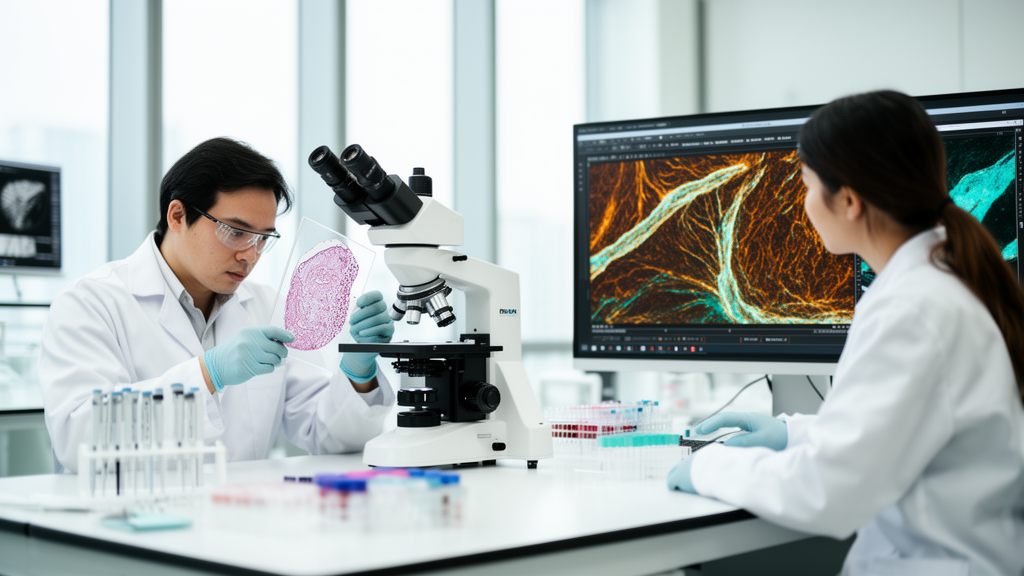
Singapore’s lead public sector research agency, the Agency for Science, Technology and Research (ASTAR), has signed a Memorandum of Understanding with HistoIndex, a company specializing in AI-driven digital pathology for fibrotic diseases, to collaborate on the preclinical evaluation and characterization of therapeutic candidates targeting a range of fibrotic conditions. The agreement, announced in mid-October 2026, covers fibrotic diseases broadly, including cancer-associated fibrosis, a phenomenon increasingly recognized as a major influence on tumor behavior and treatment resistance. The MoU was formalized at a signing ceremony on 30 September 2026, attended by representatives of both organizations, including Dr Lisa Ooi, Assistant Chief Executive of ASTAR’s Biomedical Research Council, and Dr Gideon Ho, Chief Executive Officer of HistoIndex.
The core of the partnership lies in pairing two complementary capabilities. ASTAR brings scientific expertise and therapeutic development infrastructure built over years of public investment in biomedical research, while HistoIndex contributes a proprietary imaging platform that applies artificial intelligence to produce fully quantitative tissue analysis. The stated goal is to provide objective, sensitive and accurate measures of fibrosis and of treatment response, so that researchers evaluating ASTAR’s pipeline of therapeutic candidates can make better-informed decisions about which compounds merit further advancement. In early-stage drug development, where animal models and human tissue samples are the primary evidence available, the quality of tissue measurement often determines whether a promising mechanism is correctly recognized or prematurely dismissed.
Fibrosis, the excessive accumulation of fibrous connective tissue that follows chronic injury or inflammation, poses a persistent measurement problem for drug developers. Scarring can affect virtually any organ, from the liver and lungs to the heart, kidneys and skin, and in oncology the dense, stiffened stroma that surrounds many tumors, known as cancer-associated fibrosis, can physically block drug delivery and create a microenvironment that supports tumor growth and immune evasion. Determining whether an experimental therapy can prevent, halt or reverse these processes requires detecting subtle changes in collagen deposition and tissue architecture, changes that conventional assessment methods struggle to capture reliably.
Traditional histopathology relies on visual inspection of stained tissue sections, in which pathologists grade fibrosis on ordinal scales. Such scoring is inherently semi-quantitative and subject to inter-observer variability, and it can miss spatial patterns of scarring that carry biological meaning. Quantitative approaches such as second harmonic generation microscopy, which exploits the intrinsic optical properties of collagen fibrils to image them label-free, combined with machine learning analysis, offer a way to convert tissue images into continuous, reproducible numerical readouts. This is the technological space in which HistoIndex operates, and it is precisely the kind of measurement rigor that Dr Ooi highlighted when describing the challenge of early development: understanding whether a candidate can prevent, halt or reverse fibrosis requires accurate and objective measurement of changes in fibrotic tissue, something the collaboration is intended to support more rigorously.
According to A*STAR, the collaboration will help the agency assess these effects more rigorously and make better-informed development decisions, with the ultimate aim of advancing innovations that improve patient outcomes. That framing reflects a wider shift in the pharmaceutical sciences toward quantitative, image-based endpoints in preclinical studies. When fibrosis burden can be tracked as a continuous variable across serial tissue samples, dose-response relationships become clearer, and the difference between a therapy that stabilizes disease and one that genuinely regresses scarring becomes measurable rather than impressionistic. For a public research agency charged with translating laboratory discoveries toward clinical benefit, access to such a platform could materially reduce the attrition rate of early-stage candidates.
The partnership also carries a notable institutional backstory. HistoIndex originated as one of A*STAR’s early medtech spin-offs, and Dr Ho emphasized the symbolic weight of bringing the company’s globally validated and widely adopted technology back to Singapore, where the journey began. In remarks at the signing, he described the collaboration as an opportunity to work with the local research community to identify promising therapies and to advance precision medicine for a broad range of fibrotic diseases across multiple organs. The full-circle character of the arrangement illustrates a model of public research investment that has, in this case, produced a commercial enterprise now reinvesting its capabilities in the national research ecosystem that seeded it.
Beyond the immediate task of evaluating therapeutic candidates, the MoU establishes a broader framework for scientific exchange between the two organizations. The announced areas of potential exploration include biomarker discovery, translational research, joint therapeutic development and commercialization. Each of these extends the value of the underlying imaging capability. Quantitative tissue signatures of fibrosis, for example, can serve as candidate biomarkers that link preclinical findings to clinical measurements, easing the transition of a therapy from animal studies to human trials. Joint development and commercialization pathways, meanwhile, suggest that both parties envision the relationship as a continuing engine for new therapeutic programs rather than a one-off service arrangement.
The announcement arrives amid intensifying global interest in antifibrotic drug development. Fibrotic diseases collectively represent a substantial unmet medical need, with few approved therapies capable of reversing established scarring in most organs, and cancer-associated fibrosis has moved to the forefront of oncology research as investigators pursue strategies to remodel or deplete the tumor stroma to improve drug penetration and immune response. In this context, tools that render fibrosis objectively measurable are not merely laboratory conveniences; they are enablers of clinical progress, because clinical trials for antifibrotic agents are famously long, expensive and prone to failure when endpoints are insensitive to genuine biological change.
Separately from the MoU, HistoIndex stated that it will showcase its digital pathology and AI-based tissue analysis capabilities at this year’s AASLD The Liver Meeting Exhibition in Denver, Colorado, underscoring the company’s continued focus on liver disease, one of the most prominent arenas for fibrosis research given the burden of metabolic dysfunction-associated steatohepatitis and viral hepatitis worldwide. The dual announcement, a domestic research partnership and an international scientific showcase, positions the company at the intersection of academic collaboration and clinical community engagement, both of which feed the validation cycle on which quantitative pathology platforms depend.
For the wider biomedical research community, the A*STAR–HistoIndex agreement offers a case study in how measurement technology and therapeutic development can be deliberately coupled at the earliest stages of the pipeline. Rather than treating tissue analysis as a downstream service procured once a drug candidate exists, the MoU embeds quantitative fibrosis assessment within the evaluation process itself, from preclinical characterization through decisions on candidate advancement. If the collaboration fulfills its stated aims, the result should be a more rigorous and efficient path from laboratory discovery to therapies capable of meaningfully altering the course of fibrotic disease, in Singapore and potentially well beyond it.
Subject of Research: Preclinical evaluation of fibrosis therapies using AI-driven digital pathology through an A*STAR–HistoIndex partnership
Article Title: HistoIndex and A*STAR partner to advance early-stage development of pipeline therapies for fibrotic diseases
Article References: HistoIndex and A*STAR partner to advance early-stage development of pipeline therapies for fibrotic diseases. Original publication (Bibliographic details unavailable.)
Image Credits: AI Generated
DOI: Not provided
Keywords: A*STAR, HistoIndex, fibrosis, cancer-associated fibrosis, digital pathology, artificial intelligence, preclinical research, drug development, biomarker discovery, precision medicine, Singapore, tissue analysis
Cite Scienmag News
Nathaniel Bowman. (October 19, 2026). Singapore’s A*STAR and HistoIndex Join Forces to Speed Fibrosis Drug Development. Scienmag. https://scienmag.com/singapores-astar-and-histoindex-join-forces-to-speed-fibrosis-drug-development/
Nathaniel Bowman. "Singapore’s A*STAR and HistoIndex Join Forces to Speed Fibrosis Drug Development." Scienmag, 19 October 2026, https://scienmag.com/singapores-astar-and-histoindex-join-forces-to-speed-fibrosis-drug-development/. Accessed 19 October 2026.
Nathaniel Bowman. "Singapore’s A*STAR and HistoIndex Join Forces to Speed Fibrosis Drug Development." Scienmag. October 19, 2026. https://scienmag.com/singapores-astar-and-histoindex-join-forces-to-speed-fibrosis-drug-development/


