


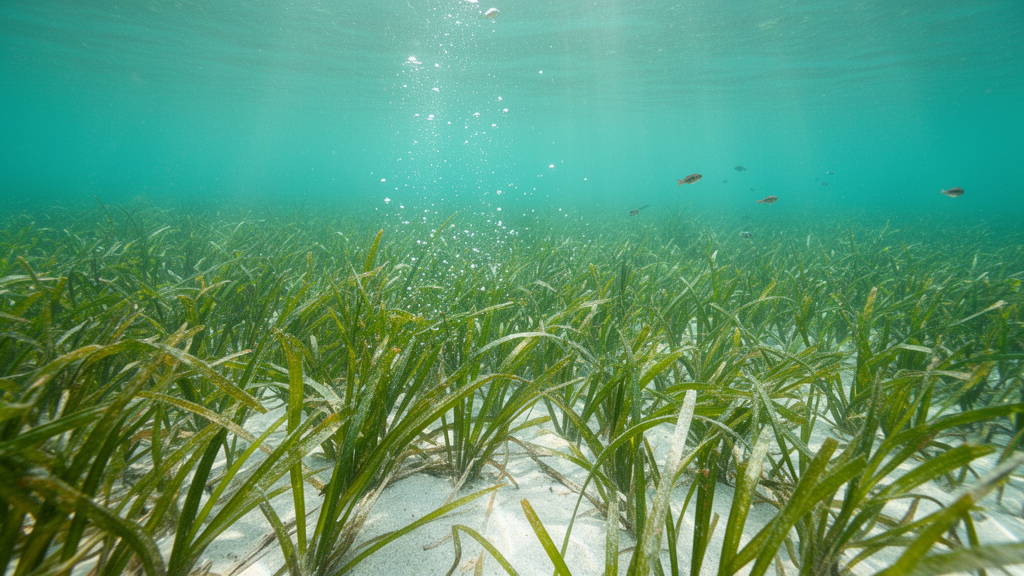
Seagrass meadows have earned a reputation as some of the planet’s most efficient carbon sinks, locking away organic carbon in their sediments for centuries. But a new year-long study of a tropical meadow in southern Taiwan shows that these underwater grasslands also harbor a hidden cost: they are persistent, localized sources of methane, a greenhouse gas roughly 96 times more powerful than carbon dioxide over a 20-year horizon. The research, published in Biogeosciences, is the first integrated assessment of methane cycling in the Haikou seagrass meadow in Pingtung County, and it reveals a striking mismatch between how much methane the seabed produces and how much actually reaches the atmosphere.
A team led by Hsiao-Chun Tseng of National Taiwan Ocean University conducted three intensive field campaigns between May 2022 and June 2023 in a subtidal meadow dominated by the seagrasses Thalassia hemprichii and Halophila pinifolia. The site covers roughly 4.38 hectares of shallow water, between 0.5 and 1.5 meters deep, bordered seaward by a reef platform beyond which the seafloor drops to about 10 meters. Because winter weather made fieldwork impossible, the campaigns captured spring, summer, and autumn conditions, combining surface water sampling, in situ benthic chamber incubations, and porewater profiling at sediment depths down to 20 centimeters.
The measurements confirmed that the meadow behaves as a methane hotspot relative to its surroundings. Dissolved methane concentrations in the seagrass meadow ranged from 6.6 to 13.1 nanomolar, consistently exceeding the 4.2 to 7.4 nanomolar observed in the deeper adjacent coastal waters. Mean sea-to-air methane fluxes were 4.9 plus or minus 2.2 micromoles per square meter per day in the meadow, nearly double the 2.7 micromoles per square meter per day measured offshore. The shallow water column, the authors argue, allows methane seeping from the sediment to influence surface waters far more directly than at the deeper coastal site.
The diurnal rhythm of these concentrations tells a story about oxygen. During the day, seagrass photosynthesis pushes dissolved oxygen saturation above 100 percent, sometimes reaching 124 percent, which appears to suppress methane accumulation and promote microbial oxidation of the gas. At night, oxygen saturation falls to roughly 87 to 95 percent, oxidation potential drops, and sediment-derived methane builds up in the water column. Nighttime dissolved methane concentrations generally exceeded daytime values in spring and summer. The one exception came in autumn 2022, when a nighttime storm with heavy rain and strong winds churned the shallow water, enhanced gas exchange, and physically stripped methane out of the surface layer faster than it could accumulate.
Seasonal patterns in atmospheric emissions, by contrast, were governed less by biology than by physics. Because dissolved methane concentrations showed no significant seasonal differences, the researchers attribute the variability in sea-to-air fluxes primarily to wind speed, which controls the gas transfer coefficient in their flux calculations. Fluxes peaked in autumn 2022 at 6.8 micromoles per square meter per day in the meadow, when mean wind speeds ranged up to 5.4 meters per second, and fell to a low of 2.5 micromoles per square meter per day in the calm summer of 2023. In other words, the same meadow can vent very different amounts of methane to the sky depending on how hard the wind blows.
Below the surface, the story was one of steady production. Benthic chambers, transparent cylinders 40 centimeters tall and 32 centimeters in diameter inserted 10 to 15 centimeters into the sediment, captured methane diffusing out of the seabed under natural light and flow conditions. Mean sediment-to-water fluxes in the seagrass meadow averaged 88.2 plus or minus 41.2 micromoles per square meter per day, with production rates climbing from about 103 micromoles per cubic meter per day in spring to 295 in summer. The likely driver is organic matter: strong winds and waves from October through April scour the meadow and limit the deposition of organic particles, while calmer conditions from late spring onward allow seagrass detritus and other labile carbon to accumulate, fueling methanogenic microbes. Porewater methane profiles mirrored this pattern, with the highest concentrations, up to 423.2 nanomolar, recorded in autumn, mostly within the upper 12 centimeters of sediment.
The comparison with adjacent bare sand proved especially revealing. In spring and summer, seagrass sediments consistently out-produced the unvegetated sediments, thanks to richer organic inputs, denser communities of methanogenic archaea, and reduced oxygen penetration in the rhizosphere. But autumn flipped the script: storm-disturbed bare sand released a massive pulse of methane, with fluxes spiking to 388.9 plus or minus 382.8 micromoles per square meter per day, far above the meadow’s values. The seagrasses’ dense root and rhizome networks stabilize their sediments and buffer them against physical disturbance, so the vegetated habitat maintained steady baseline emissions while the sandy habitat stayed quiet until a storm violently resuspended its porewater. As climate change intensifies typhoons, the authors note, such episodic pulses from unvegetated coastal sediments may grow more important in regional greenhouse gas budgets.
Perhaps the study’s most consequential finding is the dramatic decoupling between what the seabed produces and what the atmosphere receives. Using the meadow’s area and an average water depth of one meter, the team estimated that sediments released roughly 162, 465, and 415 moles of methane into the overlying water in spring, summer, and autumn respectively, yet only 21, 10, and 27 moles escaped to the air during the same periods. That means approximately 87 to 98 percent of the sediment-derived methane never reached the atmosphere directly. Most of it was likely swept laterally out of the meadow by tidal exchange and coastal circulation before it could degas, with microbial oxidation in the sediment and water column removing an additional share. The small standing stock of dissolved methane in the water column, just 0.33 to 0.43 moles despite substantial benthic inputs, further points to rapid turnover and efficient redistribution.
Placed in a global context, the Haikou fluxes sit at the low end of the seagrass spectrum. The global mean sea-to-air methane flux for seagrass ecosystems is about 79 micromoles per square meter per day, more than an order of magnitude above the values measured here, and emissions from lagoons and salt marshes rich in methylated compounds tend to be far higher still. The Taiwan fluxes were comparable to those reported from seagrass meadows in Thailand and China, but well below those of India’s Chilika Lagoon or organic-rich Caribbean sediments. The authors caution that their figures represent seasonal baselines rather than annual budgets, since winter sampling was impossible and the autumn campaign was strongly influenced by an extreme storm.
The broader message is one for anyone counting on blue carbon to fight climate change. Seagrass restoration and conservation remain powerful climate strategies, but methane emissions can offset up to a third of the carbon these ecosystems sequester in some settings, and the balance varies with species, sediment chemistry, hydrodynamics, and storm exposure. Evaluating the true climate benefit of a meadow, the study concludes, requires accounting for both sides of the ledger: the carbon buried in the seabed and the methane leaking out of it, along with the tides, winds, and microbes that decide how much of that methane ever reaches the sky.
Subject of Research: Seasonal methane production, transport, and sea-to-air emissions in a tropical seagrass meadow in Taiwan
Article Title: Linking sea–air and benthic methane fluxes across seasons in a tropical seagrass meadow of Taiwan
Article References: Tseng, H.-C., Gaol, A. S. M. L., Lin, F.-H., Chen, J.-J., & Chou, W.-C. (2026). Linking sea–air and benthic methane fluxes across seasons in a tropical seagrass meadow of Taiwan. Biogeosciences, 23(20), 7309-7325. https://doi.org/10.5194/bg-23-7309-2026
Image Credits: AI Generated
Keywords: seagrass, methane, blue carbon, biogeosciences, Taiwan, methanogenesis, benthic flux, greenhouse gas, coastal ecosystems, porewater, storm disturbance, carbon sequestration
Cite Scienmag News
Drew Townsend. (October 19, 2026). Tropical Seagrass Meadows Bury Carbon but Quietly Leak Methane, Study Finds. Scienmag. https://scienmag.com/tropical-seagrass-meadows-bury-carbon-but-quietly-leak-methane-study-finds/
Drew Townsend. "Tropical Seagrass Meadows Bury Carbon but Quietly Leak Methane, Study Finds." Scienmag, 19 October 2026, https://scienmag.com/tropical-seagrass-meadows-bury-carbon-but-quietly-leak-methane-study-finds/. Accessed 19 October 2026.
Drew Townsend. "Tropical Seagrass Meadows Bury Carbon but Quietly Leak Methane, Study Finds." Scienmag. October 19, 2026. https://scienmag.com/tropical-seagrass-meadows-bury-carbon-but-quietly-leak-methane-study-finds/


