


Half a century ago, the volcanic island of Pantelleria, rising from the deepest part of the Strait of Sicily between Italy and Tunisia, was ringed by underwater forests of large brown seaweeds. Then, around two decades ago, researchers documented a troubling collapse: the iconic fucalean algae of the order Fucales had vanished completely from depths below roughly 12 meters, replaced by morphologically simpler species such as Dictyopteris polypodioides, Halopteris scoparia and the invasive red alga Womersleyella setacea. Scientists at the time suggested that rising seawater temperatures and shifts in deep-water circulation might have driven the decline. Now, a new survey published in Italian Botanist reveals a remarkable twist in the story: many of the lost deep-water species have quietly returned, offering one of the clearest examples to date of natural recovery among Mediterranean canopy-forming seaweeds.
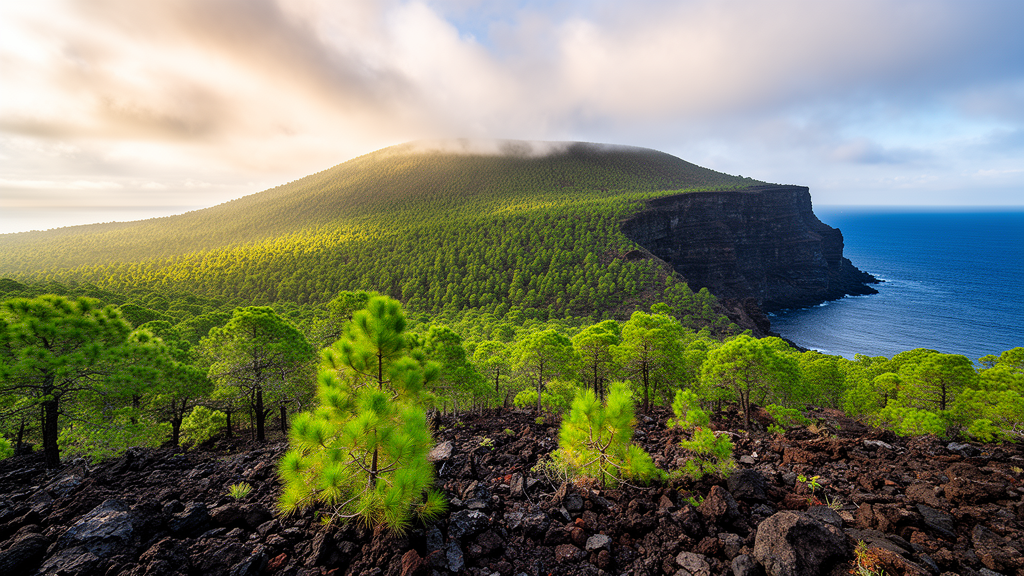
Pantelleria is a geologically dramatic setting for such a finding. The island, covering 83 square kilometers, sits within the Pantelleria Rift, the deepest basin of the Strait of Sicily, about 88.5 kilometers from Cape Granitola in Sicily and only 62.8 kilometers from Cape Bon in Tunisia. Its southeastern coast is defined by high, jagged volcanic cliffs that plunge steeply to depths of 30 to 40 meters, giving way to beds of large boulders interspersed with coarse sand and gravel. The northwestern side, by contrast, is low and hilly. This rugged underwater topography, combined with the island’s position at a biogeographical crossroads between the western and eastern Mediterranean, has historically supported an unusually rich marine flora, documented in pioneering studies dating back to the early 1970s.
Despite their ecological importance, the fucalean seaweeds — genera once lumped together under Cystoseira but now split into Cystoseira, Ericaria and Gongolaria, alongside the related Sargassum — are among the most threatened marine organisms in the Mediterranean. These large canopy algae function much like the trees of terrestrial forests: they shade the rocky substrate, dampen wave energy, provide three-dimensional habitat for countless invertebrates and fish, and anchor entire food webs. Across the Mediterranean, from the Adriatic to the coasts of France and Spain, these forests have suffered massive declines, with some species disappearing regionally. Yet detailed distribution and conservation data remain surprisingly sparse for many areas, particularly for islands, which often harbor high levels of endemism.
To establish whether Pantelleria’s forests had truly collapsed or were quietly holding on, researchers carried out an intensive monitoring campaign during the first week of July 2022. They surveyed eleven sites around the island’s entire perimeter — including Bue Marino, Punta Spadillo, Gadir, Cala Tramontana, Cala Levante, Martingana, Scauri, Grotte Sataria, Kuddie Rosse and Arenella — using a combination of snorkeling surveys and scuba dives, each dive lasting about an hour. Species were identified in situ and photographed with underwater cameras, and when field identification proved impossible, small fragments of thalli were collected and examined in the laboratory using standard Mediterranean taxonomic references. Adverse sea conditions limited the number of deep dives, a constraint the authors acknowledge, but the coverage still spanned depths from the splash zone down to 45 meters.
The results were striking. The team recorded 19 fucalean taxa in total: seven belonging to Cystoseira, six to Ericaria, four to Gongolaria and two to Sargassum. Ten of the 18 species reported in the foundational 1972 survey by Giaccone and colleagues were found again, and of the eight species identified by the most recent study in 2004, seven were reconfirmed. Most significantly, several deep-water species that had been completely absent from the 2004 survey — and in some cases unseen since the 1970s — were rediscovered. These included Cystoseira foeniculacea f. latiramosa found between 18 and 30 meters, Gongolaria elegans down to 15 meters, Gongolaria montagnei between 8 and 22 meters, its variety compressa at depths of 26 to 35 meters, and Sargassum cf. acinarium between 28 and an astonishing 45 meters.
The return of these deep-dwelling species carries particular ecological weight because their deep habitats are among the most vulnerable in the sea. Cystoseira foeniculacea f. latiramosa, for example, is considered a rare seaweed in regression, as its deep-water homes are increasingly exposed to bottom trawling, pollution, marine litter deposition, over-sedimentation and competition from invasive alien species. The researchers also recorded Ericaria cf. dubia at 35 and 40 meters, a species never previously documented for Pantelleria, and Gongolaria barbata in shallow rock pools — another first for the island. Some identifications remained provisional: without observing holdfasts, apices or receptacles, the team could not fully confirm Sargassum cf. acinarium and Ericaria cf. dubia at the species level, underscoring how much marine diversity still eludes even careful fieldwork.
The survey also benefited from, and contributed to, a revolution in seaweed taxonomy. In recent years, genetic and biogeographic analyses have dismantled the old, broad definition of Cystoseira, revealing cryptic species hiding behind nearly identical morphology. A 2022 revision by Neiva and colleagues demonstrated, for instance, that what had long been called Cystoseira humilis is in fact several distinct species with well-defined ranges — including Cystoseira pustulata, which the new study found at five sites on Pantelleria. The same revision showed that Ericaria balearica, widespread on the island from 0.5 to 28 meters, is a separate cryptic species from the superficially similar E. brachycarpa, and confirmed the presence of Ericaria sedoides, a brush-like seaweed endemic only to the coasts of Algeria, Tunisia and Pantelleria itself, whose easternmost limit lies exactly at this island.
Why would these forests rebound after two decades of apparent absence? The researchers point to a mechanism documented in marine protected areas elsewhere, such as the Medes Islands in Spain and Ustica in Italy, where fucalean populations gradually recovered 10 to 20 years after their local disappearance. As previous work has suggested, recolonization becomes possible when fragmented reproductive populations survive in scattered refuge areas, even at very low densities — a crevice here, a shaded boulder there, easily overlooked by earlier surveys. Over the years, these residual populations appear to have gradually expanded, seeding the recovery now visible across Pantelleria’s slopes. Shallow species, meanwhile, seem never to have left: Ericaria amentacea still forms a continuous blue-violet iridescent belt along wave-exposed shores, and Cystoseira compressa and Sargassum vulgare remain among the most common seaweeds around the island, with one species, Ericaria barbatula, even expanding its distribution since 2004.
But the recovery is fragile, and the clock may be ticking. The deep-water populations now clinging to Pantelleria’s lower infralittoral and circalittoral zones sit directly in the path of intense fishing activity around the island, where trawling and anchoring can strip canopy algae from the rock in a single pass. What makes this especially frustrating for conservationists is that Pantelleria’s rich waters currently enjoy no formal environmental protection at all, even though a proposal to establish a marine protected area was submitted roughly 20 years ago and has languished ever since. The authors argue that creating a marine protected area, with zonation and regulation of human activities, is the surest way to guarantee the long-term survival of the fucalean populations — and the extraordinary biodiversity they shelter.
The stakes extend well beyond the seaweeds themselves. In a companion study published earlier this year, the same researchers documented a remarkably high diversity of sea slugs in Pantelleria’s waters, reinforcing the picture of an island whose marine life rivals that of far better-protected corners of the Mediterranean. Forests of Cystoseira, Ericaria and Gongolaria are not merely decorative: they are nursery grounds, carbon sinks and buffers against storms, and their disappearance from so much of the Mediterranean has been described as one of the region’s most underappreciated ecological losses. Pantelleria’s story suggests that recovery is not a lost cause — that given refuges and time, even ecosystems written off two decades ago can stage a comeback. Whether the island’s underwater forests complete their recovery, however, may depend less on nature than on whether the long-stalled promise of protection is finally kept.
Subject of Research: Recovery of fucalean brown seaweed communities around the Island of Pantelleria in the Strait of Sicily
Article Title: The Fucales ( Ochrophyta , Phaeophyceae ) of the Island of Pantelleria (Sicily Channel, Mediterranean Sea): a new contribution
Article References: Marletta, G., & Lombardo, A. (2023). The Fucales (Ochrophyta, Phaeophyceae) of the Island of Pantelleria (Sicily Channel, Mediterranean Sea): a new contribution. Italian Botanist, 15, 137-163. https://doi.org/10.3897/italianbotanist.15.103217
Image Credits: AI Generated
DOI: 10.3897/italianbotanist.15.103217
Keywords: Fucales, Pantelleria, Cystoseira, Ericaria, Gongolaria, Sargassum, Mediterranean Sea, Sicily Channel, marine vegetation, seaweed recovery, marine protected area, biodiversity
Cite Scienmag News
Margaret Porter. (October 19, 2026). Lost Forests of the Mediterranean Come Back to Life Around a Remote Volcanic Island. Scienmag. https://scienmag.com/lost-forests-of-the-mediterranean-come-back-to-life-around-a-remote-volcanic-island/
Margaret Porter. "Lost Forests of the Mediterranean Come Back to Life Around a Remote Volcanic Island." Scienmag, 19 October 2026, https://scienmag.com/lost-forests-of-the-mediterranean-come-back-to-life-around-a-remote-volcanic-island/. Accessed 19 October 2026.
Margaret Porter. "Lost Forests of the Mediterranean Come Back to Life Around a Remote Volcanic Island." Scienmag. October 19, 2026. https://scienmag.com/lost-forests-of-the-mediterranean-come-back-to-life-around-a-remote-volcanic-island/


