


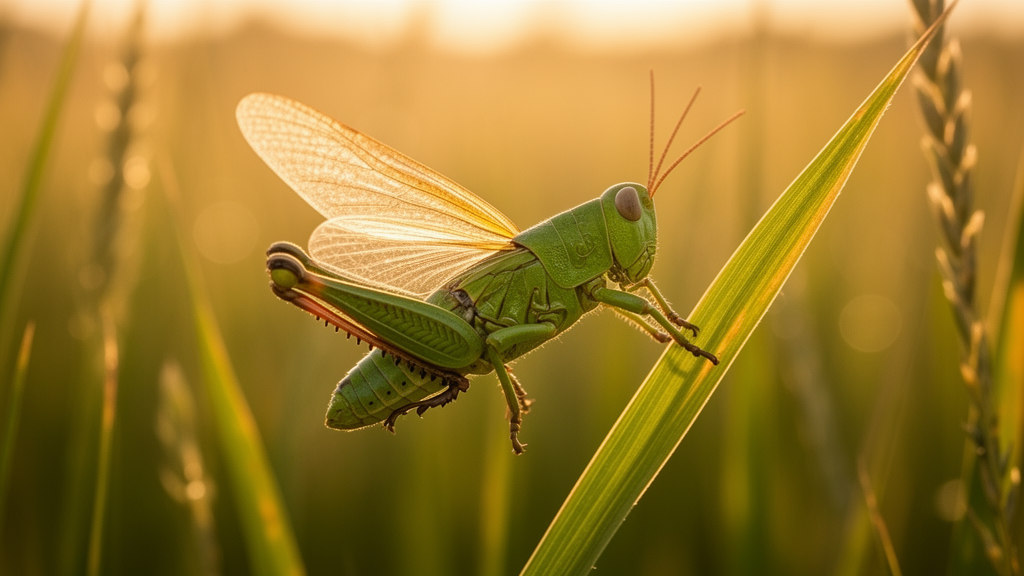
When a predator closes in, most animals keep quiet. The Chinese grasshopper Acrida cinerea does the opposite: as it bursts from the grass in a whirring flight, it often produces a loud, crackling noise that seems calculated to announce its presence to everything in the vicinity. Yet the same species frequently escapes in complete silence, and for years nobody knew why. A field study conducted at Kyushu University in Fukuoka, Japan, and published in the Journal of Orthoptera Research, has now disentangled the circumstances that separate the noisy getaways from the silent ones, and the answers point to an unexpected combination of weather, anatomy and the sheer length of the escape.
The research team staged hundreds of simulated predator attacks on adult grasshoppers in grassland plots on the university campus between August 1 and September 25, 2017. An investigator, walking at a carefully controlled speed of roughly 36.6 centimeters per second with the aid of a metronome app, approached each grasshopper three times in succession. Cameras strapped to the investigator’s waist, including a high-speed model filming at 120 frames per second, recorded every takeoff. Steel tape measurements between wire-ring markers pinned down two crucial numbers for each escape: the flight initiation distance, meaning how far away the predator was when the insect bolted, and the distance fled, the ground the grasshopper covered once airborne. Temperature and humidity were logged at each trial, and every captured insect was measured for body length, body weight and whether it had lost one of its large hind legs.
The first and most striking result concerned sex. Sound production was observed exclusively in males, and even then only in males that escaped by flying. Approximately 70 percent of males produced sound during their escapes, with the proportion hovering between 71 and 76 percent across the three consecutive attempts. Males almost always fled by flying, in 96 to 99 percent of trials, but the handful that chose to jump never made a sound. The 13 females in the sample were entirely silent no matter how they escaped, and they jumped far more often than the males did. The sex difference in sound production was statistically significant for every escape attempt, with p-values below 0.001.
The grasshoppers generate their escape noise, known as crepitation, by clapping their hindwings together during flight, a mechanism documented in earlier work by the same research group. Because the upstroke speed of the wings determines how loudly the clap resonates, the researchers suspected temperature might matter, and it did. Males that produced sound did so at an average ambient temperature of 30.73 degrees Celsius, whereas silent fliers escaped at an average of 29.06 degrees. A statistical model confirmed that higher temperature significantly increased the probability of noisy escape. Warmer air allows insects to beat their wings faster, and a faster upstroke means a sharper, more audible wing clap when the hindwings meet.
Anatomy told an equally clear story. Males that had autotomized one of their hind legs, a self-amputation defense common in grasshoppers, produced escape sounds far less often than intact individuals: only 53 percent of the seventeen one-legged males were noisy, compared with 79 percent of the 117 intact males. Losing a hind leg reduces leaping power, and the authors suggest this may destabilize takeoff or impair the vigorous wing clapping needed for sound production. There is also an alternative reading, the researchers note: males that habitually escape silently may be poorer at dodging predators in the first place, and therefore more likely to have already sacrificed a leg. Intriguingly, body length and body weight showed no relationship with sound production, suggesting that even smaller males carry enough energy reserves for the clapping motion.
The strongest predictor of all turned out to be the distance fled. Across all three escape attempts, males that travelled farther were significantly more likely to have produced sound on the way. The researchers outline three hypotheses that could explain this pattern, none of them mutually exclusive. The noise might function as a pursuit-deterrent signal, an honest advertisement of good escape ability that convinces the predator further pursuit is futile, a mechanism previously proposed for the lizard Psammodromus algirus, which flees greater distances when it vocalizes. Alternatively, a longer flight simply gives a male more wingbeats and therefore more opportunities to clap and crackle. Or the wing clapping may itself serve an aerodynamic purpose, generating extra lift and thrust, with the sound arriving as a byproduct of improved flight performance.
One leading hypothesis was noticeably weakened by the data. Some conspicuous escape behaviors, such as the flash behavior documented in other animals, work by abruptly switching from conspicuous to cryptic, confusing the predator about the prey’s location. Theory and computer experiments indicate this tactic works best when the prey detects the predator from a long distance, so that the predator never saw the prey at rest. If the grasshoppers’ noise were flash behavior, noisy escapers should have longer flight initiation distances. They did not. Sound production was unrelated to flight initiation distance in every model, suggesting the crackle is probably not a classic flash display, although the authors caution that flash theory was developed for visual signals rather than acoustic ones.
Repeated attacks also produced informative results. When the same investigator approached the same individual three times in a row, the frequency of noisy escape did not decline, unlike the tail-waving lizard Callisaurus draconoides, which abandons its conspicuous displays when a predator persists. Even more interestingly, males showed individual consistency: whether a male had been noisy on the second escape predicted whether he would be noisy on the third, with sound production in the second attempt significantly related to sound production in the third. Some males were reliably loud across all three escapes, while others remained consistently silent. The authors speculate that the lack of consistency between the first and second attempts may reflect the short preparation time available when an animal is surprised by its very first encounter with a predator.
The complete silence of the females adds a final puzzle. Under laboratory conditions in previous work, females produced pulse sounds using exactly the same wing-clapping mechanism as males, so they are physically capable of the behavior. In the field, however, they rarely used it. The researchers point to the desert locust Schistocerca gregaria, in which females beat their wings at lower frequencies than males, and suggest that a slower upstroke in female A. cinerea may simply fail to produce an audible clap. Whatever the mechanism, the field data show that noisy escape in this species is overwhelmingly the signature of a healthy, intact male making a long, powerful flight on a hot day.
The overall picture, the authors conclude, is that noisy escape is most frequent in male grasshoppers in the best escape condition: warm enough for rapid wingbeats, equipped with both hind legs, and covering substantial ground. That association fits the pursuit-deterrent hypothesis, since the sound would tell an approaching predator that this particular prey is a difficult target, but the aerodynamic explanation has not been ruled out, and the sound could yet prove to be no more than the acoustic shadow of an energetically demanding flight style. Settling the question will require watching how real predators respond to noisy versus silent grasshoppers, an experiment that remains to be done. In the meantime, the study offers a practical lesson for future fieldwork: anyone studying escape behavior in crepitating grasshoppers should record temperature, limb loss and flight distance as standard variables, because each one can quietly determine whether the insect takes to the air in silence or in a burst of crackling sound.
Subject of Research: Factors influencing sound production during escape flight in the Chinese grasshopper Acrida cinerea
Article Title: Factors related to sound production by the Chinese grasshopper Acrida cinerea during escape
Article References: Kuga, T., & Kasuya, E. (2024). Factors related to sound production by the Chinese grasshopper Acrida cinerea during escape. Journal of Orthoptera Research, 33(1), 13-19. https://doi.org/10.3897/jor.33.100865
Image Credits: AI Generated
Keywords: Acrida cinerea, grasshoppers, escape behavior, antipredator strategy, crepitation, flight initiation distance, distance fled, limb autotomy, ambient temperature, pursuit-deterrent signal, sexual differences, Orthoptera
Cite Scienmag News
Gavin Prescott. (October 19, 2026). Warm Weather, Long Flights and All Eight Legs: What Makes Grasshoppers Scream in Escape. Scienmag. https://scienmag.com/warm-weather-long-flights-and-all-eight-legs-what-makes-grasshoppers-scream-in-escape/
Gavin Prescott. "Warm Weather, Long Flights and All Eight Legs: What Makes Grasshoppers Scream in Escape." Scienmag, 19 October 2026, https://scienmag.com/warm-weather-long-flights-and-all-eight-legs-what-makes-grasshoppers-scream-in-escape/. Accessed 19 October 2026.
Gavin Prescott. "Warm Weather, Long Flights and All Eight Legs: What Makes Grasshoppers Scream in Escape." Scienmag. October 19, 2026. https://scienmag.com/warm-weather-long-flights-and-all-eight-legs-what-makes-grasshoppers-scream-in-escape/


