


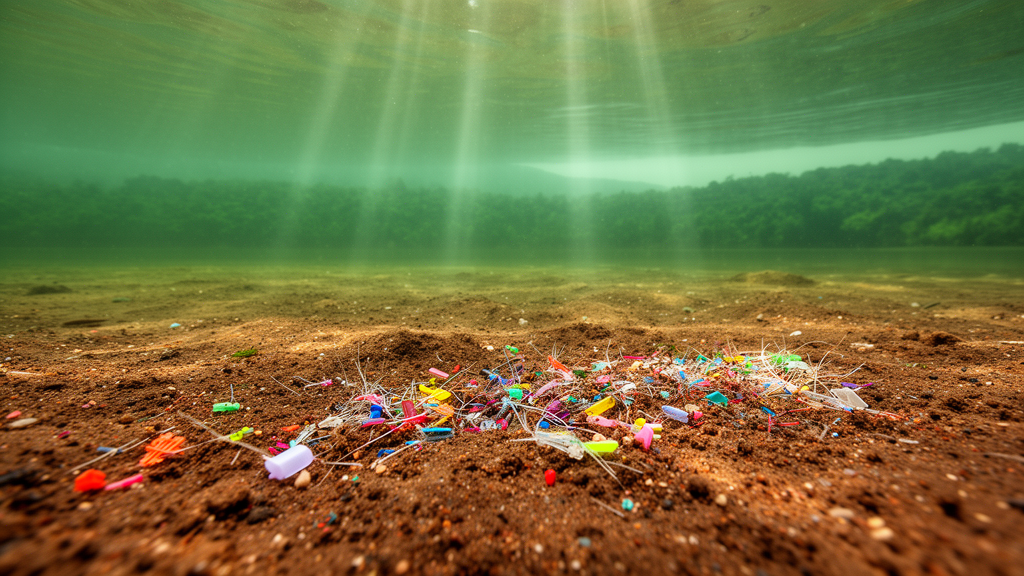
A new study of the Aruvikkara reservoir, one of the primary drinking water sources for the Kerala region of southern India, has found that the fine sediments lining its bed are acting as a long-term sink for microplastic pollution. The research, published in Environmental Monitoring and Assessment by Navami Surendran Sethulekshmi and Jaya Divakaran Sarasamma of the Department of Environmental Sciences at the University of Kerala, combined microplastic identification with a detailed analysis of sediment texture to understand why particles accumulate so effectively in this tropical water body. The findings place the reservoir in the highest risk categories used by the researchers, driven largely by the presence of polyvinyl chloride, and point directly to municipal waste dumping and other human activities as the likely sources of contamination.
Microplastics, generally defined as plastic fragments smaller than five millimetres, have become one of the most widespread pollutants of aquatic environments worldwide. Although many plastic particles are initially buoyant and float at the water surface, they do not remain there indefinitely. Over time, particles undergo vertical transport through the water column. Biofilm colonization, aggregation with organic matter such as marine or lake snow, and changes in particle density all contribute to the settling process. Once microplastics reach the bed of a lake or reservoir, they can become incorporated into the benthic sediment layer, where they may persist for years. The Aruvikkara study set out to quantify this accumulation in a tropical reservoir context, an environment that has received far less attention than marine and temperate freshwater systems.
The researchers focused on the benthic sediments of the reservoir and applied a suite of established analytical techniques. Identification of the plastic polymers present in the sediment samples was carried out using FTIR and Raman spectroscopy, methods that match the vibrational fingerprints of unknown particles against reference spectra of known plastics. This spectroscopic approach is considered a reliable way to distinguish genuine synthetic polymers from naturally occurring particles and to determine exactly which plastic types have accumulated. Beyond simple identification, the team calculated three risk metrics: the Pollution Load Index, the Polymer Hazard Index, and the Potential Ecological Risk Index. These indices are widely used tools in environmental monitoring that translate raw contamination data into comparable categories of pollution severity and ecological hazard.
The results of these calculations were striking. The reservoir sediments were classified as High-Risk and at Hazard Level III, a categorisation driven by critical levels of polyvinyl chloride, commonly known as PVC. PVC is of particular concern among commodity plastics because it contains chlorine in its polymer structure and is associated with higher toxicity in hazard ranking systems based on chemical composition. The presence of PVC fragments in the bed sediments of a reservoir that supplies drinking water to a large population raises significant questions about the long-term safety of the water source and the pathways by which such particles enter and persist in the system. The Polymer Hazard Index weighting reflects the fact that not all plastics pose equal risks, and the dominance of a high-hazard polymer pushed the overall assessment into the most serious category.
A distinctive contribution of the study is its treatment of sediment texture as a primary determinant of microplastic retention. Textural analysis of the reservoir sediment revealed that the bed material is silty clay, a fine-grained composition dominated by particles far smaller than sand. This grain size distribution matters for a specific physical reason: fine sediments with low hydrodynamic energy provide abundant surface area and stable depositional conditions that favour the trapping and burial of small, low-density particles. Previous research in coastal and estuarine settings has shown that microplastic abundance in sediments often correlates with fine grain size fractions and with distance from pollution sources. The Aruvikkara findings extend this pattern to a tropical reservoir, demonstrating that the silty clay substrate actively contributes to the accumulation and retention of microplastics in the benthic layers rather than allowing them to be resuspended and flushed downstream.
The physical processes underlying this retention are well understood from laboratory and field studies of particle dynamics. Microplastic particles in freshwater differ widely in their settling and rise velocities depending on polymer type, particle shape, and size. Fibres shed from synthetic textiles, fragments from degraded larger debris, and spheres or pellets from industrial sources each behave differently in the water column. In a reservoir, where water residence time is long and flow velocities are low compared with rivers, particles that enter through inflows or direct dumping have ample opportunity to settle. Once deposited, the cohesive nature of silty clay helps bind particles in place. Seasonal mixing, flood events, and human disturbance of the bed can remobilise some material, but the net effect is that reservoir sediments function as sinks, gradually concentrating plastic pollution that entered the water body over many years.
The study links the observed contamination to identifiable human pressures on the reservoir catchment. Municipal waste dumping and other human activities in the surrounding area can be correlated with the microplastic burden found in the sediments. This connection is consistent with a broader body of research showing that catchment-scale land use, urban runoff, and inadequate waste management are dominant controls on the flux of plastics into freshwater systems. In densely populated regions of South India, where reservoirs often sit close to settlements and agricultural land, the pathway from household and municipal plastic waste to reservoir sediment can be short and direct. The authors argue that the results mandate stringent municipal waste management and reservoir protection measures to restrict further contamination and safeguard the region’s primary potable water source.
The ecological implications of sediment-locked microplastics extend beyond the particles themselves. Research has shown that plastic debris in aquatic environments can transport hydrophobic organic contaminants and act as a medium for toxic chemicals, effectively concentrating pollutants that would otherwise remain diluted in the water. Benthic organisms living in and on the sediment can ingest microplastic particles, and the physical impacts of such ingestion on aquatic organisms include gut blockage, reduced feeding, and tissue damage. There is also concern about the transfer of particles and associated chemicals through food webs, potentially reaching fish consumed by humans. In a reservoir that supplies drinking water, the presence of high-hazard polymers such as PVC in the bed sediment adds a further dimension of concern, since sediment disturbance during water treatment or extreme weather could release particles back into the water column.
The Aruvikkara study also fits into a growing national and international research effort to assess microplastic risk in sediments using standardised indices. Meta-analyses of potential ecological risk in coastal sediments across India have revealed widespread contamination, and studies of freshwater tidal marshes, seagrass meadows, and river systems around the world have repeatedly demonstrated that sediment composition influences microplastic trapping. By applying the same index framework to a tropical reservoir, the Kerala researchers provide data that can be compared directly with these other systems. Their conclusion that reservoir sediments can act as sinks for microplastics reinforces a message emerging from catchment-scale studies: plastics do not simply disappear after entering freshwater, but are progressively stored in the landscapes and water bodies through which they pass.
For the managers of Aruvikkara and similar water bodies, the study’s message is clear. Protecting a drinking water reservoir from microplastic pollution requires action at the source, particularly improved municipal solid waste management to prevent dumping and runoff from carrying plastics into the reservoir. The combination of a High-Risk classification, Hazard Level III status, and a sediment texture that naturally favours retention means that contamination already present will not disperse on its own. Without intervention, the silty clay bed of the reservoir will continue to accumulate plastic particles from ongoing human activity, and the burden in the sediment will grow. The research underscores that safeguarding potable water sources in tropical regions depends not only on treating water at the point of supply but on controlling the flow of plastic waste into the catchments that feed these critical reservoirs.
Subject of Research: Microplastic pollution and sediment texture in the Aruvikkara tropical reservoir, Kerala, India
Article Title: Microplastic pollution and textural characteristics of sediments in a tropical reservoir, Kerala, India
Article References: Sethulekshmi, N. S., & Sarasamma, J. D. (2026). Microplastic pollution and textural characteristics of sediments in a tropical reservoir, Kerala, India. Environmental Monitoring and Assessment, 198(9), Article 1009. https://doi.org/10.1007/s10661-026-15860-7
Image Credits: AI Generated
DOI: 10.1007/s10661-026-15860-7
Keywords: microplastics, Aruvikkara reservoir, Kerala, sediment texture, silty clay, PVC, Polymer Hazard Index, Pollution Load Index, Potential Ecological Risk Index, drinking water, Environmental Monitoring and Assessment, tropical reservoir
Cite Scienmag News
Violet Maxwell. (October 19, 2026). Microplastics Build Up in Sediments of a Key Kerala Drinking Water Reservoir. Scienmag. https://scienmag.com/microplastics-build-up-in-sediments-of-a-key-kerala-drinking-water-reservoir/
Violet Maxwell. "Microplastics Build Up in Sediments of a Key Kerala Drinking Water Reservoir." Scienmag, 19 October 2026, https://scienmag.com/microplastics-build-up-in-sediments-of-a-key-kerala-drinking-water-reservoir/. Accessed 19 October 2026.
Violet Maxwell. "Microplastics Build Up in Sediments of a Key Kerala Drinking Water Reservoir." Scienmag. October 19, 2026. https://scienmag.com/microplastics-build-up-in-sediments-of-a-key-kerala-drinking-water-reservoir/


