


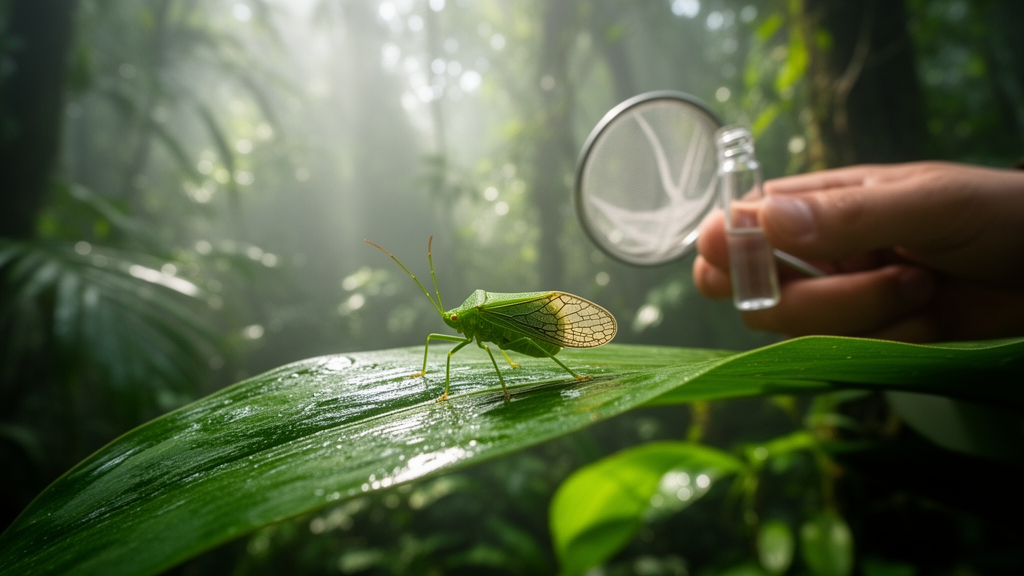
Deep in the rainforests of Panama, Ecuador, and Bolivia, tiny insects no larger than a grain of rice have been quietly living on leaves and stems, unknown to science. Now, a new study published in the Deutsche Entomologische Zeitschrift has revealed two entirely new genera and four new species of plant bugs belonging to the tribe Eccritotarsini, a group within the family Miridae, commonly known as plant bugs. The discovery, led by researchers examining museum specimens collected over decades, adds fresh branches to the tree of life and highlights just how much biodiversity remains undocumented in the Neotropics.
The newly described genera are Thomasomiris and Egerocoris. Thomasomiris is a monotypic genus, meaning it contains just one species: Thomasomiris setosus, collected on Barro Colorado Island in Panama. Egerocoris, by contrast, is richer, encompassing three new species: Egerocoris ecuatorianus and Egerocoris dimorphus, both from Ecuador, and Egerocoris chaparensis from Bolivia. Each species is illustrated with detailed photographs of the adult body and male genitalia, and the authors provide a diagnostic key to help future researchers separate the species from one another.
Eccritotarsini is the most diverse of the five tribes currently recognized within the subfamily Bryocorinae of the Miridae. Worldwide, the tribe includes roughly 115 genera and more than 628 species, but the greatest diversity is concentrated in the New World, where over 70 genera and more than 450 species are known. These bugs are often associated with herbaceous plants and shrubs, and many species are poorly studied because of their small size, cryptic habits, and the sheer difficulty of accessing remote tropical habitats where they live.
What makes eccritotarsines particularly interesting to entomologists is their remarkable morphological heterogeneity. Members of the tribe vary enormously in general appearance, body size, coloration, and genital structures. Males often bear elaborate projections around the aperture of the genital capsule, and the parameres—the paired sclerites used during mating—can differ dramatically between species. The aedeagus, the male intromittent organ, may be simple and membranous or complex with sclerotizations in various regions. This diversity in genital morphology is one of the primary tools taxonomists use to distinguish species, since these structures often evolve rapidly and are less likely to be shared between closely related lineages.
Neotropical eccritotarsines can be recognized by a suite of distinctive characters. They possess a reduced scent gland evaporative area, large disc-shaped pulvilli that cover nearly the entire inner surface of the claws with a comb-like row of long setae on their outer surfaces, deeply recessed and tuberculate bothria of the femoral trichobothria, asymmetrical setiform parempodia, and female genitalia featuring an asymmetric, complexly sclerotized vestibulum. These features, while technical, are the fingerprints that allow researchers to place a specimen within this tribe with confidence.
Thomasomiris setosus, the sole species of the new genus Thomasomiris, is a macropterous female measuring between 5.6 and 5.7 millimeters in body length. The genus name honors Dr. Thomas J. Henry, a renowned expert on Heteroptera who has published numerous important papers on the family Miridae. The species epithet setosus is Latin for bristly, referring to the abundant short, erect setae that cover the dorsal surface of the body. The insect is pale yellow with extensive dark brown areas, and its eyes are small, stylate, and directed anteriorly—less than half the height of the head. The anterior pronotal lobe is depressed in lateral view, and the cuneus, a triangular section of the forewing, is wider than it is long.
Egerocoris, the second new genus, is named in honor of Joe Eger, who has extensively collected Heteroptera and contributed one of the specimens studied in this work. The genus is diagnosed by large, stylate eyes that partly cover the collar in lateral view, a short labrum, an antennal segment I that is wider than segment II, and a ductus seminis that is basally expanded. The three included species can be separated by a combination of characters including coloration of the antennal segments, the shape of the labial segment I, the relative development of the cuneus, and detailed features of the male genitalia, particularly the parameres and the processes of the subgenital plate.
One of the most intriguing findings is the pronounced sexual dimorphism in Egerocoris dimorphus. In this species, the cuneus—the distal triangular part of the forewing—is sexually dimorphic in both shape and length. Males possess a concave internal margin and a cuneus that extends to the posterior margin of the membrane, while females have a shorter cuneus that does not reach the posterior margin. This kind of dimorphism is relatively rare among eccritotarsines and is shared with species of the genus Proneella, suggesting a possible evolutionary relationship worth further investigation.
The specimens used in this study were collected from several localities across Panama, Ecuador, and Bolivia, and are deposited in the Museo de La Plata in Argentina and the National Museum of Natural History at the Smithsonian Institution in Washington, DC. The researchers used modern imaging techniques, including focus-stacking photography with automatic rails and specialized macro lenses, to capture high-resolution images of external morphology and dissected genitalia. Geographic data were mapped using QGIS and georeferenced with Google Earth Pro, providing a visual record of where each species occurs.
This discovery underscores how much remains to be learned about insect diversity in tropical ecosystems. Even in well-studied groups like the Miridae, new genera and species continue to emerge from museum drawers and field collections, often representing lineages that have been evolutionarily isolated for millions of years. As habitat destruction accelerates across the Neotropics, documenting this hidden diversity becomes increasingly urgent. Each new species described is not just a name in a catalogue but a piece of the evolutionary puzzle, offering clues about how tropical ecosystems function and how they have changed over geological time.
Subject of Research: Entomology
Article Title: Two new genera and four new species of Neotropical Eccritotarsini ( Heteroptera , Miridae , Bryocorinae )
Article References: Minghetti, E., Montemayor, S. I., & Dellapé, P. M. (2024). Two new genera and four new species of Neotropical Eccritotarsini (Heteroptera, Miridae, Bryocorinae). Deutsche Entomologische Zeitschrift, 71(1), 1-15. https://doi.org/10.3897/dez.71.104130
Image Credits: AI Generated
Keywords: Miridae, Eccritotarsini, new species, Neotropics, taxonomy, plant bugs, biodiversity, genera, four, species, Neotropical, Heteroptera
Cite Scienmag News
Drew Townsend. (October 19, 2026). Hidden in the Rainforest Canopy: Two New Genera and Four New Species of Neotropical Plant Bugs Unveiled. Scienmag. https://scienmag.com/hidden-in-the-rainforest-canopy-two-new-genera-and-four-new-species-of-neotropical-plant-bugs-unveiled/
Drew Townsend. "Hidden in the Rainforest Canopy: Two New Genera and Four New Species of Neotropical Plant Bugs Unveiled." Scienmag, 19 October 2026, https://scienmag.com/hidden-in-the-rainforest-canopy-two-new-genera-and-four-new-species-of-neotropical-plant-bugs-unveiled/. Accessed 19 October 2026.
Drew Townsend. "Hidden in the Rainforest Canopy: Two New Genera and Four New Species of Neotropical Plant Bugs Unveiled." Scienmag. October 19, 2026. https://scienmag.com/hidden-in-the-rainforest-canopy-two-new-genera-and-four-new-species-of-neotropical-plant-bugs-unveiled/


